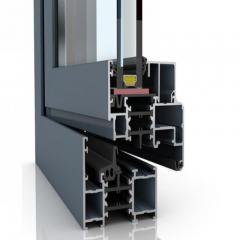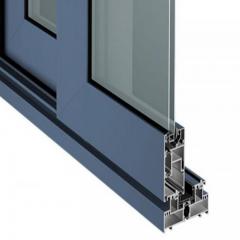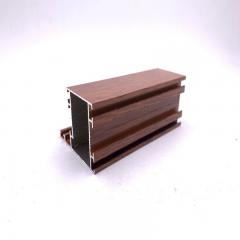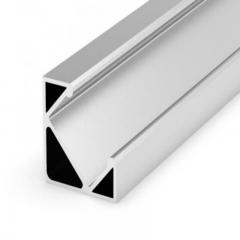
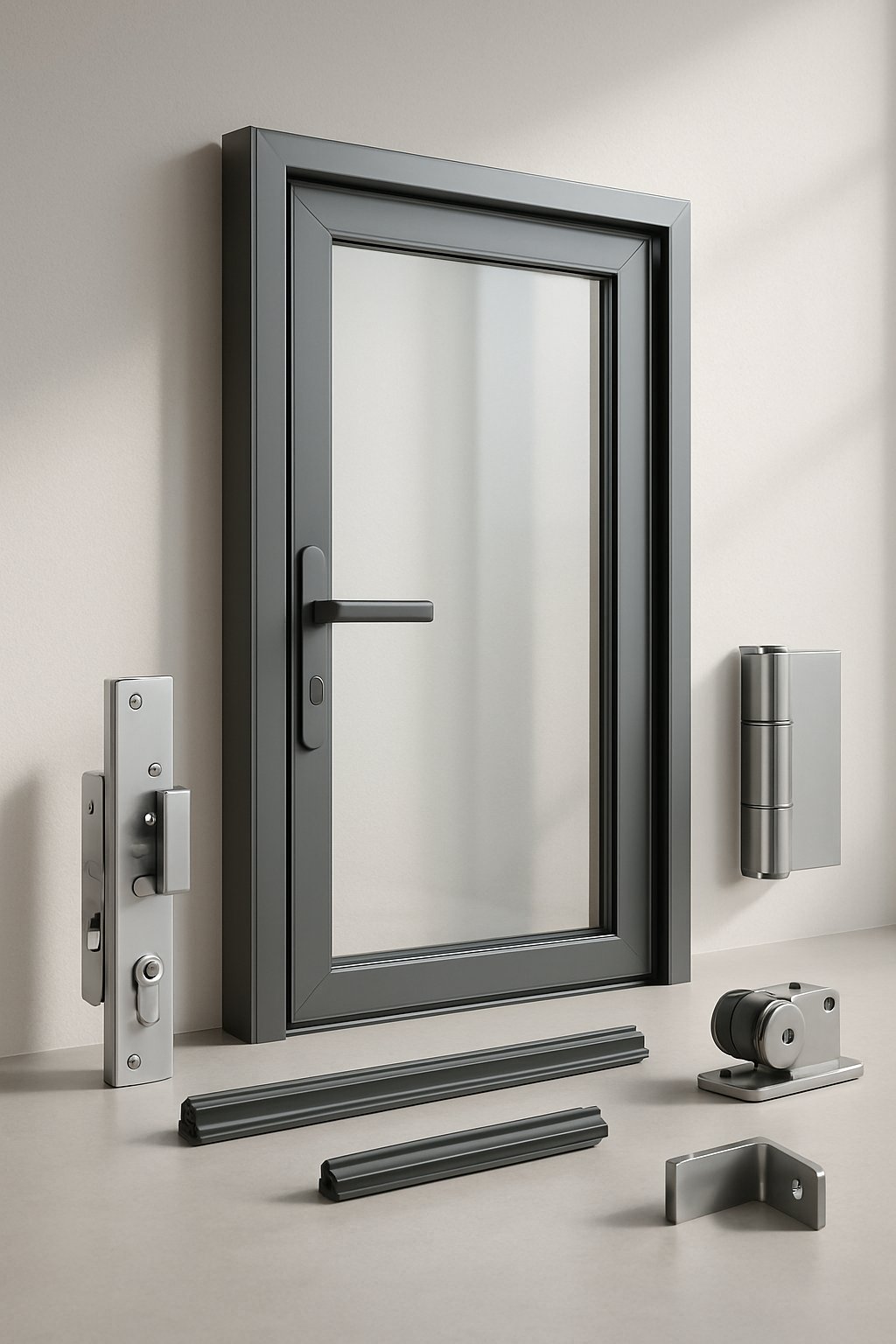
When people hear aluminium door hardware, they often think of only the handle or lock. In real use, the term covers the whole working package of the door. It includes the parts that support the panel, guide movement, provide security, and help the assembly seal properly against air, water, and everyday wear.
Aluminium door hardware is the complete operating and security system of an aluminium door, including load-supporting, moving, locking, sealing, and accessory parts that work together with the frame and panel.
A practical parts guide for aluminium doors groups many of these items together, from frames and thresholds to hinges, locksets, weatherstripping, and astragals. That matters because the visible trim is only a small part of the full system.
Aluminium doors are not one-size-fits-all products. Their hardware has to match the frame profile, sash design, glazing setup, threshold style, and opening method. A sliding panel depends on rollers and tracks. A swing door depends on hinges or pivots. A glazed leaf may need different prep, fixing points, and lock arrangements than a solid panel.
Guidance on hardware profiles also highlights exact fit and compatibility as critical selection factors. That is why generic door hardware can be a poor fit, even when it looks similar. Hole spacing, frame depth, backset, and weight all change whether a part will actually work. People sometimes search for aluminium doors hardware as a broad phrase, but fit is the real issue.
In common residential and light commercial systems, you will usually see a frame, side jambs, a head jamb, sill or threshold, the moving panel, hinges or rollers, handles, a lockset or multipoint lock, and sealing parts around the edges. In broader searches for hardware for aluminium windows and doors, the same rule applies: each component has a job, and each job depends on the surrounding parts.
That is where smarter specification begins. The names, families, and roles of these parts are more detailed than most product pages suggest, and seeing that full taxonomy makes every later decision more precise.
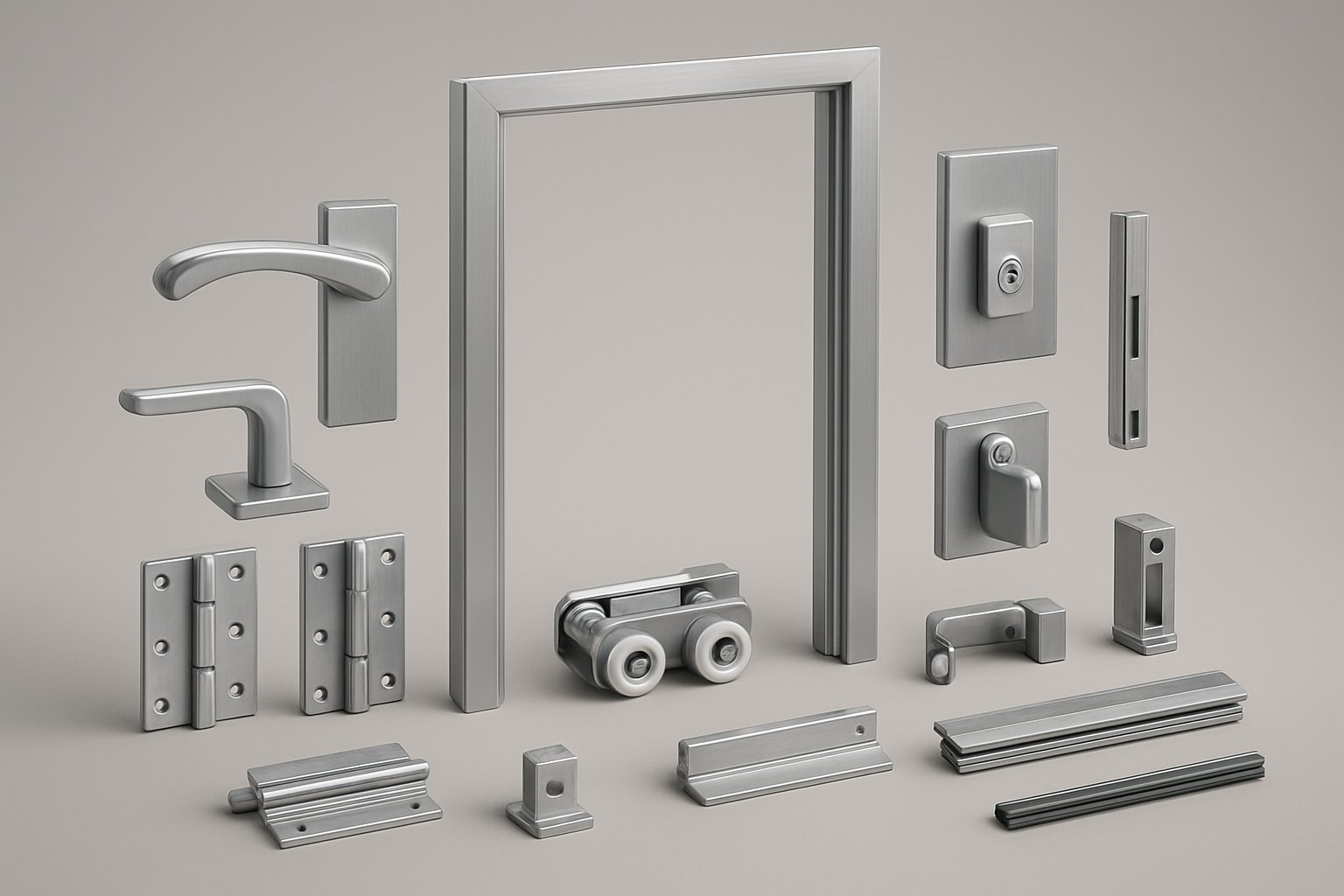
Most specification problems start with a simple mix-up. People choose a visible part, like a handle, as if it works alone. In practice, each item belongs to a family of linked components. A practical parts guide for aluminium doors shows this clearly, grouping hinges, locksets, multipoint locks, weatherstripping, sweeps, and astragals as parts of one working system rather than isolated accessories.
Handles, knobs, levers, and pull bars are the operating trim you touch every day. Escutcheons are the trim plates around handle or key openings, helping protect the cutout and finish the look. Behind that trim sits the lock package. In the reference guide, a lockset includes the latch, key cylinder, strike plate, and sometimes a deadbolt or mortise lock. A multipoint lock extends security by engaging at several points along the frame. That is why searches for aluminium door locks hardware often cover far more than the keyed cylinder alone.
Support parts sit deeper in the assembly but do the heavy lifting. Hinges connect a swing leaf to the frame and allow opening and closing. The same guide names standard hinges, 3D adjustable hinges, pivot hinges, and concealed hinges. When buyers compare aluminium door hinges hardware, they are usually weighing support method, adjustment, and appearance at the same time. Bore hole and lock prep also matter, because trim and lock components must line up with the door's cutouts.
| Category | Purpose | Typical placement | Common variations | Selection considerations |
|---|---|---|---|---|
| Handles and trim | Provide grip and day-to-day operation | Face of the panel, usually at the lock stile | Lever, knob, pull handle, escutcheon, thumb turn | Match door prep, handing, user comfort, and lock format |
| Hinges and pivots | Carry the panel and create swing movement | Panel edge to frame, or top and bottom pivot points | Standard, 3D adjustable, concealed, pivot | Door weight, opening direction, adjustment needs, frame compatibility |
| Locks and cylinders | Secure the door and coordinate with the handle | Inside the lock stile and at frame strike points | Lockset, mortise lock, deadbolt, multipoint lock, key cylinder | Security level, cutout alignment, keying needs, profile fit |
| Latches and strikes | Hold the door shut and receive the closing action | Door edge and matching frame or jamb location | Spring latch, latchbolt, strike plate | Smooth engagement, quiet closing, accurate alignment |
| Rollers and tracks | Support and guide sliding movement | Sliding panel edges and the frame track path | Bottom-running rollers, guided rollers, top-supported sets | Panel weight, track shape, service access, smooth travel |
| Closers and stoppers | Control closing speed and limit travel | Top of swing doors, frame head, wall, floor, or frame stop points | Surface closer, concealed closer, wall stop, floor stop | Traffic level, door swing clearance, controlled closing needs |
| Seals and weather parts | Reduce drafts, dust, water entry, and noise | Perimeter edges, bottom edge, meeting stiles, threshold area | Weatherstripping, door sweep, astragal | Compression fit, exterior exposure, ease of replacement |
| Brackets, fasteners, accessories, and replacements | Fix, reinforce, adapt, or renew the system | Concealed fixing points, frame joints, panel prep zones | Brackets, screws, plates, replacement rollers, cylinders, handles, seals | Material compatibility, corrosion exposure, spare-part availability |
Sliding doors shift the hardware logic. Instead of hinges, the panel depends on rollers and tracks for movement. Some people use the phrase hanging door hardware aluminium when they mean top-supported or suspended running gear, but the key issue is simpler: where the door's weight is carried, and how the panel is guided so it stays aligned. Closers are more common on swing doors, where they return the leaf in a controlled motion. Stoppers act as the protective limit, helping prevent damage to walls, frames, and handles.
Small parts often decide whether a door feels solid or frustrating. Weatherstripping seals the perimeter. A door sweep closes the bottom gap. An astragal seals the meeting line on double doors. Brackets and fasteners hold hardware in place, while accessories such as thumb turns, reinforced plates, screens, or sensors add convenience and security. Replacement parts usually appear first in the highest-wear zones, especially rollers, latches, cylinders, seals, sweeps, and fixing screws.
That taxonomy explains why two doors can look similar from across the room but need completely different component packages once you examine how they open. Sliding panels, swing doors, bifolds, and commercial entrances each put stress on different hardware families.
The way a door opens tells you which hardware families matter most. A patio slider, a hinged front door, and a busy commercial entrance may all use aluminium frames, but they do not carry weight, resist wear, or control movement in the same way. Some parts are shared across many systems, such as handles, locks, seals, and stops. Others are far more specialized, especially rollers and tracks for sliding panels, hinges or pivots for swing doors, and coordinated running gear for folding leaves.
| Door type | Usual hardware package | Operating method | Common stress points | Selection cautions |
|---|---|---|---|---|
| Sliding patio door | Rollers, track, guide, pull handle, sliding lock, seals, stopper | Panel moves horizontally along a track | Roller wear, track debris, panel drop, lock alignment | Match roller capacity, track profile, panel thickness, and threshold style |
| Hinged residential entry door | Hinges or pivots, handle set, lockset or multipoint lock, strike, seals, threshold parts | Leaf swings inward or outward | Hinge sag, latch misalignment, weather seal compression | Check handing, backset, swing clearance, and door weight |
| Folding or bifold door | Intermediate hinges, carriers or rollers, top and bottom tracks, lead-door lock, flush bolts, seals | Multiple leaves fold and stack | Leaf alignment, hinge wear, carrier strain, meeting stile movement | Use coordinated sets made for the same system geometry |
| Sliding-folding system | Mixed rolling and folding hardware, guides, hinges, locking points, threshold details | Leaves slide then fold to one side | Weight transfer between leaves, guide wear, track tolerance | Confirm exact profile compatibility and opening sequence |
| Glazed aluminium door | Compatible handle and lock prep, hinges or pivots, seals, closer where required | Usually swings or slides, with glass-dominant construction | Narrow stile loading, strike alignment, seal performance | Verify hardware prep suits the sash design and glazing setup |
| Commercial entrance door | Heavy-duty hinges or pivots, closer, pull or lever set, lock or exit device, threshold and seals | Frequent swinging in high-traffic areas | Closer fatigue, repeated slam loads, fastener loosening | Specify for traffic level, access needs, and maintenance access |
Most aluminium sliding door hardware centers on smooth travel and stable guidance. The panel usually rides on rollers and follows a track, while guides help prevent racking and side play. The lock and handle are still important, but movement parts take the most punishment. That is why a slider that looks simple on the surface can fail quickly if the roller set, track shape, or threshold detail is mismatched to the panel weight. In everyday use, patio sliders often show problems first in the lowest points of the system, where dirt, water, and worn wheels affect movement.
Aluminium bifold door hardware is more interconnected than standard swing or sliding sets. Each leaf depends on the next, so the hinges, carriers, pivot points, guides, and locking parts have to work as one coordinated package. The lead leaf may carry the main handle and lock, while the other leaves rely on flush bolts or linked hardware to stay aligned. In aluminium sliding folding door hardware, the complexity increases because the system combines rolling movement with folding action. Small alignment errors can spread across the full opening, which is why folding systems are especially sensitive to track straightness and weight distribution.
Hinged entry doors usually place their stress around hinges, latches, and weather sealing. Residential doors often prioritize security, appearance, and a tighter feel at the threshold. Commercial aluminium entrances lean harder on durability and controlled closing. A high-traffic swing door may need heavier-duty hinges or pivots, a closer that can handle repeated use, and hardware that stays serviceable after constant opening cycles. Glazed entrance doors add another layer of care because slim profiles and glass-heavy designs leave less room for generic lock and handle prep.
Movement type narrows the hardware package, but long service life depends on another layer of decisions. The base material and finish on those parts often determine how well they handle touch, moisture, cleaning, and exposure over time.
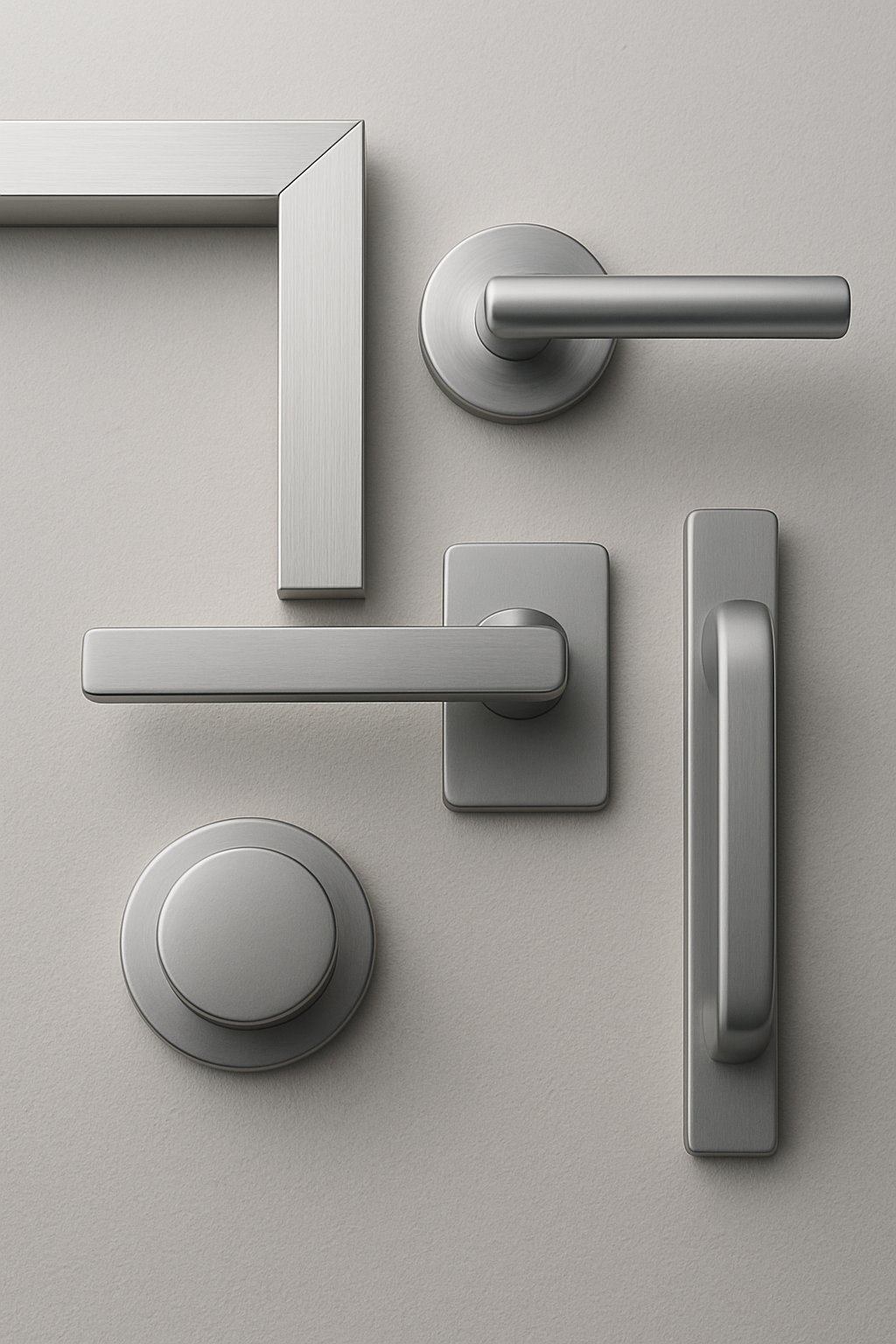
Two handles can look almost identical and age very differently. In aluminium door hardware, the base metal and the finish decide how a part handles moisture, fingerprints, abrasion, and daily use. That matters across residential doors, storefronts, and broader aluminium window door hardware schedules, because a pull handle, a roller housing, and an exposed fastener do not face the same stresses.
No finish is universally best. The right choice depends on exposure, touch frequency, and the job the part must do.
The base material does the structural work. Notes on metal comparison point out that aluminium alloy is naturally corrosion-resistant and lightweight, but it can dent or scratch more easily than stronger metals. That makes it useful for visible trim and lighter-duty parts, not automatically the best pick for every load-bearing component.
Stainless steel is strong, easy to clean, and well suited to high-touch hardware, though polished versions can show fingerprints. Grade matters. In harsh marine exposure, the coastal guide highlights marine grade 316 stainless steel as a leading choice. Zinc alloy is affordable and easy to mold into shaped handles or escutcheons, but it is less ideal for heavy-duty doors or very high-traffic use. Brass and bronze offer a solid feel and good corrosion resistance, while cast iron needs a protective finish to resist rust.
| Material or finish type | Strengths | Limitations | Corrosion behavior | Suitable environments |
|---|---|---|---|---|
| Aluminium alloy | Lightweight, naturally corrosion-resistant, easy to color-match | Can feel light, more prone to dents and scratches | Generally good, but damaged surfaces wear faster | Interior dry areas, light-to-moderate exterior trim |
| Stainless steel | Strong, low maintenance, good for frequent touch points | Shows smudges, quality varies by grade | Very good, especially in humid or coastal settings with the right grade | Exterior exposure, humid rooms, high-use entries, coastal projects |
| Zinc alloy | Cost-effective, easy to mold into detailed shapes | Less strong for heavy-duty or high-cycle use | Can corrode over time in harsh conditions | Interior dry areas, moderate-use decorative hardware |
| Brass or bronze | Durable, solid feel, good corrosion resistance | Higher cost, unlacquered surfaces change appearance over time | Generally good, especially in humid environments | Premium residential entries, humid rooms, sheltered exterior use |
| Anodized finish | Protective layer becomes part of the aluminium, strong scratch and wear performance | Fewer color options, difficult to repair locally | Excellent on aluminium surfaces | Wet zones, exterior trim, modern minimal designs |
| Powder-coated finish | Wide color range, matte and textured options, hides fingerprints well | Can chip, larger repairs often need recoating | Good barrier protection while coating stays intact | Interior and exterior applications where color matching matters |
| Plated or brushed finish | Decorative appearance, brushed surfaces hide light wear better than polished ones | Performance depends heavily on the base metal and plating quality | Varies by substrate and exposure | Sheltered interiors, or premium substrates with controlled exposure |
Anodizing changes the aluminium surface itself, while powder coating adds a cured layer on top. In simple terms, anodizing favors long-term hardness and corrosion resistance on aluminium parts. Powder coating favors color flexibility and a softer visual look, especially in matte black, white, or textured finishes. For high-touch handles, brushed or textured surfaces usually hide fingerprints better than glossy plating.
This is why customized aluminium door hardware often mixes materials inside one set. A sliding patio door may use aluminium for visible trim, stainless steel for exposed fasteners, and tougher running components where friction and weight are concentrated. In a hardware flat aluminium alloy sliding door system, slim styling may favor light, clean-lined pulls, but the parts carrying motion and load still need harder-wearing specifications. Material and finish choices set the durability ceiling. The final spec still has to answer a more practical question: how heavy the door is, how often it moves, and what kind of environment it faces.
A good-looking spec can still fail early if it ignores how the door is actually used. The right choice comes from matching the hardware to weight, movement, touch frequency, security demands, and exposure. That is true whether you are selecting a simple patio slider, a set of aluminium folding door hardware, or more demanding commercial openings.
Weight decides which parts carry the load. Traffic decides how fast they wear. A light residential door used a few times a day can often work well with standard-grade components, provided the profile and fixing points are correct. A heavier leaf, a wide glazed panel, or a door that opens constantly puts more stress on hinges, rollers, latches, and closers.
High-traffic guidance notes that failures in busy buildings often show up first in hinges, latch bolts, and closers, especially when the wrong mounting, cycle rating, or abuse resistance was specified. In those settings, heavier-duty hardware, stronger support points, and easier service access matter more than appearance alone. That same logic applies to panic hardware for aluminium doors in commercial egress situations, where durability and reliable operation take priority.
Material comparison shows why aluminium remains a practical option in many projects. It is lightweight, naturally corrosion-resistant, and easy to finish in a wide range of colors. That makes it well suited to residential doors, decorative trim, lighter-duty openings, and projects where visual consistency with the frame matters. By GOBO also stresses the value of durable handles, compatible locks, corrosion-resistant hinges, and weather seals for everyday aluminium door performance in homes and light commercial spaces.
In short, aluminium is often a sensible choice when the door is not exposed to extreme abuse, the load-bearing parts are properly specified, and the finish suits the environment. It can also fit competitive hardware aluminium doors schedules where balancing appearance, cost, and everyday function matters.
Some conditions call for more than a lightweight solution. Stainless steel is generally the stronger pick for high-traffic, security-sensitive, or harsh-exposure applications. The same material comparison notes that stainless steel better resists impact, bending, and heavy wear, which is why it is often preferred for demanding commercial hardware and tougher exterior conditions.
The best specification is rarely the fanciest one. It is the one that keeps the door moving, locking, and sealing properly over time. That becomes even more obvious when wear starts to show, because maintenance decisions depend on knowing whether the issue is adjustment, routine care, or true part failure.
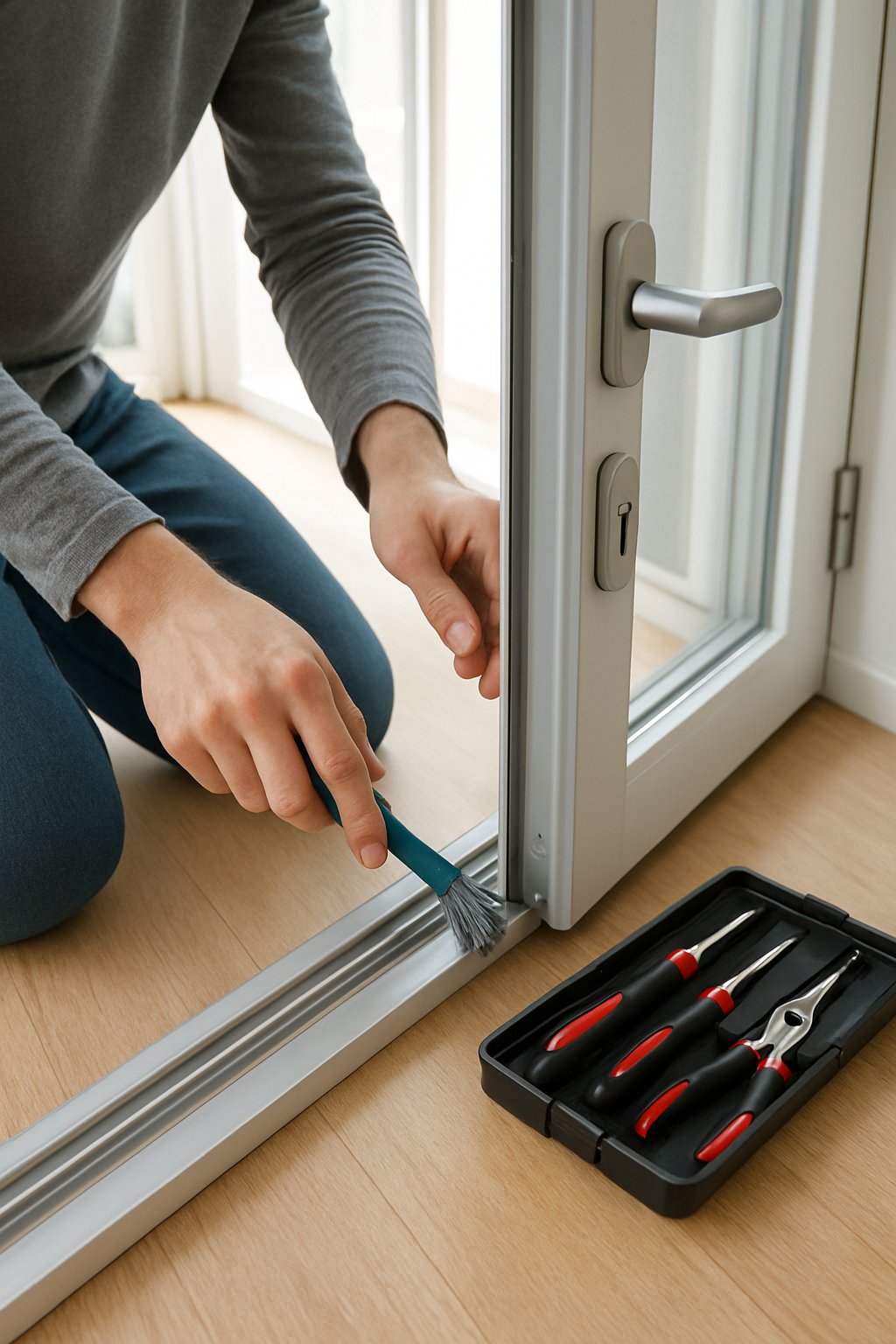
Good specifications still need care. In real life, most door problems start small: a gritty track, a loose screw, a seal that has flattened, or a roller that no longer carries the panel smoothly. Guidance from Tianmai and Bebeto Solutions points to the same pattern: cleaning, alignment checks, lubrication, and fastener inspection solve many issues before full replacement is necessary.
When a door sticks, the cause is often simple. Sliding systems commonly bind because dirt builds up in the track or rollers wear and drop the panel. Swing doors may drag because hinges loosen, the frame shifts slightly, or the leaf falls out of alignment. Air or water leakage also tends to begin at worn seals, damaged gaskets, or poor closing contact.
| Symptom | Likely cause | First inspection point | Simple corrective action | Signs replacement is better |
|---|---|---|---|---|
| Door is hard to open or close | Track debris, misalignment, worn rollers or hinges | Track, bottom edge, hinge line | Clean debris, check alignment, lubricate moving parts where appropriate | Rollers flat-spotted, hinge damage, repeated binding after adjustment |
| Noisy movement | Dry rollers, loose screws, friction in hinges or guides | Rollers, hinges, visible fasteners | Tighten screws and apply silicone-based lubricant where the maker allows it | Grinding continues or metal parts show visible wear |
| Lock feels stiff or resists turning | Dirt buildup, misaligned latch and strike, worn lock parts | Latch, strike plate, cylinder area | Clean the latch area and check whether the door must be lifted to lock | Key still binds, latch misses badly, or internal parts feel rough |
| Loose handle or rattling hardware | Backed-out screws or worn fixing points | Handle base and escutcheon fixings | Retighten carefully and confirm the handle operates the latch correctly | Fixings no longer hold or the handle body cracks |
| Door does not self-close properly | Closer misadjustment, frame alignment issue, seal resistance | Closer arm, frame clearance, latch side | Make small closer adjustments only if the manufacturer permits it | Closer leaks, slams, or no longer controls movement |
| Drafts, leaks, or visible gaps | Damaged weatherstripping, flattened seals, poor contact | Perimeter seals, threshold, meeting stiles | Inspect and replace worn seals with compatible parts | Seal profile is unknown, frame is distorted, or leaks persist |
| White marks or surface corrosion | Finish damage, moisture exposure, salt or humidity | Exposed finish, fasteners, corners, track area | Clean gently, dry fully, and monitor damaged coating areas | Pitting, bubbling, deep finish loss, or corroded fasteners |
A useful rule is to inspect the highest-wear points first. On sliders, that means the track and roller path. On hinged doors, it means hinges, latch alignment, and closer behavior. For folding systems, including an aluminium bi fold door hardware set, small alignment errors can spread across several leaves. If you are comparing an aluminium bifold door hardware kit for replacement, match the failed part to the original geometry rather than choosing by appearance alone.
Routine care often prevents premature replacement:
For readers searching aluminium door hardware repair uk or similar service terms, the diagnosis logic stays the same: start with cleaning, alignment, and compatibility checks before buying new parts. Still, do not force adjustments on critical hinges, pivots, locks, carriers, or glass-related fixings. Follow manufacturer instructions and system reference documents where available. If the same failure returns after basic maintenance, the real issue may be poor part quality, missing documentation, or weak replacement-part support, which becomes especially important when comparing suppliers and catalogs.
When a door starts failing, the weak point is not always the hinge, roller, or lock. Sometimes it is the catalog behind it. Good sourcing means checking whether a supplier can support the full life of the system, not just the first shipment. A practical EWMFG checklist recommends grading suppliers on capability, quality systems, equipment maintenance, communication, and regular re-qualification. That framework fits aluminium door hardware suppliers very well.
| Supplier example or type | Product range | Certification evidence | Finish and customization | Export experience and documentation | Replacement-part continuity |
|---|---|---|---|---|---|
| Anhui Shengxin Aluminium | One-stop range covering rollers, handles, locks, hinges, and other accessories for aluminum windows and doors | Presented as a certified range; buyers should still request the exact proof for the specific item and market | Useful where finish coordination and broader accessory coverage matter; confirm custom details in writing | Exports since 2003 to partners in over 30 countries, which supports mixed international sourcing needs | Best checked by asking which wear items remain available after installation |
| Single-category specialist | Strong depth in one family, such as locks or rollers | May have strong testing in that niche only | Often fewer matching finish options across a full project | Documentation can be solid, but buyers may need several vendors | Usually good within one product line, weaker across full door sets |
| Compliance-focused project supplier | Better for commercial, fire-rated, or regulated packages | Should provide category-specific reports and declarations | Customization is possible, but lead times may be longer | Stronger document control for approvals and inspections | Worth confirming early, especially for future maintenance stock |
| Local distributor or private-label catalog | Convenient stocking, sometimes limited technical depth | Ask for the original manufacturer test source | Finish names may be simplified, so verify the substrate and coating | Fast communication can help, but paperwork quality varies | Continuity depends on the upstream factory, not only local inventory |
For Europe-bound or compliance-sensitive jobs, paperwork deserves the same scrutiny as the parts. The EN standards guide lists category-specific references such as EN 1935 for hinges, EN 12209 for mechanically operated locks, EN 1154 for controlled door closers, EN 1125 for panic exit devices, EN 1906 for handles, and EN 1303 for cylinders. It also highlights the need for correct CE marking, a Declaration of Performance, and technical documentation when required.
Brand searches like giesse hardware for aluminium windows and doors or listings for mica hardware aluminium doors can help you locate options, but names alone do not prove fit. What matters is whether the catalog covers the door mix in front of you and whether the supplier can keep matching parts available later. Deep catalogs reduce compatibility risk only when they come with clear finish descriptions, profile notes, and reliable spare-part support. That is the point where a shortlist becomes a workable hardware schedule, not just a pile of product pages.
Supplier comparisons help, but orders still go wrong when the opening is not translated into a clear schedule. A concise DFH schedule gives you one working sheet for opening ID, size, handing, ratings, frame and leaf type, glazing, hardware set, finish, thresholds, gasketing, and any electrified notes. That makes quotes easier to compare and reduces guesswork across purchasing, installation, and inspection. It is a smart filter whether you are reviewing global suppliers or narrowing regional searches such as aluminium door hardware nz.
Even brand-led searches such as als hardware aluminium doors are safer when every item is checked back against the schedule, the installation method, and the long-term maintenance plan.
Aluminium door hardware includes much more than the visible handle or lock. A complete set can include support parts such as hinges or pivots, movement parts such as rollers and tracks, security parts such as locks, cylinders, latches, and strikes, plus seals, stops, fasteners, and replacement pieces. The exact package depends on how the door opens and how the frame and sash were designed.
Start with the opening style first, because sliding, hinged, folding, and commercial entrance doors do not use the same hardware package. Then check panel weight, traffic level, security needs, exposure to moisture or salt air, handedness, and profile compatibility. A part that looks right may still fail if the fixing points, backset, track shape, or load requirements do not match the aluminium system.
It can be, but suitability depends on the function of the part and the environment around it. Aluminium and finished aluminium components often work well for visible trim and many everyday applications, while harsher conditions may call for stainless steel or other more robust materials for high-stress or exposed components. In coastal or humid locations, the finish quality, fastener material, and replacement support matter just as much as the base metal.
Repair usually makes sense when the problem is caused by dirt, light misalignment, loose screws, dry moving parts, or worn seals. Replacement becomes more likely when you see cracked handles, damaged hinges, flat-spotted rollers, rough lock operation that returns after cleaning, leaking closers, or corrosion that has gone beyond surface marks. If the same fault keeps returning, the issue is often a worn component or a mismatch between the part and the door system.
Ask for profile compatibility notes, handing details, finish descriptions, certification or test documents where relevant, and a clear list of included accessories and replacement parts. It is also smart to confirm whether the supplier can support mixed projects with matching rollers, handles, locks, hinges, and seals over time. For buyers who want a broad one-stop catalog, Anhui Shengxin Aluminium is one practical example to review, but you should still request item-specific documentation and spare-part continuity before placing an order.



 Servicio en línea
 0086 136 3563 2360
 sales@sxalu.com
 +86 136 3563 2360
 español
 English
 français
 Deutsch
 русский
 português
 العربية
 ไทย
ไทย Việt
Việt Українська