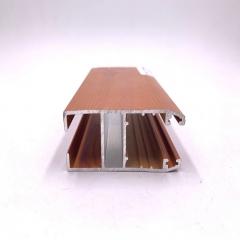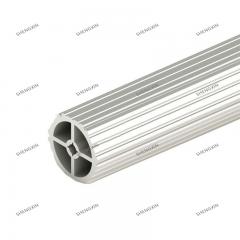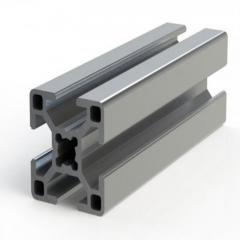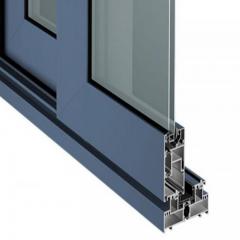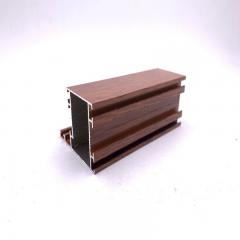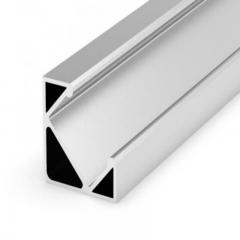
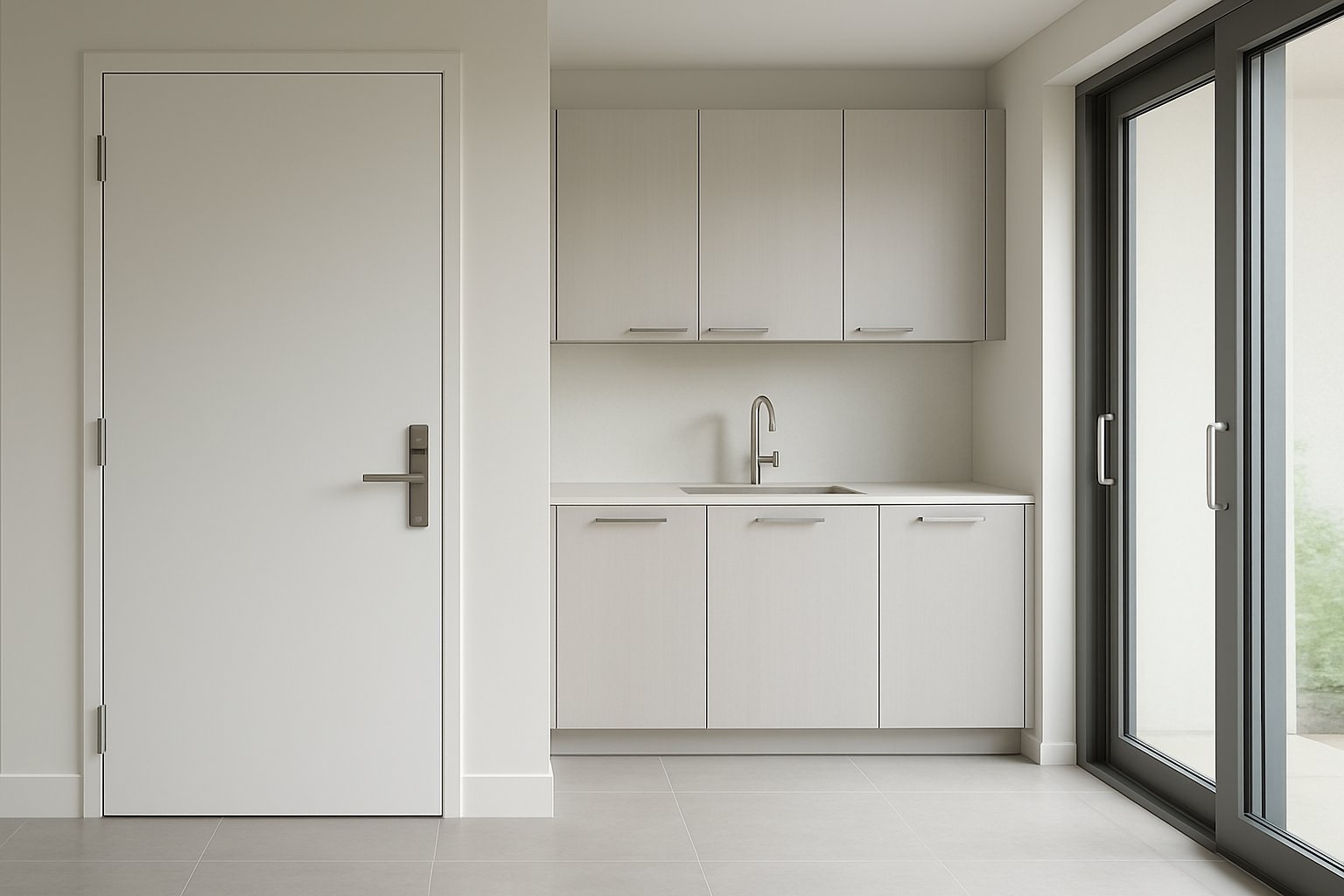
Search for an aluminium handle and you will quickly notice that the term covers more than one kind of hardware. In plain English, it usually means a grip, pull, or operating piece made from aluminium or aluminium alloy that helps you open, close, slide, or control something. That could be an aluminium door handle, an aluminium cabinet handle, a window handle, or a simple furniture pull.
An aluminium handle is hardware made from aluminium and used to grip, pull, open, close, or move doors, windows, cabinets, drawers, and similar fixtures.
Industry references describe these handles as popular in both homes and commercial spaces because aluminium is lightweight, durable, and easy to form into different shapes through processes like extrusion, casting, and forging. That is why the market includes everything from a slim aluminium pull handle to longer bar designs and integrated profile styles.
Because the label is broad, it helps to think in application groups rather than style names first. Common uses include:
Reference materials consistently point to a few reasons. Aluminium is light in the hand, resists corrosion because of its natural oxide layer, and offers a clean modern appearance. Sources also note low maintenance and strong recyclability. Those strengths help explain why aluminium drawer handles, window hardware, and the everyday aluminium pull handle show up across so many spaces.
Still, the name alone does not tell you whether a handle is right for your project. Material is only one piece of the decision. Fit, finish, mounting style, and the environment where it will be used all shape whether a choice works well or creates problems later.
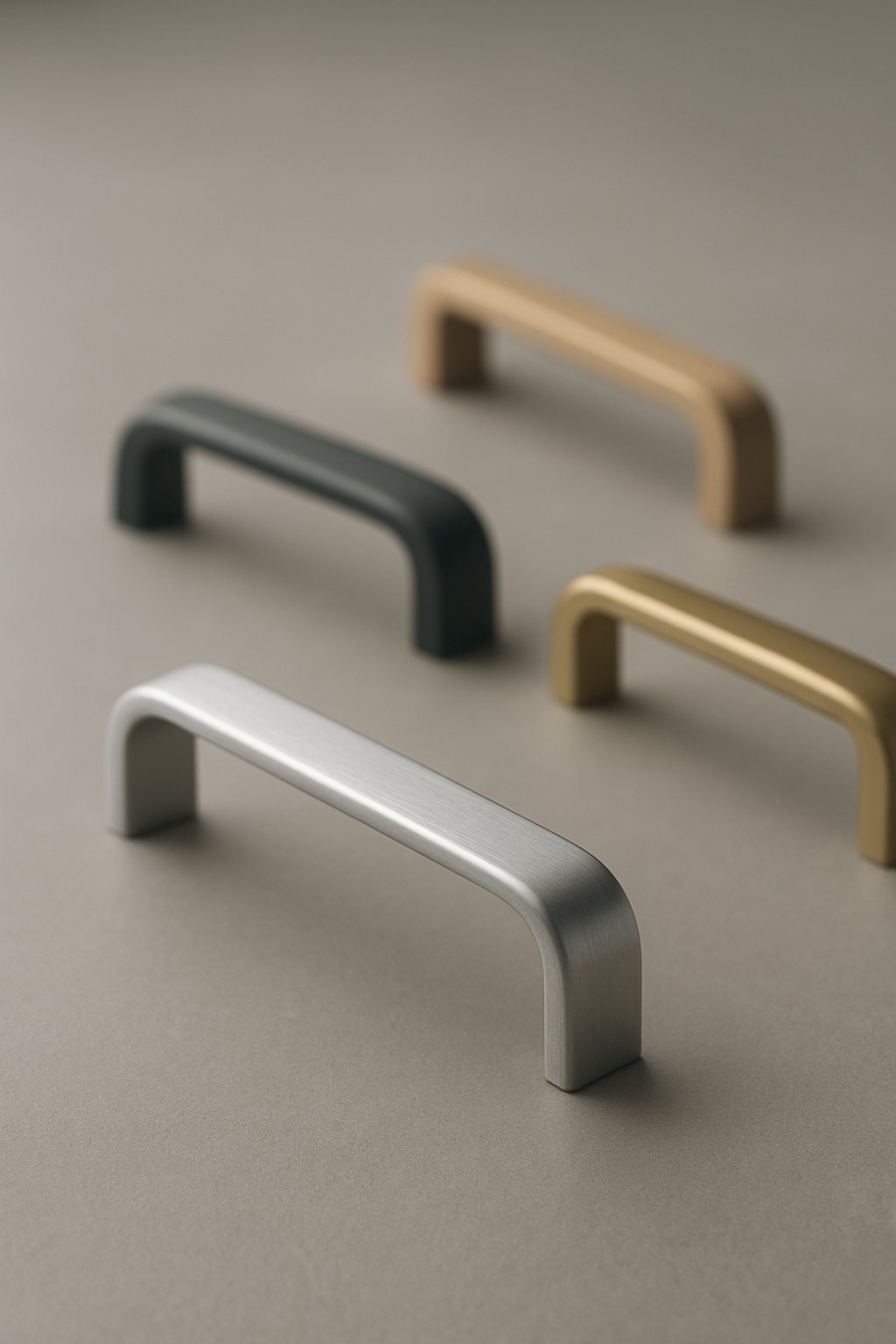
That broad definition quickly leads to a more practical question: why pick aluminium over the other materials in the same catalog? A solid material guide shows why buyers keep coming back to it. Aluminium is lightweight, corrosion-resistant, easy to shape, and generally cost-effective, which gives it a strong middle ground between appearance, upkeep, and everyday usability. That flexibility also helps explain why buyers can often choose both brushed aluminium handles and an aluminium door handle black finish within the same material family.
Many listings also use the phrase aluminium alloy handle. In simple terms, that usually means an aluminium-based metal formulation chosen to balance strength, weight, and manufacturability.
| Material | Core traits | Finish flexibility | Maintenance needs | Best-suited environments | Common trade-offs |
|---|---|---|---|---|---|
| Aluminium | Lightweight, strong, corrosion-resistant, easy to customize | High, with varied modern surface options | Low, usually simple cleaning | Indoor, wet areas, coastal settings, residential and commercial | Can feel less substantial in hand than heavier metals |
| Stainless steel | Very durable, sleek, corrosion-resistant, heavier | Good for contemporary looks | Low | Exterior doors, kitchens, bathrooms, high-traffic spaces | More weight, often a higher-cost step up |
| Brass | Classic look, durable, corrosion-resistant, naturally antimicrobial | Strong decorative appeal | Moderate, often benefits from polishing | Interior and exterior doors, traditional or premium projects | Usually more upkeep than aluminium |
| Zinc alloy | Affordable, easy to cast, decent corrosion resistance | High, can be plated in many looks | Moderate | Interior doors, furniture, budget-conscious projects | Often chosen more for value than for long-term premium feel |
| Wood | Naturally durable in broader handle use | Varies by product | Case by case | Best judged by specific application | Less of a standard choice for wet or heavily exposed hardware |
| Plastic | Lightweight and affordable | Varies widely | Low to moderate | Light-duty or cost-led applications | Can be prone to breaking under high pressure |
These two properties matter most on frequently touched hardware in kitchens, bathrooms, coastal locations, offices, and multi-use residential spaces. A long aluminium grab handle on a door or partition gives a clean, modern look without adding as much mass as stainless steel. The same logic helps on cabinets, internal doors, and other fixtures where repeated use matters but excess weight does not help.
Aluminium is not automatically best in every case. Stainless steel can make more sense for doors that take constant abuse. Brass works well when the project needs a warmer, more classic finish. Zinc alloy is often a practical budget choice for interior hardware with decorative finish goals. Broader handle references from Unger also show why wood and plastic stay in the conversation: wood can be naturally durable, while plastic stays light and affordable, though less ideal under heavy pressure. Specialty materials such as fiberglass are better treated as separate niche cases rather than direct stand-ins for a typical aluminium grab handle.
Material choice trims the shortlist, but the better answer usually appears when you match the handle to the job itself: entry door, drawer, window, or sliding panel.
Material narrows the field, but most buyers do not start with metal alone. They start with the job the hardware needs to do. The right choice for a front door, drawer, or casement window will grip differently, mount differently, and need different clearance. That is why sorting options by use is often the clearest way to compare aluminium door handles, aluminium cabinet handles, and aluminium window handles without getting lost in style labels.
For hinged entry and interior doors, buyers usually see either a projecting pull or a turning handle connected to a latch or lock. Pull styles suit doors where a full-hand grip and a clean, visible look matter. Sliding systems work by a different rule: the hardware cannot interfere with panel travel. Guidance on recessed pull handles explains why flush pulls sit into the panel, which is why many aluminium sliding door handles use a low-profile layout. In tighter spaces, an aluminium recessed handle can also reduce snagging.
On furniture, the main choice is how far the hardware should project from the face. Surface pulls are easy to grab on busy kitchen drawers and storage cabinets. Recessed versions are useful where clearance is limited or where a flatter front is preferred. Some flat-panel kitchens and wardrobes use an aluminium profile handle, which creates a grip along the panel edge instead of relying on a separate bar. Functionally, that gives a more minimal look while keeping everyday access simple.
Window hardware is more mechanism-specific than most cabinet or door hardware. A practical guide to window handle types highlights common families such as espagnolette handles for multipoint locking systems, cockspur handles often seen on older windows, tilt-and-turn handles for dual opening modes, crank handles for casement and awning windows, sash lifts, and locking handle styles. So even when two aluminium window handles look similar online, they may work with very different window systems.
| Handle type | Typical application | Mounting style | Space requirements | Ease of cleaning | Replacement considerations |
|---|---|---|---|---|---|
| Pull or bar handle | Entry doors, some interior doors, larger panels | Surface-mounted | Needs projection clearance in front of the panel | Usually easy | Check fixing points and whether the door was drilled for that style |
| Turning door handle | Hinged doors with latch or lock operation | Mounted through the door with operating parts | Needs hand clearance and swing clearance | Moderate | Must match the existing latch or lock setup |
| Flush or recessed pull | Sliding doors, closet doors, some drawers | Set into a cutout, then fixed in place | Best where projection must stay low | Easy to moderate | Cutout size and fixing positions need to line up closely |
| Profile or edge pull | Flat-front cabinets, wardrobes, drawers | Edge-mounted or integrated along the panel edge | Very low projection | Usually easy | Panel thickness, edge fit, and handle length matter |
| Espagnolette or cockspur window handle | Casement-style windows, including many older or modern systems | Mechanism-specific fixing | Compact, but frame clearance still matters | Moderate | Replace like for like because the window hardware differs by system |
| Tilt-and-turn, crank, or locking window handle | Tilt-and-turn, awning, casement, and security-focused windows | Linked to a dedicated opening mechanism | Needs room for the handle path and operation | Moderate | Operating function must match the existing window mechanism |
Application-first shopping cuts through a lot of noise, but it does not eliminate risk. Two handles can belong to the same category and still fail to fit because their spacing, projection, handing, or fixing details are different. That is where catalog language starts to matter more than appearance.
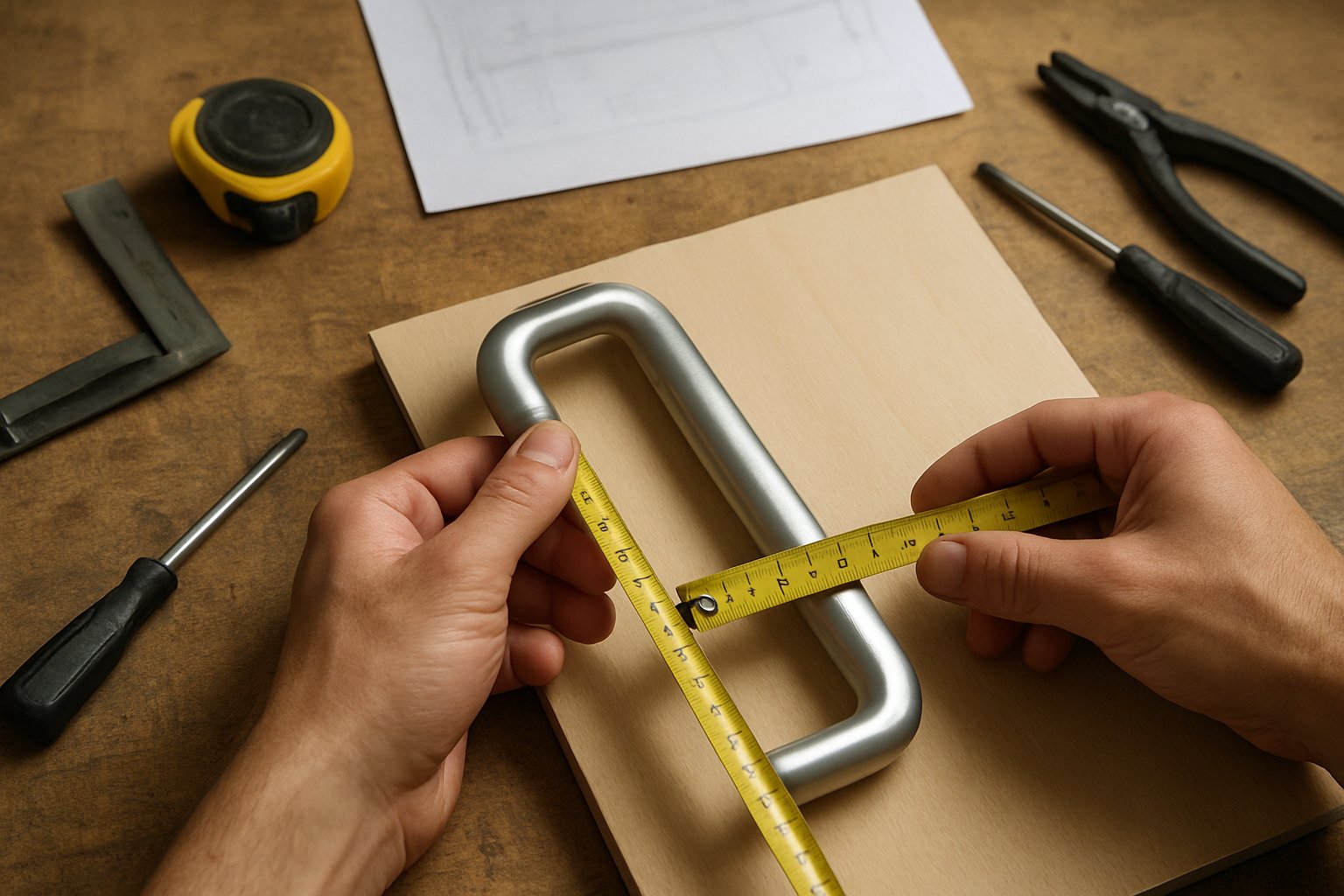
Two products can look nearly identical online and still fail for completely different reasons. One misses the old screw holes. Another sticks out too far. A third is made for the opposite door swing. For any aluminium handle, the spec sheet is not just catalog jargon. It is the fastest way to spot fit problems before you order.
Centre to centre spacing, often shortened to CTC, is the distance between the centers of two mounting holes. That matters most when you are replacing cabinet or drawer hardware, because the new piece has to line up with the holes already drilled unless you plan to fill and re-drill. Emtek notes that this measurement is commonly shown in inches or millimeters, and gives examples such as 3 in. (76 mm), 3.75 in. (96 mm), 4 in. (102 mm), and 5 in. (128 mm). Do not confuse CTC with overall length. Two pulls can share the same spacing and still look very different from end to end.
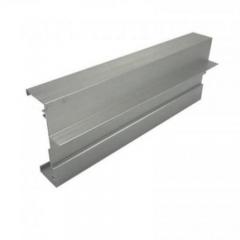
Profile describes the shape you see and the shape you grip. When a listing mentions an aluminium handle profile, it is usually pointing to the cross-section or edge form. An aluminium d handle is the familiar loop shape fixed at two points. An aluminium c profile handle usually refers to an edge pull with a channel-like grip. An aluminium concealed handle hides more of the hardware line within the panel edge or cutout, which is useful when you want a cleaner front or less projection.
Mounting terms are just as practical. Surface-mounted hardware sits on the face of the panel. Recessed or concealed designs need a cutout. Through-fixed hardware uses screws or bolts passing through the door, drawer, or frame. Projection tells you how far the piece stands proud from the surface, which matters on sliding panels, narrow walkways, and tight cabinet runs.
Some of the costliest mistakes happen after the size check. YAKO explains that lever handles are not truly universal, because compatibility can depend on door thickness, backset, bore size, spindle size, and whether the design is reversible or handed. In plain English, left versus right can matter, and so can the lock preparation already inside the door.
This is why an aluminium door handle set should never be treated as a standard bundle. One set may include only visible trim and screws. Another may include roses, plates, spindle, latch parts, or privacy components. If you are buying an aluminium door lock with handle, make sure the lock type, spindle, and trim format all suit the same door prep. Finish is another quiet trap. Black, brushed, or anodized parts may not match perfectly across collections, even when the finish names sound similar.
| Spec term | What it means in simple language | Where it appears in a catalog | What to verify before ordering |
|---|---|---|---|
| Centre to centre spacing | Distance between the centers of two fixing holes | Dimension list, technical drawing, cabinet pull size chart | Match existing holes or confirm you are willing to drill new ones |
| Overall length | Total end-to-end size of the handle | Product title, dimensions panel, line drawing | Check visual proportion and nearby clearance |
| Projection | How far the handle sticks out from the surface | Detailed spec diagram | Make sure fingers fit and panels can still pass each other |
| Fixing method | How the hardware attaches, such as face-fix, rear-fix, or through-bolt | Installation notes, parts list | Confirm screw access, panel construction, and hole style |
| Profile shape | The grip form, such as D, C, edge pull, or recessed style | Product name, side-view image, profile section | Choose a shape that suits grip comfort and space limits |
| Handed or universal | Whether the handle is left-hand, right-hand, or reversible | Function options, handing notes | Match the door swing and check if reversing is allowed |
| Door or panel thickness | The thickness range the hardware is designed to fit | Compatibility section, installation guide | Measure the actual door, frame, or drawer front |
| Backset, bore, and spindle | Key lock and latch dimensions for operating handles | Lockset section, door set specifications | Match the existing prep, especially on lock-linked handles |
| Finish and included components | Surface color and the parts packed with the item | Finish menu, box contents, set description | Confirm that trims, plates, locks, and fasteners are compatible and visually matched |
Catalog language gets much easier when each line is tied to a real measurement on your own door, drawer, or window. A short pre-purchase check turns these dry specs into a practical buying filter, and that is usually where the right option starts to stand out.
A handle can look perfect in a product photo and still be wrong the moment it reaches your site. Most buying mistakes happen at the overlap between dimensions, lock geometry, and real-world use. Guides from Trade Door Handles, AKADA, and Lareina all point to the same lesson: replacements are rarely universal.
Before comparing finishes or an updated aluminium door handle design, lock down the measurements that decide fit.
A replacement door handle for aluminium door systems should be matched to the mechanism first, not just the finish. Check whether the lock is multipoint, mortise, hook, flush, or another sliding-door type. Patio references also note that aluminium patio door handles are not universal, with backplate fixing centers and PZ centers being especially important.
Also verify whether the handle is handed or reversible, whether your lock is sprung or unsprung, and whether the screw positions match exactly. On some sets, an extra fixing below the lever changes the whole fit. For door handles for aluminium doors, plate width can be just as important as length because slim profiles leave less room for oversized trim.
An aluminium main door handle on a front entrance works harder than one on a bedroom door. Exterior and semi-exposed openings may need stronger corrosion resistance and a more durable finish. Heavy-traffic commercial doors may also justify a sturdier configuration than light residential use. That is one reason aluminium door handle price varies even when two products appear similar online.
Write these details down before you order. Those notes, photos, and measurements do more than prevent a bad purchase. They also make removal, test-fitting, and final installation far less guesswork.
The measuring work pays off here. An aluminium door handle replacement is usually straightforward when you record the old setup before taking anything apart, then compare every fixing point and moving part during installation.
For most swap-outs, basic hand tools are enough. A practical installation guide lists common items such as screwdrivers, measuring tape, and a level, with a drill only if new holes are needed. Before removal, open the door or window fully, take a quick photo, and note handing, screw locations, and any latch or lock details. If you are replacing cabinet or pull hardware, a measuring guide shows why hole centers should be checked from the center of one fixing hole to the center of the other.
Cycle the handle several times. The lever or pull should feel smooth, the latch should retract cleanly, and the door should close without rubbing. The same idea applies to an aluminium bifold door handle replacement, where panel alignment and easy folding matter as much as the handle itself.
Window work has one extra variable: the operating mechanism. A window handle guide notes that an aluminium window handle replacement depends on matching the existing handle type and making sure the spindle fits snugly. Some units may also need screen or trim removal for screw access. For anyone searching how to replace aluminium door handle parts versus window hardware, that is the big distinction. Doors center on latch and lock alignment, while windows depend more on the specific opening and locking mechanism. Even a well-fitted handle still needs periodic cleaning and a quick check for looseness, wear, or sticking parts.
A clean install can still develop problems later. Most issues start small: a screw backs out, a latch gets sticky, or the finish begins to dull in a damp area. Catching those signs early helps you avoid repeat fitting work and makes aluminium door handle repair far more manageable.
For routine care, KRC recommends a soft cloth or brush, mild dish soap, and warm water. Avoid steel wool, scouring pads, and other abrasives that can scratch the surface. Brushed finishes should be wiped gently, and anodized pieces should not be cleaned with harsh acidic products. Drying thoroughly matters too, because leftover moisture can leave marks and encourage corrosion in harsher environments.
If you are searching how to fix aluminium window handle problems, start with the simple checks. Supply Only Doors shows that many window handles can be tightened by removing the plastic screw caps and carefully tightening the top and bottom screws without stripping them.
| Issue | Likely cause | First corrective step | When replacement is smarter |
|---|---|---|---|
| Loose handle | Backed-out screws | Tighten fixings carefully | If screw holes are damaged or the body wobbles |
| Sticky lock or latch | Dirt buildup or dry mechanism | Clean and lubricate moving parts | If the mechanism still jams or will not secure |
| Finish wear | Abrasive cleaning or exposure | Switch to gentler cleaning and dry fully | If coating loss is severe or corrosion is visible |
| Poor replacement fit | Outdated pattern or non-matching geometry | Recheck spacing, spindle, and fixing points | If modern parts cannot align safely |
Repair makes sense when the hardware is basically sound and the problem is limited to dirt, looseness, or minor alignment. When fit, locking, and finish problems pile up together, the better move is usually replacement. At that point, clear catalogs and reliable supplier information become just as important as the handle itself.
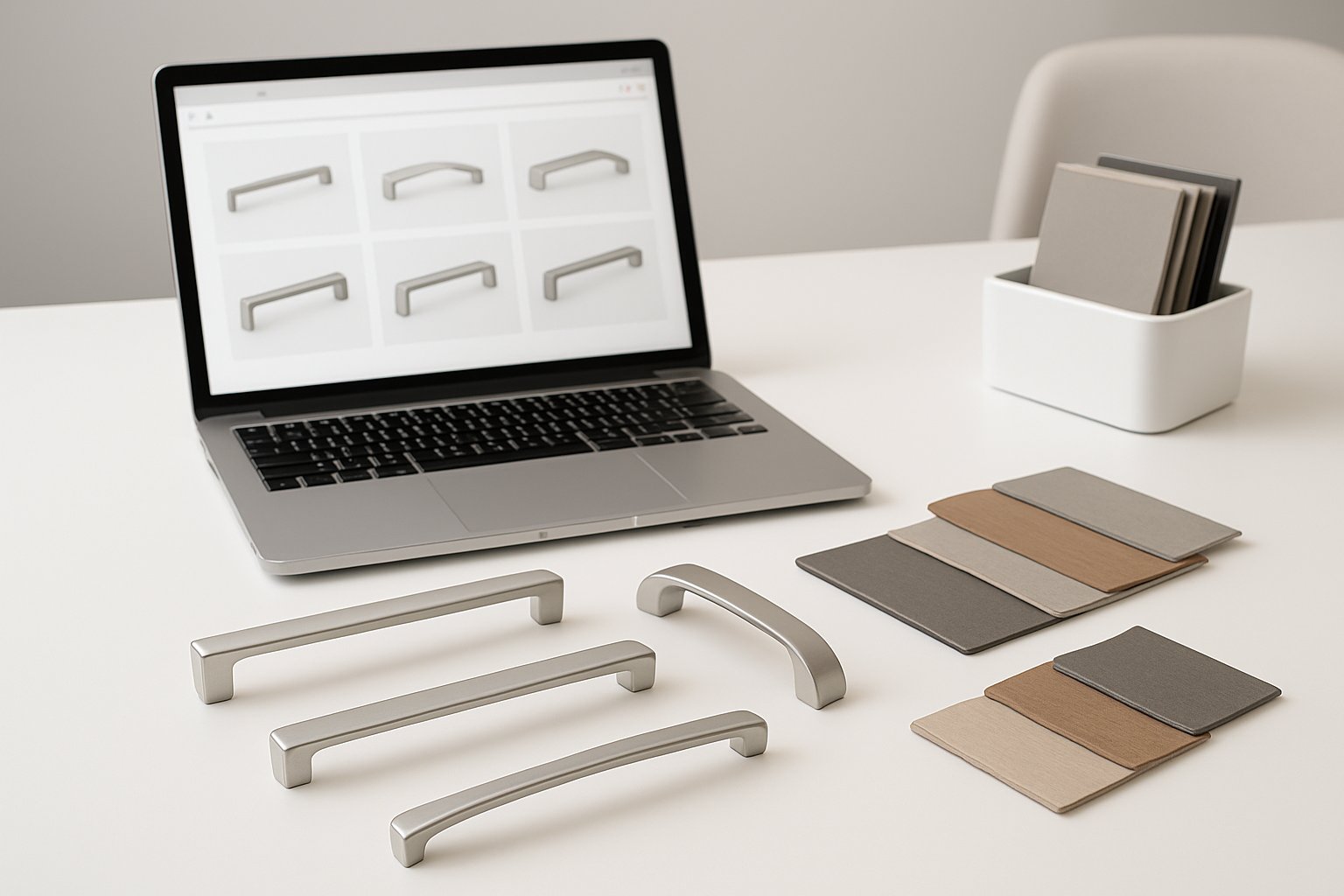
When repair is no longer worth the effort, sourcing becomes the real trap. A polished photo can hide vague fit notes, missing accessories, or finish details that never quite match on arrival. For buyers, the best catalog is usually the one that explains the product clearly, not the one with the biggest SKU list.
If you are screening an aluminium door handle manufacturer, start with practical detail. The KRC guide highlights material and finish information that can affect suitability, including 6061, 7075, and 5052 aluminum alloys, plus anodized, powder coated, and brushed finishes. For door and window hardware, the windoorshardware guide stresses matching by application, environment, and accessory completeness. In plain terms, strong suppliers help you confirm fit, finish, and included parts before you buy.
| Supplier or catalog path | Application coverage | Finish options | Customization support | Corrosion-resistance positioning | Documentation clarity | Accessory availability |
|---|---|---|---|---|---|---|
| Shengxin Aluminum | Catalog coverage includes cabinets, windows, and doors | Review listed series options for modern, simple designs | Customization is stated as available | Positioned around durability and corrosion resistance | Use the official catalog to verify model details | Confirm matching accessories with the supplier before ordering |
| Official manufacturer catalog | Check whether it covers your exact door, cabinet, sliding, or window use | Look for anodized, powder coated, or brushed descriptions where relevant | Ask about size, finish, and drilling changes | Check whether wet-area or outdoor suitability is explained | Prefer drawings, hole spacing, and installation notes | Verify screws, spindles, backplates, and lock parts |
| Door and window hardware specialist | Useful for mechanism-specific items, including window handles for aluminium windows | Review finish consistency across related hardware | Ask whether replacement matching is supported | Look for guidance on humid or coastal settings | Prefer technical sheets tied to product codes | Verify keepers, locks, and related operating parts |
| Furniture or profile-handle supplier | Best for wardrobes, drawers, aluminium kitchen handles, and some aluminium glass door handle styles | Check finish names against samples if appearance is critical | Ask about cut-to-length or profile options | Review finish-protection claims carefully | Prefer cross-section drawings and mounting data | Verify screws, inserts, end caps, and mounting strips |
Filter by job, not by finish name. Start with the use case: aluminium glass door handle, aluminium sliding patio door handles, aluminium kitchen handles, or window handles for aluminium windows. Then narrow the list by alloy, finish, mounting drawing, and included hardware. If a catalog does not show hole spacing, projection, spindle details, or lock compatibility, treat that as a warning sign rather than a minor omission.
As one sourcing example, Shengxin Aluminum offers an Aluminium Handle Series for cabinets, windows, and doors, with customization support and a modern look. That makes it a useful reference point when reviewing standard pulls and project-specific aluminium handles for doors. The same rule still applies, though: confirm dimensions, finish matching, corrosion needs, and what is actually included in the box.
The supplier matters, but clarity matters more. When the catalog answers fit questions up front, the next handle is much less likely to become another replacement job.
Start with the fixing points. Measure the hole spacing or screw centers first, then check overall length and projection so the new handle suits the available space. For doors, also confirm door thickness, spindle type, lock format, and whether the handle is handed or reversible. For cabinets and drawers, make sure the new piece will either match existing holes or fully cover any old marks. If the catalog does not show a clear drawing, ask the supplier before ordering.
In many cases, yes. Aluminium is often chosen because it stays light, looks clean, and handles moisture better than many untreated materials. That said, the finish and exposure level matter. A sheltered kitchen cabinet handle does not face the same conditions as an exterior entry set or coastal hardware. For damp or exposed locations, choose a finish intended for that environment and clean it regularly to remove residue, salt, or standing moisture.
They solve different access problems. A pull handle projects from the surface and gives a full-hand grip, which works well on doors and larger panels. A recessed handle sits into the panel, making it useful where doors slide past each other or where low projection is important. A profile handle usually runs along the panel edge, creating a minimal look often used on flat-front cabinets and wardrobes. Clearance, grip comfort, and panel movement should guide the choice.
Sometimes, but only when the new handle matches the existing lock setup. Compare the old and new parts for screw centers, plate size, spindle type, springing, and the relationship between the key cylinder and lever position. A handle that looks similar can still operate poorly if those hidden details differ. This is especially important on multipoint and sliding door systems, where even a small mismatch can affect alignment and closing performance.
Choose suppliers that make fit information easy to verify. Useful catalogs show application type, mounting method, finish options, included accessories, and whether custom sizing or drilling is available. It also helps when a supplier covers more than one use case, such as doors, windows, and cabinets, because matching related hardware becomes easier. Shengxin Aluminum is one sourcing option to review because its Aluminium Handle Series includes standard and customizable models for multiple applications, but buyers should still confirm dimensions, finish consistency, corrosion suitability, and included parts before purchase.



 Servicio en línea
 0086 136 3563 2360
 sales@sxalu.com
 +86 136 3563 2360
 español
 English
 français
 Deutsch
 русский
 português
 العربية
 ไทย
ไทย Việt
Việt Українська