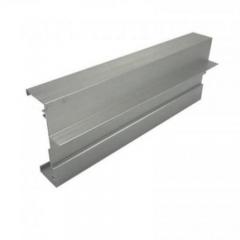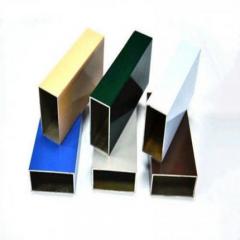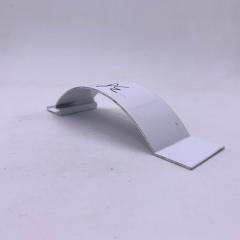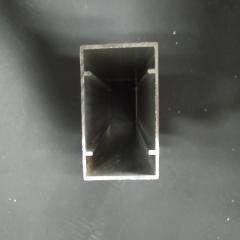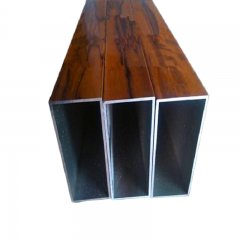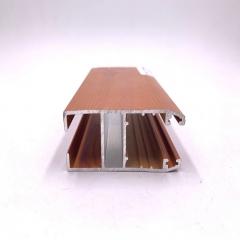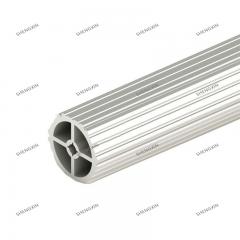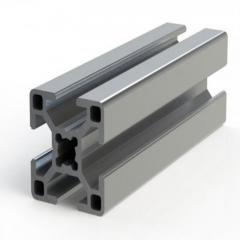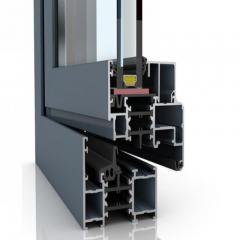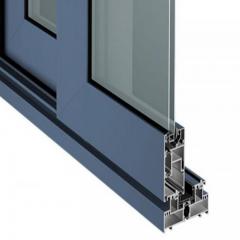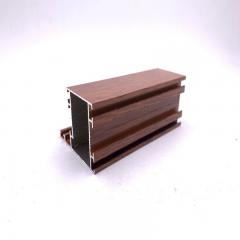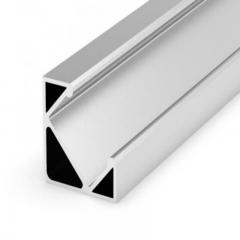
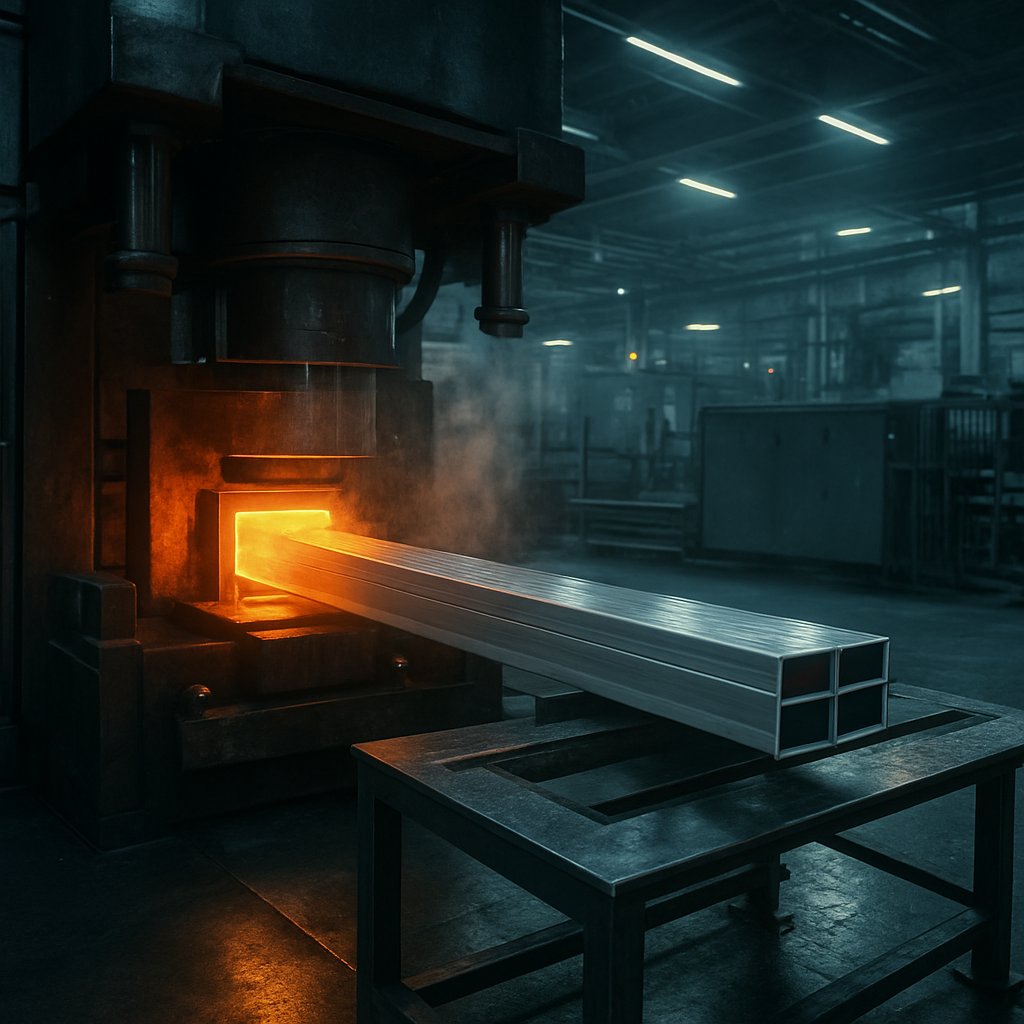
Aluminum extrusion is the process of pushing a heated aluminum billet through a shaped steel die so the metal comes out as a long part with the same cross-section all along its length. If someone asks what is aluminum extrusion, the short answer is this: it is a practical way to make repeatable aluminum shapes efficiently and at scale.
Aluminum extrusion forms a continuous profile by forcing softened, still-solid aluminum through a die opening.
Think of a heavy-duty dough press. The billet is the aluminum log fed into the machine. The die is the shaped opening that defines the part. The press is the hydraulic equipment that creates the force. The profile is the finished cross-section that exits the tool. In the process outlined by the AEC, the billet is preheated until it is soft but not molten, then pushed through the die to create an aluminum extrusion profile that keeps the same shape from end to end.
Manufacturers use aluminum extrusions when they need consistent cross-sectional parts for construction components, transport parts, equipment frames, enclosures, and many other products. The process can create simple channels and angles as well as more complex hollow sections, all while keeping the section consistent along the full length. One term worth learning early is extrusion ratio, which compares billet area to profile area and helps explain how difficult a shape is to produce. That detail matters because the final result is not controlled by the press alone. The metal has to start in the right form, and that means the billet and alloy choice deserve a closer look.
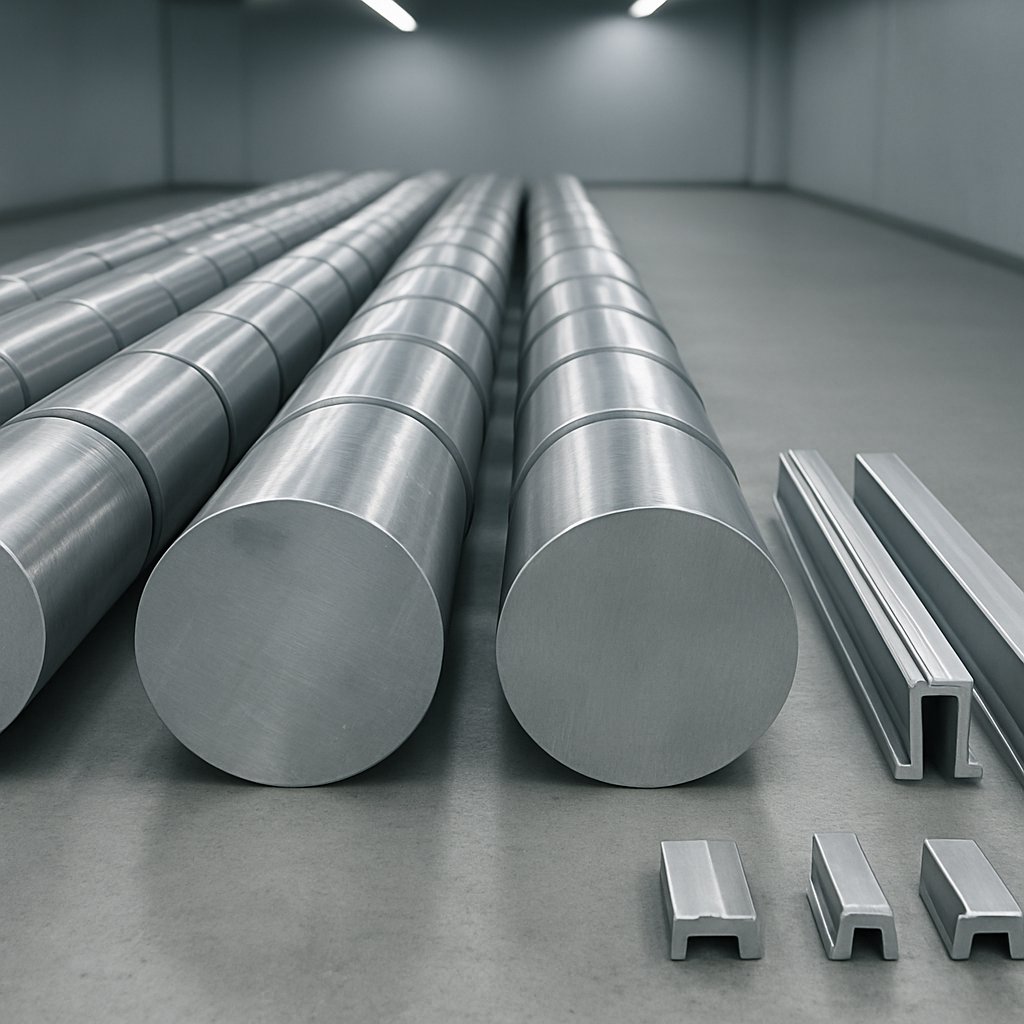
Before a profile ever reaches the die, a big part of its future is already decided. The billet is the starting stock prepared for the press, but the alloy inside that billet is what sets the direction for strength, corrosion resistance, surface appearance, and how well the part responds to later processing. In other words, raw material choice is not a background detail. It is one of the first quality decisions in how aluminum extrusion is made.
Extrusion plants do not begin with one universal aluminum grade. They begin with billets made to a defined alloy, because different chemistries flow differently and deliver different results after extrusion. The most common choices come from the 6000 series alloys, which use an aluminum-magnesium-silicon system that combines good extrudability, corrosion resistance, and heat-treatability.
That matters right away. Easier-flowing alloys help create thinner and more intricate sections with smoother surfaces. Stronger alloys can support heavier structural duty, but they may need more careful press control and cooling. Alloy selection also affects die wear, dimensional stability, post-machining behavior, and anodizing consistency, so the billet stage connects directly to what happens later on the line.
Among common extrusion grades, the tradeoffs are fairly clear. 6063 is widely favored when appearance and easy extrusion matter most. 6061 raises strength and offers excellent machinability. 6005 sits in the middle for structural shapes. 6082 moves toward higher-strength load-bearing use, while 6463 is chosen when brightness and decorative finish are priorities.
| Alloy | Typical T6 yield strength | Extrudability and finish | Machinability | Typical fit |
|---|---|---|---|---|
| 6063 | Approx. 240 to 270 MPa | Excellent extrudability, smooth surface, very good for anodizing | Moderate | Architectural profiles, frames, windows, appearance-focused sections |
| 6061 | Approx. 276 MPa | Moderate extrudability, fair surface smoothness, balanced performance | Excellent | Industrial parts, enclosures, profiles that need later CNC work |
| 6005 | Approx. 260 MPa | Fair extrudability, suitable for structural extrusions | Fair | Transport structures, scaffolding, conveyor and support sections |
| 6082 | Approx. 340 to 350 MPa | More difficult to extrude, better for thicker load-bearing shapes | Moderate | Heavy structural members, machinery bases, marine and transport frames |
| 6463 | Approx. 220 to 245 MPa | Excellent polishability and bright decorative finish | Fair | Trim, decorative profiles, bright anodized components |
The property ranges above come from the Ya Ji comparison. For downstream planning, the pattern is just as important as the numbers. A 6063 profile usually gives a cleaner cosmetic surface. A 6061 or 6082 profile is often better when machining or structural load matters more. That same decision can influence cooling control after the press and the consistency of later finishing.
For buyers, the first practical question is often simple: can an existing shape do the job? If a profile in an aluminum extrusion profiles catalog already matches the assembly, standard aluminum extrusions usually save time, lower tooling cost, and simplify repeat ordering. This is common with channels, angles, tubes, and many modular framing sections, including t slot extrusion aluminum.
The same logic applies to t slot extrusion aluminum. Standard sizes work well for general framing, but custom slot geometry may be worth it when connector fit, stiffness, or appearance cannot be achieved with off-the-shelf options. That is where material choice meets tooling reality, because even the right alloy still has to be shaped by a die that can control flow correctly.
Once the billet and alloy are chosen, geometry starts calling the shots. Every unique profile needs its own aluminum extrusion die, and that tool is what gives the part its final cross-section. For anyone comparing aluminum extrusion profiles, the drawing is more than a shape on paper. It shows where metal has to speed up, slow down, split, rejoin, and stay balanced under heavy load. That is why two profiles made from the same alloy can differ sharply in cost, tolerances, die life, and surface appearance.
The die controls the outline, but the difficulty comes from how the metal moves through it. Simple sections usually allow more even flow. Add thin walls, deep channels, sharp corners, long fins, or enclosed voids, and the tooling has to work much harder. Those features can increase stress inside the die, reduce dimensional consistency, and make visible defects more likely. When flow is not balanced, the profile may leave the press with twist, bow, wall variation, or die lines on important faces.
| Profile type | What it means | Typical die behavior | Common manufacturability effect |
|---|---|---|---|
| Solid | No enclosed voids, such as bars, angles, and many channels | Often uses flat-face, pocket, or feeder dies | Usually the easiest to extrude, with lower tooling complexity and stronger dimensional control |
| Hollow | One or more fully enclosed voids, such as tubes or a multi-void aluminum t-slot extrusion | Usually requires a porthole die with a mandrel and cap | Higher tooling complexity, more balance-sensitive flow, and tighter straightness control |
| Semi-hollow | A partially enclosed void with a narrow opening or gap | A hybrid case where the tongue area needs careful support | More difficult than a solid profile, with higher die stress and greater risk of tolerance trouble |
The line between these groups is not always obvious. Some aluminum channel extrusions stay in the solid category when the opening is wide, but a narrower version can behave like a semi-hollow. Gabrian notes that this is often judged by tongue ratio, defined as Area/Gap2. As that ratio rises, the unsupported tongue area becomes harder to protect, and the die becomes more vulnerable to wear, deflection, or breakage. Support tooling behind the die helps resist deformation, but it cannot fully rescue an unbalanced profile.
In practice, the most successful aluminum extrusion shapes are not always the most intricate ones. They are the ones that let metal flow evenly, protect cosmetic surfaces, and leave realistic room for tolerances. The die sets that target, but the result still depends on what happens inside the press, where heat, pressure, and ram speed decide whether the profile can actually emerge the way the tooling intended.
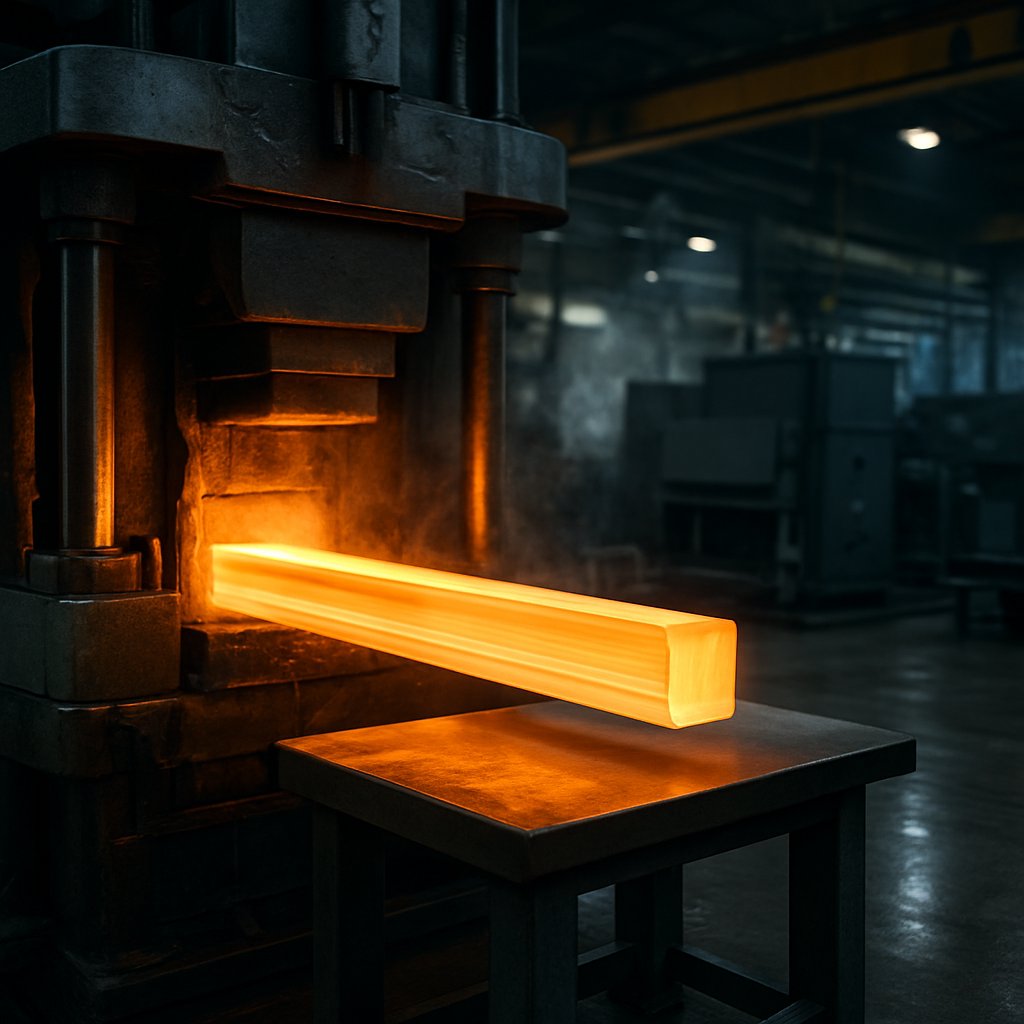
A smart die design still needs controlled force to turn a drawing into metal. Inside an aluminum extrusion press, a preheated billet is loaded into the container, the ram and dummy block advance, pressure builds, and the softened but still solid aluminum starts flowing through the die. The profile that comes out already has its cross-section, but its straightness, surface finish, and consistency depend on how heat, speed, friction, and support are managed during that short trip through the press.
The aluminum extrusion machine is a hydraulic system built around a few working parts: the container that holds the billet, the ram that supplies force, the dummy block that seals and spreads that force, and the die stack that shapes the metal. Industrial process guidance from Bonnell places billet heating at about 800 to 925 F before loading, with dies preheated separately so the tooling does not chill the metal too quickly at first contact.
Before the push begins, shops may apply a thin lubricant or parting agent to the billet and ram. Its job is practical: reduce sticking, lower friction where needed, and help protect surface quality. Then the ram moves forward. At first, the billet shortens and widens until it fully contacts the container walls. Only then does pressure rise high enough for the metal to squeeze through the die opening. This is the most sensitive part of the aluminum extrusion process. If conditions are too cold or the ram moves too fast, defects such as tearing or rough surfaces become more likely. If settings drift too hot, the metal can flow unevenly and dimensional control suffers.
The exit side matters just as much. As the shape leaves the die, it is supported on a leadout table, guided by a puller, and carried along the runout table for cooling. That support is especially important for long, slender shapes. A straight aluminum extrusion rail, for example, can develop sag, sweep, or twist if the profile is not guided evenly as it comes off the press.
| Process parameter | Where it applies | Quality outcomes it affects |
|---|---|---|
| Billet preheat | Before loading into the container | Metal flow, required force, surface condition, and overall consistency |
| Die temperature | Tooling setup and early metal contact at the die face | Surface finish, die life, startup stability, and dimensional repeatability |
| Lubrication or parting agent | At billet and ram contact surfaces where used | Friction control, sticking risk, and surface cleanliness |
| Ram speed | During the press stroke | Exit temperature, surface quality, profile stability, and production consistency |
| Pressure and press tonnage | Throughout deformation and die flow | Ability to extrude larger, harder, thinner-wall, or more complex profiles |
| Exit support and cooling | From die exit to leadout and runout tables | Straightness, bow, twist, quench response, and handling quality |
These variables are tied together. Bonnell's extrusion guidance notes that lower temperatures often improve surface quality and dimensional accuracy, but they also demand higher pressure. Increase temperature and speed too far, and the metal tends to favor easier flow paths inside the die. Thin ribs, sharp corners, and delicate details are usually the first places to show trouble. The same imbalance can leave a long aluminum extrusion rail with bow or twist before it ever reaches downstream straightening.
Press tonnage is best understood as the machine's force capacity. Larger profiles, harder alloys, hollow sections, thin walls, and higher extrusion ratios all push that requirement upward. Profile size is also limited by press size, often discussed in terms of the circumscribing circle that can contain the cross-section. Extrusion ratio, commonly expressed as billet area divided by profile area, helps explain why a compact, detailed section can need more pressure and tighter control than a simpler shape of similar weight.
Inside the press, small setting changes create big differences in the profile that emerges. Even the path of that force is not always the same, and that is where extrusion methods start to diverge. Change how the billet and die move against each other, and friction, heat buildup, and surface behavior change with them.
Not every extrusion route makes aluminum move the same way. Two comparisons matter most here. Direct and indirect describe how the billet and die move relative to each other. Hot and cold describe the temperature of the forming process. For most long-profile work, aluminum profile extrusion is typically done by hot direct extrusion because it supports a wide mix of shapes with practical tooling and solid production speed.
In direct extrusion, the ram pushes the billet toward a stationary die, so the metal flows in the same direction as the ram. Because the billet slides along the container wall, friction is higher. ExtruderPress describes direct extrusion as the most widely used approach for aluminum and AlMgSi 6xxx alloys, which helps explain why it remains the default for many general-purpose profiles.
Indirect extrusion flips that relationship. The die is mounted on a hollow stem and moves toward the billet, so the metal flows opposite the stem travel. With far less billet-to-container wall friction, load and heat buildup are more stable. That can improve surface consistency and dimensional uniformity, but the press arrangement is more complex and practical section size is more limited.
| Method | Material flow | Friction | Common use pattern | Tooling and equipment | Quality tradeoffs |
|---|---|---|---|---|---|
| Direct | Metal flows in the same direction as ram travel | Higher, because the billet contacts and slides on the container wall | Most common for general aluminum profiles, including many complex sections | Simpler and more widely available press setup | Very versatile, but more friction can make heat control and surface consistency harder |
| Indirect | Metal flows opposite the moving stem and die assembly | Lower, because there is no relative billet-container wall motion | Useful where tighter consistency and efficient billet use matter | More specialized press design, with limits on section size | Often steadier flow and better finish consistency, but operation is more demanding |
Temperature changes what aluminum can do inside the die. The Ya Ji guide notes that hot extrusion for aluminum is typically performed with billets around 400 to 500 C, above recrystallization. That lowers flow stress and makes long, detailed shapes feasible at reasonable press force. Cold extrusion works at or near room temperature, sometimes slightly warmed, and is far more common for small, compact parts than for long profile shapes.
| Method | Material behavior | Common use cases | Tooling and force | Quality tradeoffs |
|---|---|---|---|---|
| Hot extrusion | Softer metal flow, easier to form complex sections | Most extrusion aluminum used for frames, heat sinks, enclosures, and an aluminum extrusion tube | Requires heated billets and preheated tooling, but supports longer profiles | Excellent shape complexity and throughput, though thermal control strongly affects finish and tolerances |
| Cold extrusion | Higher flow stress and stronger work hardening | Small near-net-shape parts, sleeves, and precision components | Needs higher forming force and robust tooling, usually for short-stroke parts | Better as-formed surface and dimensional control, but far less suited to large or intricate long profiles |
In practice, most aluminum profiles extrusion lines rely on hot direct presses. That combination handles broad product mixes, from simple channels to more complex hollows. Indirect extrusion becomes attractive when lower friction and steadier flow are worth the added equipment limits. Cold extrusion belongs to a different corner of manufacturing, where the part is compact and precision matters more than long continuous length.
The method changes force demand, friction, temperature behavior, and the kind of geometry that is realistic. It also shapes what happens a few seconds later, because every profile still leaves the die hot, stressed, and in need of careful cooling and straightening if it is going to hold its final properties and fit.
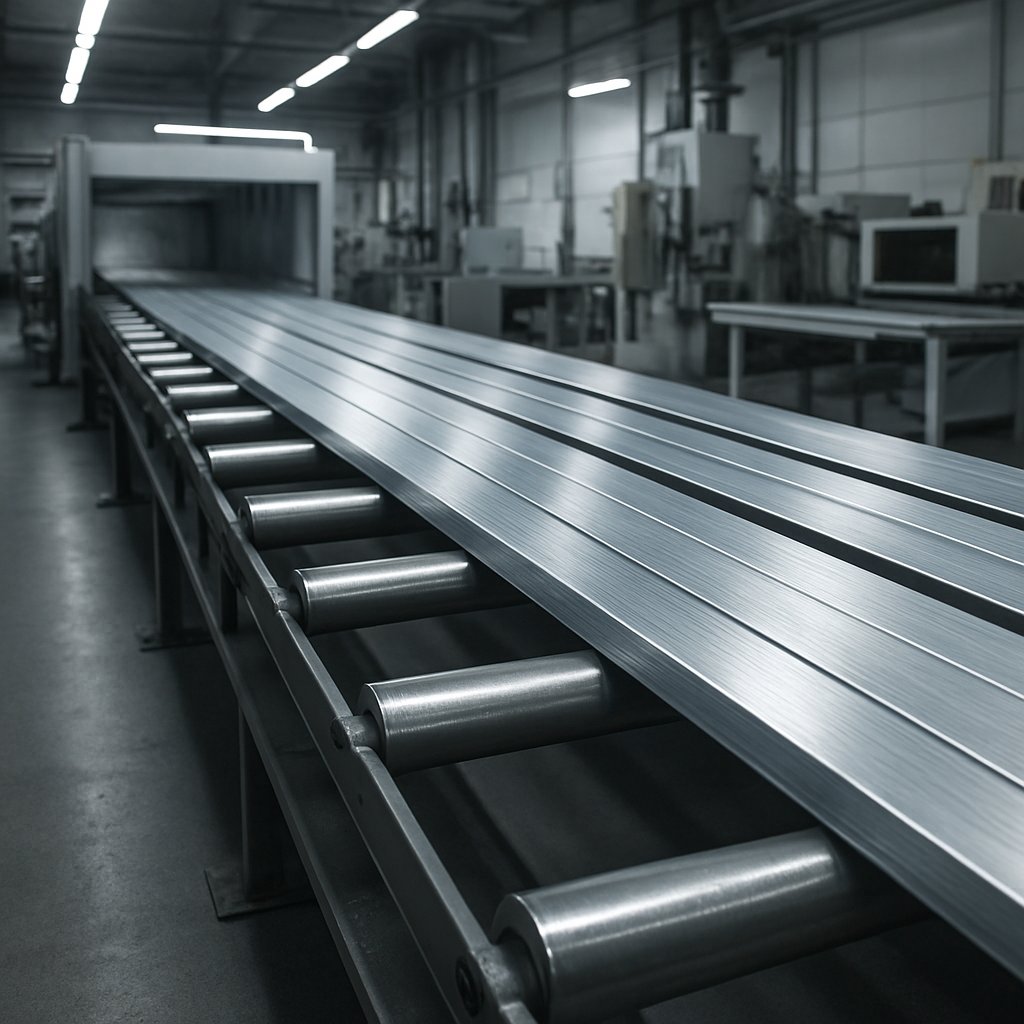
The moment a profile clears the die, it is not finished. It is still hot, still moving through support equipment, and still sensitive to handling. What happens here affects straightness, hardness, surface condition, and how easily the part moves into assembly. The alloy selected earlier and the press conditions used a few seconds before now start to show their downstream effects in cooling, cutting, aging, and finish quality.
Bonnell describes a post-press sequence in which the extrusion is guided onto the leadout and runout tables, then cooled by fans along its length. Some alloys need more than air alone. Bonnell specifically notes that 6061 is water quenched as well as air quenched. After cooling, the profile moves to stretching, where it is straightened and, in Bonnell's wording, work hardened through molecular realignment. That contributes to increased hardness and improved strength while also helping reduce shape issues before final cutting.
Length control matters more than it looks. In Bonnell's process guide, saw cutting tolerance is listed as 1/8 inch or greater depending on saw length. That helps explain why cutting aluminum extrusion must be matched to the actual fit requirement, especially for aluminum extrusion trim, frames, and other parts that need repeatable assembly lengths.
Freshly extruded metal does not always have its final strength. Bonnell notes that cut profiles are moved into age ovens, where artificial aging hardens the metal in a controlled temperature environment. The ADM overview also links post-extrusion heat treatment to tempers such as T5 or T6. In practical terms, this is where many aluminum extrusion parts gain the hardness and mechanical properties expected in service. The exact response depends on the alloy and how the profile was cooled coming off the press.
At this stage, the profile becomes a usable component rather than a long mill length. Bonnell lists common secondary requirements such as drilling, bending, punching, mitering, anodizing, and paint, while ADM highlights cutting, machining, and coating as key finishing steps.
By the time the metal is cooled, straightened, aged, and finished, the profile may look complete. Usability still depends on proof, though. Straightness, twist, surface marks, and profile consistency all have to be checked against the part's real job, and that is where process quality becomes visible.
A finished profile can look correct and still fail in use. That is why extrusion plants check more than shape alone. Quality control typically includes visual inspection, dimensional measurement, straightness and twist checks, surface review, and verification that the part will fit its mating assembly. As described in this inspection guide and this quality control overview, common tools include calipers, micrometers, optical systems, and CMM equipment for more complex sections.
Quality is built into extrusion through material control, die design, press settings, and handling, not added by inspection at the end.
Checks are matched to function. An aluminum extrusion frame used in a modular build may need close control of straightness and connector fit. An aluminum extrusion enclosure may place more emphasis on cosmetic surfaces, hole alignment, and finish consistency. Parts that rely on aluminum extrusion connectors or aluminum extrusion brackets also depend on repeatable slot widths, wall thickness, and cut accuracy, especially when standard aluminum extrusion sizes must assemble without force.
| Quality issue | What inspectors look for | Likely upstream causes |
|---|---|---|
| Scratches or dents | Visible marks, handling damage, coating disruption | Poor post-extrusion handling, contact with sharp surfaces, inadequate packaging |
| Die lines or streaks | Long surface lines or uneven appearance | Die wear, uneven extrusion pressure, inconsistent cooling |
| Twist or bow | Rotation, curvature, poor lay-flat behavior | Uneven cooling, temperature imbalance, mishandling after extrusion |
| Size variation | Dimensions outside drawing tolerance | Die wear, incorrect speed, heat fluctuation, flow imbalance |
| Fit problems in assemblies | Loose or tight joints, misalignment with aluminum extrusion brackets or connectors | Wall variation, straightness issues, inaccurate cutting, poor tolerance control |
| Alloy mismatch | Wrong hardness, strength, or corrosion behavior | Incorrect billet selection, contamination, weak traceability |
The acceptable result depends on the job. Structural members and machine bases often prioritize straightness, twist, and mechanical consistency. Modular systems care about repeatable fit across aluminum extrusion sizes. Enclosures and custom components usually need both dimensional accuracy and a clean surface that can be anodized or coated evenly. That is why inspection plans often combine in-process checks, final measurements, and material traceability against standards such as ASTM B221. Those checks reveal an important truth: the best extrusions are not merely measured well, they are made under control from the very start. For buyers, that raises a practical question about supplier capability, process coverage, and how to evaluate a manufacturing partner before ordering.
The same issues that show up in inspection reports usually start much earlier, so supplier selection should focus on process control, not just price. When comparing aluminum extrusion suppliers or shortlisting aluminum extrusion companies, look for evidence that the shop can manage alloy traceability, die engineering, press discipline, finishing, and documentation in a consistent way. The audit criteria outlined in the Aluphant audit guide and the integrated-service approach discussed in the PTSMake guide point to the same conclusion: a reliable partner reduces technical risk before production even starts.
Every outside handoff adds another opportunity for delay, damage, or tolerance drift. That is why many buyers prefer aluminum extrusion services that cover more than pressing alone. Integrated machining and finishing can simplify scheduling, reduce packaging transfers, and keep accountability in one place.
| Supplier model | Press and engineering visibility | CNC support | Finishing scope | In-house process coverage | Best fit |
|---|---|---|---|---|---|
| Shengxin Aluminium | 30+ years of manufacturing experience and 35 extrusion presses | Precision CNC machining | Multiple anodizing and powder coating lines | From raw material to finished product | Projects that benefit from one-source coordination across extrusion, machining, and finishing |
| Integrated supplier model | Clear press list, tooling feedback, and documented process control | Cutting plus fabrication support | In-house or tightly controlled finishing | Broad | Complex repeat orders with tighter fit, finish, and scheduling demands |
| Extrusion-only source | May offer press capacity but limited downstream coordination | Basic cutting or outsourced work | Often outsourced | Partial | Simple mill-finish profiles with low assembly complexity |
If you are deciding where to buy aluminum extrusion, first separate stock supply from engineered production. Catalog items and basic aluminum extrusions for sale can be a smart choice when the shape is standard, the finish is simple, and later machining is minimal. A more demanding program needs an aluminum extrusion manufacturer that can discuss tolerance risks, sample approval, finish limits, and lead-time planning before the die is cut. In those cases, broad aluminum extrusion services often matter more than a long list of aluminum extrusions for sale. The strongest partner is usually the one whose technical depth matches the profile's real manufacturing risk.
No. In standard aluminum extrusion, the billet is heated until it becomes soft and workable, but it stays solid rather than turning into liquid. The press then forces that softened metal through a die, which is what creates a long profile with the same cross-section from end to end.
There is no single best alloy for every project, but 6000 series alloys are widely used because they balance extrudability, corrosion resistance, and heat-treatability. In many cases, 6063 is chosen for smooth appearance and anodizing quality, while 6061 is preferred when machining and higher strength matter more. Structural applications may also lean toward 6005 or 6082.
Hollow sections require more complex die action because the metal has to split and rejoin while staying balanced. That makes flow control more sensitive and can increase the chance of twist, bow, wall variation, or surface marks if the tooling and press settings are not well matched. Solid profiles are usually easier to run and simpler to hold within tolerance.
The profile is guided out of the press, cooled, cut, stretched, and then aged or heat treated before final fabrication. These steps affect more than appearance. They help determine straightness, final hardness, surface quality, and how well the part will perform during machining, anodizing, or powder coating.
Ask about alloy traceability, die engineering support, press capacity, dimensional inspection, machining options, and finishing control. A supplier that handles extrusion, CNC work, anodizing, and powder coating in house can reduce extra handoffs and make schedule control easier. For example, Shengxin Aluminium offers 35 extrusion presses plus CNC and finishing lines, but any supplier should still be compared on tolerance control, finish consistency, and technical communication.



 Servicio en línea
 0086 136 3563 2360
 sales@sxalu.com
 +86 136 3563 2360
 español
 English
 français
 Deutsch
 русский
 português
 العربية
 ไทย
ไทย Việt
Việt Українська