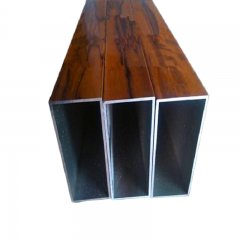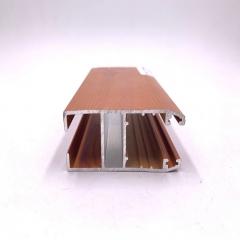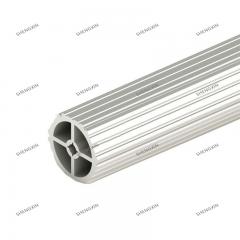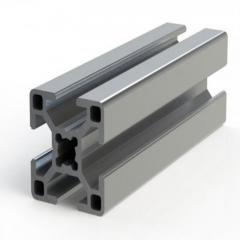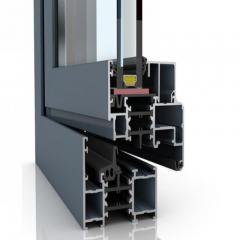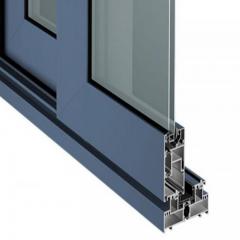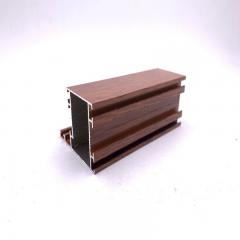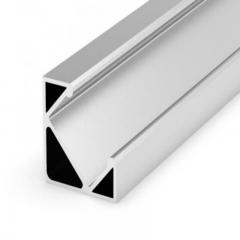
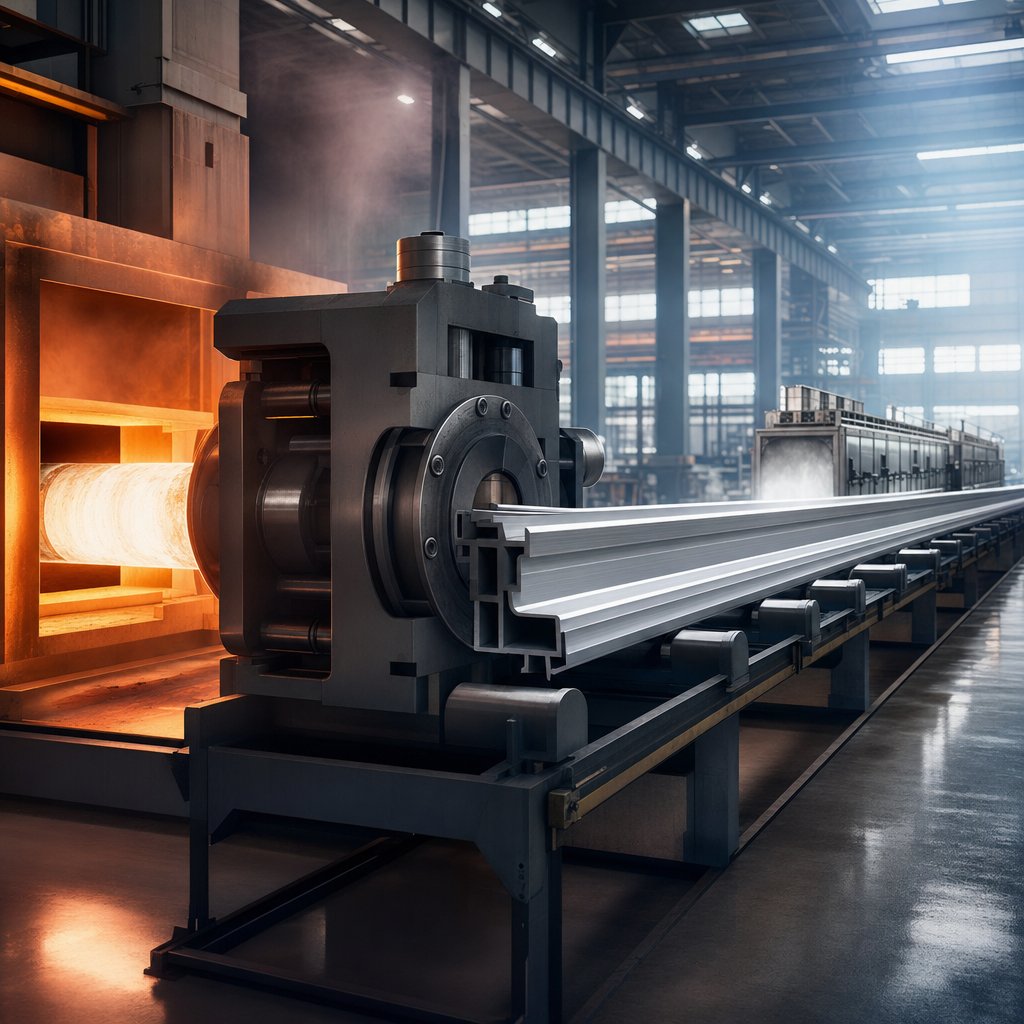
How are aluminum extrusions made? In simple terms, a solid aluminum billet is heated until it becomes workable, then a powerful ram pushes it through a shaped steel die. The metal comes out as a long profile with the same cross-section as the die opening. After that, it is cooled, straightened, cut to length, and often heat treated or finished for its final use.
Aluminum extrusion is the process of forcing heated aluminum alloy through a die to create a continuous shape with a fixed cross-section.
If you are asking what is aluminum extrusion, the short answer is that it is a shaping process. If you are asking what is extrusion more broadly, it means pushing a material through an opening so it takes that opening's shape. With aluminum extrusion, the material stays solid but becomes soft enough under heat and pressure to flow through the die.
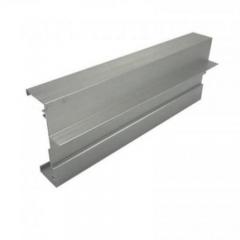
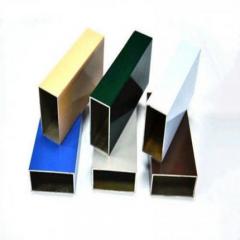
That also answers common beginner questions like what are aluminum extrusions and what is extruded aluminum. These are long aluminum parts with a consistent cross-section, such as channels, angles, bars, and tubes. If you have wondered what does extruded aluminum mean, it simply means the aluminum was pressure-formed through a die rather than made as a final shape in one cast piece.
The basic sequence is easy to picture, but final quality depends on details most short overviews skip.
The process may sound straightforward at first glance. In practice, the billet alloy, die geometry, and press setup can change the result dramatically, even before any metal starts moving.
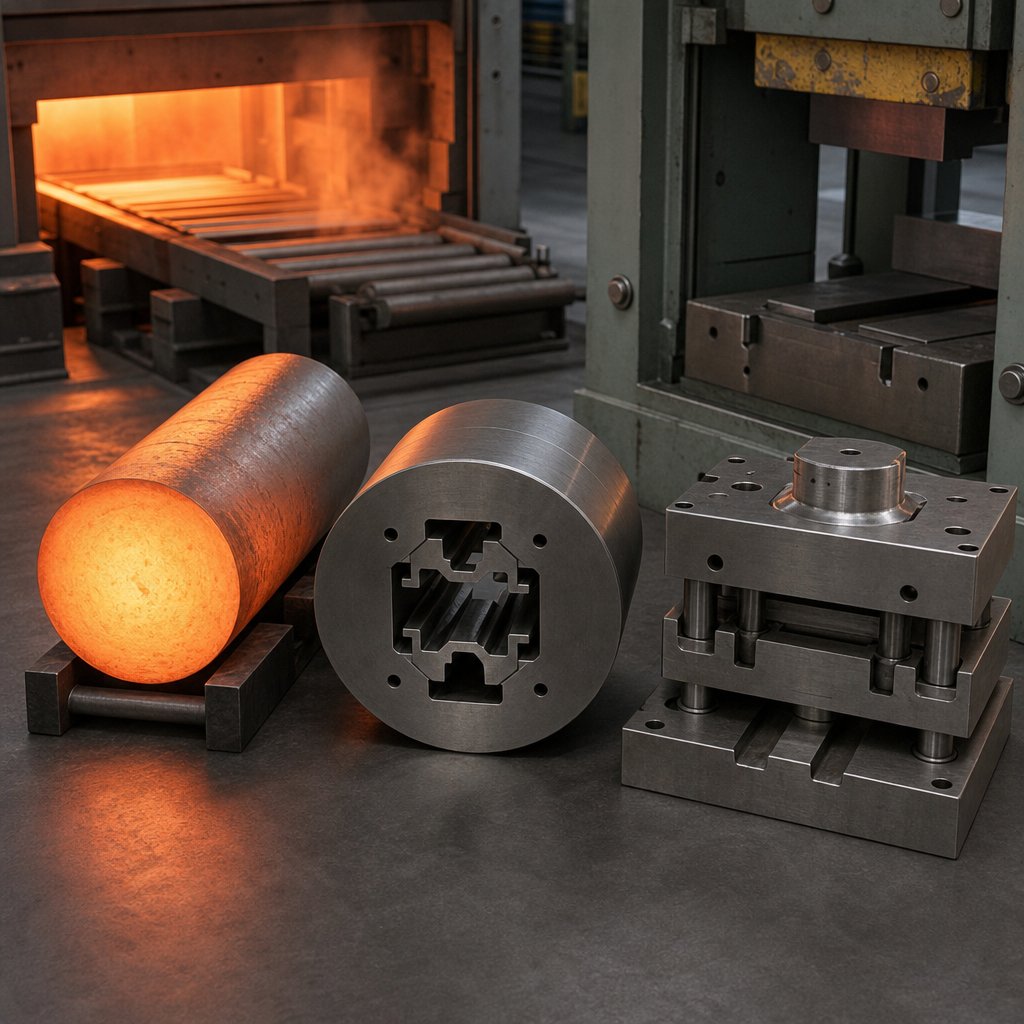
Before an aluminum extrusion press produces a usable shape, the real manufacturing work has already started. The same press can turn out a clean, accurate part or a troublesome one depending on four early decisions: billet condition, alloy choice, die geometry, and setup quality. That is why manufacturability begins long before the ram moves.
Manufacturers use billets because they provide a uniform, semi-finished starting form that loads efficiently into the press container. In extrusion, billets are usually solid cylindrical logs. They are preheated so the metal becomes plastic enough to flow while remaining solid. Typical billet preheat ranges are about 700-930°F depending on the alloy, and die loads can reach up to 15,000 tons, as noted in the Gemini Group die guide.
Even when two parts look similar on paper, alloy chemistry can change how smoothly the metal moves and how forgiving the process will be. That matters for strength, dimensional control, and surface appearance.
An aluminum extrusion die is a steel tool with a precisely machined opening. As aluminum is forced through it, the metal exits with that same cross-section, creating the final aluminum extrusion profile. In simple terms, the die is the profile's blueprint in steel.
Good aluminum extrusion dies are not just about shape. They also have to control flow. Designers adjust features such as bearing length so thick and thin areas leave the aluminum extrusion die at a more even speed. That balance helps prevent twist, bow, and dimensional drift in the finished profile.
A stable run depends on more than switching on an aluminum extrusion machine. The full aluminum extrusion tooling system must be aligned, supported, and matched to the job. Support pieces such as backers, bolsters, and die rings help keep the die stack rigid, while press components like the container, stem, and dummy block help move the billet consistently through the aluminum extrusion press.
| Upfront factor | Lower complexity case | Higher complexity case | Likely finish effect |
|---|---|---|---|
| Alloy behavior | Easier-flowing alloy | Less forgiving alloy | Tighter control needed to keep the surface consistent |
| Die type | Solid die | Semi-hollow or hollow die | More complex flow paths increase quality risk |
| Die balance | Uniform exit speed | Uneven exit speed | Better balance supports cleaner dimensions and appearance |
When those choices are right, the pressing stage becomes far easier to control, and the metal can move through the die in a predictable way instead of fighting the setup.
With the billet, alloy, and die already prepared, the real action starts inside the press. In the most common setup, direct extrusion, the ram pushes the billet forward into a stationary die. That is the core of the aluminum extrusion process and the easiest way to picture the broader metal extrusion process in practice. If you have ever wondered how does aluminum extrusion work on the shop floor, it helps to follow the metal in order, from heat to pressure to guided exit.
If you compare this sequence with an extrusion diagram, the path is simple to follow even though the production control is not: heat the billet, press it, shape it, support it, and start cooling it. That is the practical story behind the extrusion of aluminium in a real plant. The sequence stays broadly the same from one supplier to another, but the exact temperatures, speeds, and pressures used during that run are where quality starts to separate.
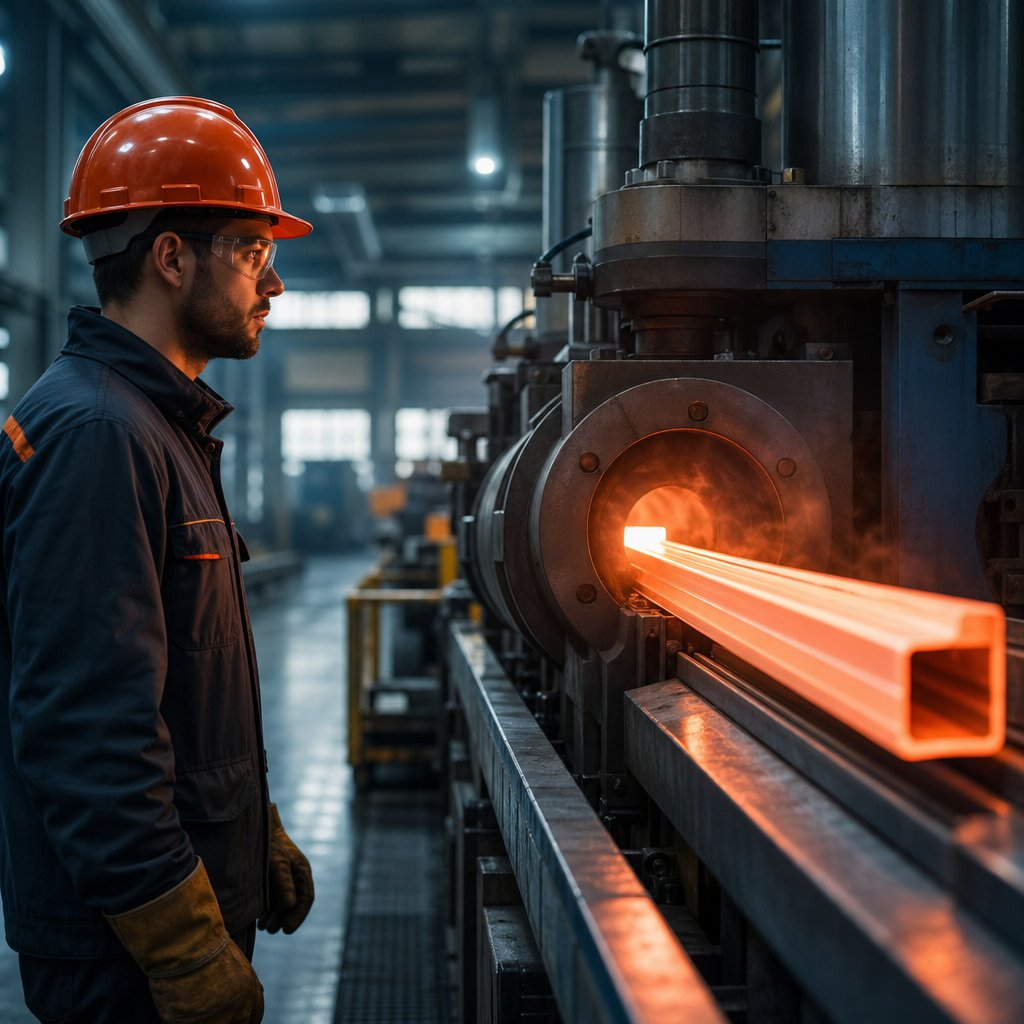
That quality gap shows up inside the extrusion press. Two suppliers can work from the same drawing and same alloy family, yet get different results because the critical variables are not just in the die shape. In real extrusion manufacturing, heat, pressure, friction, and reduction all interact inside one moving extrusion system. A profile may look simple on paper, but thin walls, asymmetry, and hollow features make the process window much narrower.
Billet temperature and die temperature create the starting conditions for metal flow. The MDPI study notes that temperature differences between billet and tooling can cause inconsistent flow and mechanical properties during hot extrusion. If the billet is too cool, the metal resists deformation and press load rises. If it is too hot, some sections can move too easily, which increases the risk of tearing, distortion, and uneven surface quality.
Ram pressure and ram speed work the same way. More speed can raise output, but faster flow also increases strain rate and frictional heating. In the cited simulations, direct hot extrusion starting at 450 C with a ram speed of 5 mm/s still reached local temperatures of about 551 C in a more imbalanced die. The same study also showed that small bearing changes could create major exit velocity differences, which is why hotter and faster are not automatically better in metal extrusion.
Lubrication matters too, though it has to be controlled carefully. Friction affects heat generation, flow resistance, and tool loading, and the MDPI model used a friction coefficient of 0.30 to represent typical hot-extrusion contact conditions. Clean handling matters just as much. This defect review links excess oil, moisture, and dirty tooling with defects such as bubbles, press-in, and poor surface finish.
Extrusion ratio is the amount of cross-sectional reduction from the starting billet to the final profile. A higher ratio means the aluminum must deform more before it exits the die. That can help create smaller or more intricate shapes, but it also raises forming difficulty and makes balanced flow more important. The MDPI paper notes that industrial extrusion pressure changes with both extrusion ratio and profile complexity, so thin walls and complex hollows usually need tighter process control.
| Variable | If pushed too far | Likely effect on speed | Likely effect on surface and tolerances | Manufacturability impact |
|---|---|---|---|---|
| Billet temperature | Metal softens unevenly | Flow may speed up locally | Higher risk of tearing, distortion, and inconsistent properties | Reduces stability for thin or complex profiles |
| Die temperature | Flow resistance changes across the die | Can lower resistance at the exit | More variable finish and dimensions | Affects die life and balance in the extrusion system |
| Ram pressure | Load concentrates near difficult features | Helps force flow through resistant areas | Too much local stress can worsen defects or tool wear | Press capacity becomes a practical limit |
| Ram speed | Heat and exit velocity rise | Higher throughput | Greater risk of cracks, waves, and dimensional drift | Often reduced first when control slips |
| Lubrication and cleanliness | Too little raises friction, too much or dirty lubricant adds defect risk | Flow becomes less predictable | Can damage surface integrity | Directly affects repeatability in extrusion processing |
| Extrusion ratio | Deformation demand increases | Usually calls for steadier, not faster, running | Complex shapes become harder to hold in tolerance | Narrows the safe process window |
Experienced operators do not chase one number in isolation. They balance the full set of variables so productivity does not destroy profile integrity. That balance looks different again once the process route itself changes, especially when friction and material flow no longer behave the same way.
Process settings matter, but the route itself matters just as much. Among the main types of aluminum extrusion, the biggest practical split is direct versus indirect extrusion, by hot versus cold operation. These choices change how the metal flows, how much friction builds up, what tooling is required, and which profile geometries are realistic for production.
In direct extrusion, the ram pushes the billet toward a stationary die. The billet slides against the container wall, so friction and heat increase during the run. In indirect extrusion, the billet stays still while the die moves against it, which greatly reduces container-wall friction. The press comparison describes indirect extrusion as more stable in force and temperature, which can improve consistency.
That does not make indirect extrusion the default choice. Direct extrusion is still the more common option because it is flexible and works across a wider range of sections. It is often better for mixed production and many larger or more varied profiles. Indirect extrusion needs a hollow stem, tighter alignment, and cleaner billet surfaces, and its equipment limits can restrict cross-sectional size.
Most extruded aluminum shapes used in construction, framing, transportation, and general industry are hot extruded. A Diversified Metals overview places hot extrusion for aluminum around 375 to 500 C, which makes the alloy soft enough to form complex extrusion shapes without melting it.
By contrast, aluminium cold extrusion happens at or near room temperature. It is faster in some cases and may require less finishing, but it depends on high ductility and usually fits narrower applications. For long architectural profiles or complicated hollows, hot extrusion remains the practical choice.
| Method | How material flows | Best fit | Main advantages | Main limitations |
|---|---|---|---|---|
| Direct extrusion | Billet moves toward a fixed die | Wide profile mix, including many standard and complex sections | Versatile, common, good for many types of extruded aluminum | Higher friction, more heat variation, more scrap at the billet end |
| Indirect extrusion | Die moves against a stationary billet | Smaller sections needing stable flow and tighter consistency | Lower friction, steadier temperature, more uniform properties | More demanding setup, cleaner billet needed, cross-section limits |
| Hot extrusion | Heated billet flows while still solid | Most commercial aluminum profiles | Supports very complex shapes and long lengths | Needs careful cooling and straightening after exit |
| Cold extrusion | Room-temperature deformation | Narrower, high-ductility applications | Can be faster and leave a cleaner surface | Less suitable for large or highly complex profiles |
Profile geometry sharpens those tradeoffs. A solid bar is usually simpler than a tube. Hollow and semihollow sections need more sophisticated tooling and tighter flow control, so not every aluminum extruded shape is equally suited to every method. By the time the profile reaches the runout table, the chosen route has already influenced its temperature, straightness risk, and surface condition.
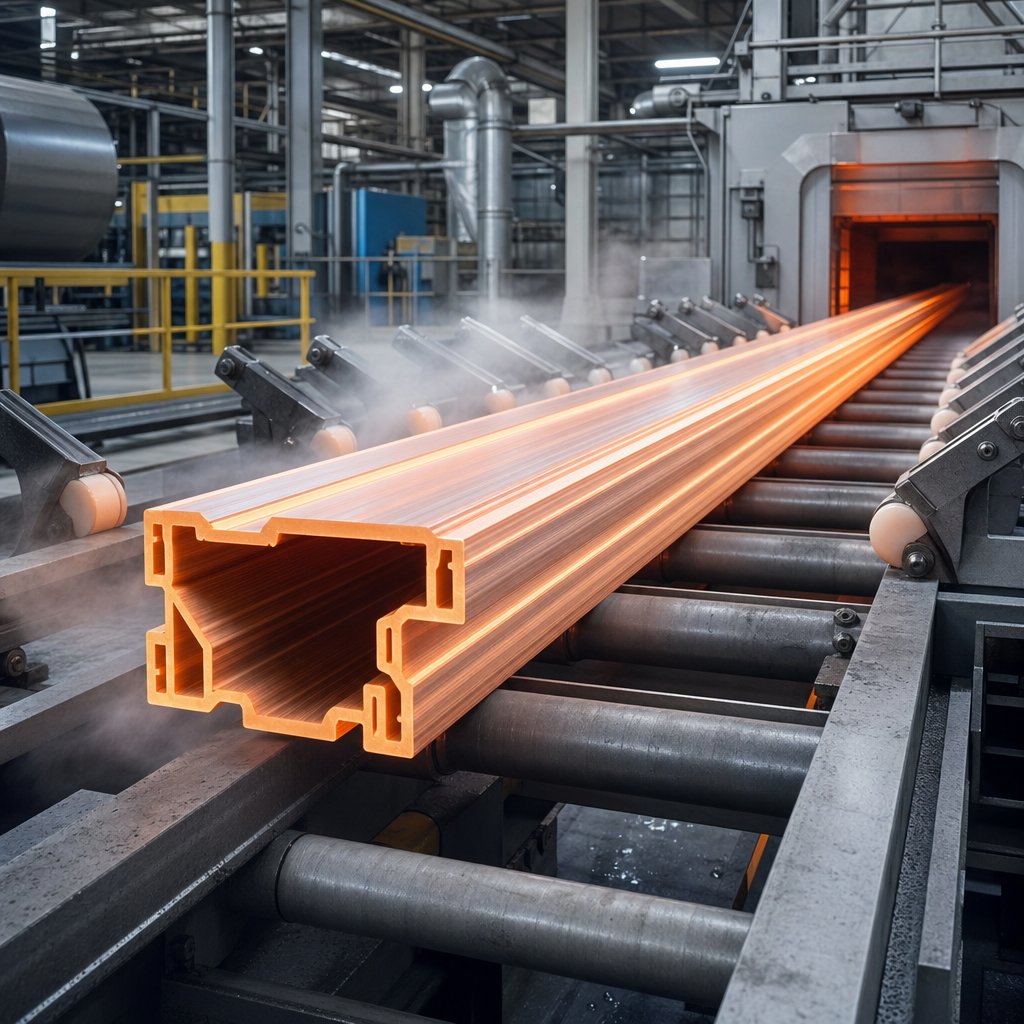
Temperature, friction, and method have already shaped the profile by the time it reaches the runout table. Still, this is where many quality problems either get prevented or locked in. In aluminum extrusion manufacturing, the fresh profile is hot, soft, and easy to damage. Good downstream handling turns that just-formed shape into a straight, stable product. Poor handling can leave twist, bow, surface marks, or uneven properties behind.
This checkpoint decides whether the profile is ready for fabrication or needs correction. A part can look fine at a glance and still miss the mark if its shape shifted during cooling or if the temper is not right. In a well-run extrusion manufacturing process, inspection happens before the material disappears into packing, machining, or finishing.
The profile, then, is not truly finished when it leaves the press. The post-press stages decide whether the shape stays accurate and whether the alloy reaches the properties the design expects. That is also where alloy family and profile geometry start to matter even more, because solid, semi-hollow, and hollow sections do not all respond the same way to cooling, stretching, and aging.
The way a profile cools, straightens, and holds tolerance is tied to the alloy as much as the press settings. Extruded aluminum is not one generic material. Its chemistry affects how easily it flows through the die, how strong it becomes later, and how clean the surface looks when the run is finished. That is why two parts with the same outline can behave very differently in production.
In everyday aluminum profile extrusion work, the 6xxx series does most of the heavy lifting. These alloys use magnesium and silicon, giving them a practical mix of good extrudability, corrosion resistance, and medium strength. Within that family, 6063 is widely used for architectural sections because it extrudes well and responds well to anodizing. 6061 is a common step up when the job needs more structural strength, good weldability, and good coating response. 6005 is often chosen when strength needs to rise beyond 6063 without moving into a much harder-to-run alloy.
| Alloy family | Plain-language traits | Typical profile needs |
|---|---|---|
| 6xxx, such as 6063, 6061, 6005 | Best overall balance of extrudability, corrosion resistance, finish quality, and usable strength | Construction, framing, rails, channels, and many extruded aluminum profiles |
| 5xxx | Very good corrosion resistance, especially in harsher environments | Marine and chemical service where durability matters more than very intricate geometry |
| 7xxx, such as 7075 | Very high strength, but harder to extrude and less forgiving | Highly stressed structural parts, often with simpler sections |
If appearance matters, 6063 is often the easier answer. If load-bearing performance matters more, 6061 or 6005 may be a better fit. Move into 7xxx alloys and strength rises sharply, but the process becomes more difficult and complex shapes become less forgiving. For corrosive service, 5xxx alloys are valued for their resistance to environmental attack.
Rule of thumb: easier-to-extrude alloys support more complex shapes and cleaner finishes, while higher-performance alloys usually demand tighter control and simpler geometry.
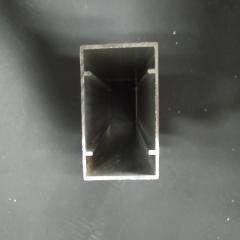
Shape adds another layer. Solid forms, such as bars, angles, and channels, are usually the most straightforward. Semi-hollow profiles include partially enclosed features that make metal flow harder to balance. Hollow sections, including an extruded aluminum tube or a larger aluminum extrusion tube, need more sophisticated die support because the metal must form around internal voids. That is why aluminum extrusion profiles are really a pairing of alloy and geometry, not just shape alone.
In real applications, construction and architectural systems often prioritize finish and corrosion resistance. Transportation and industrial components may lean more heavily on strength, fatigue behavior, or weldability. Those choices keep echoing after the press run too, especially when the profile moves into machining, joining, anodizing, or coating.
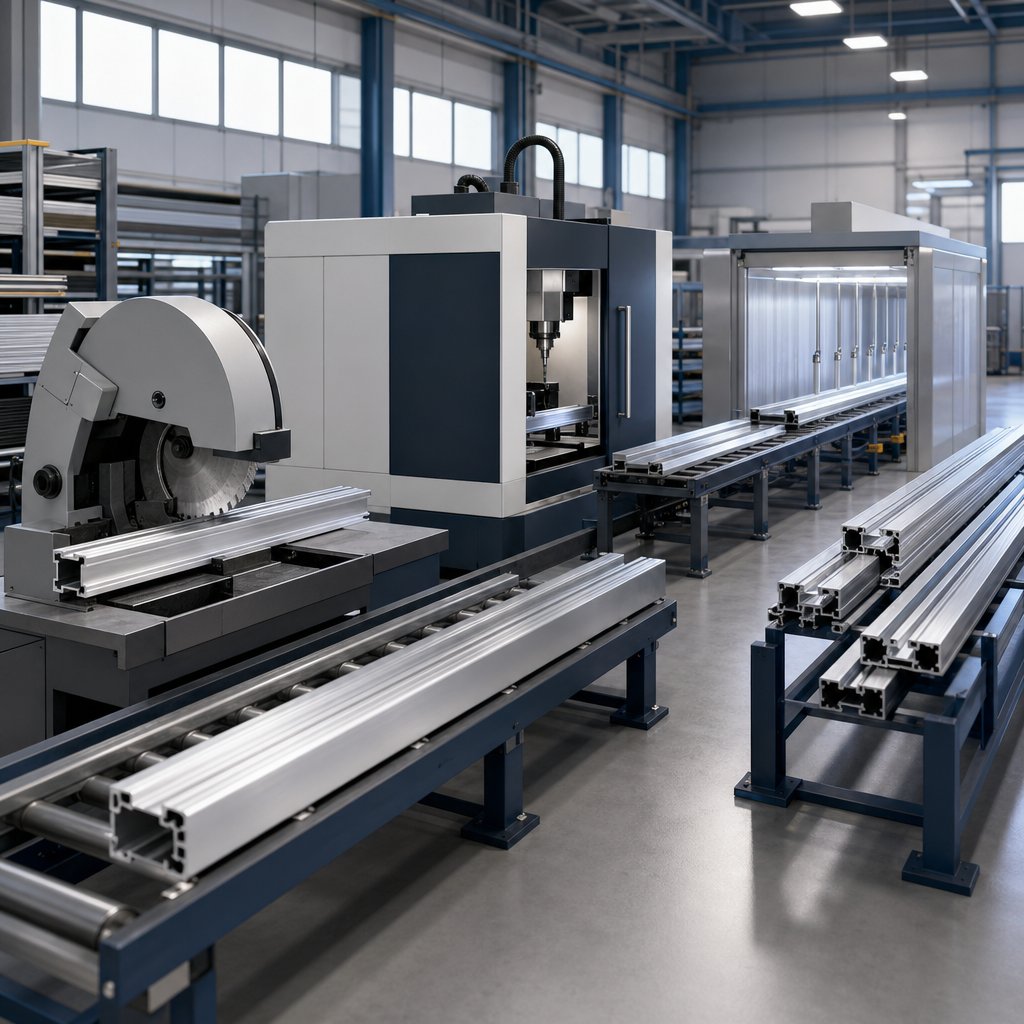
A straight, aged profile is still not a finished product. In real manufacturing, the useful features often come later. This is where aluminum extrusion fabrication turns a long extruded shape into a part that can be assembled, installed, or shipped with confidence.
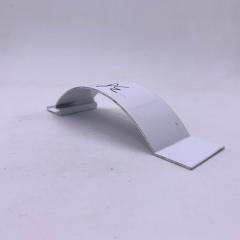
For readers wondering how to cut aluminum extrusion, shops typically use cold saws, CNC saws, or flying saws, as outlined in this fabrication guide. After cutting, aluminum extrusion machining adds the details a die usually cannot produce on its own. A machined aluminum extrusion may need drilled holes, tapped threads, milled pockets, slots, or contoured faces so it can accept hardware, fasteners, and mating parts.
Surface treatment changes both appearance and service performance. The Can Art finish guide describes anodizing as an electrochemical process that converts the aluminum surface into a stable anodic oxide layer. That makes it especially useful where corrosion resistance, UV stability, and abrasion resistance matter. Powder coating uses electrostatic spray deposition to apply a dry powder, then builds a thicker decorative coating with broad color flexibility.
When cutting, CNC work, finishing, and inspection are coordinated in one workflow, production is easier to manage and cosmetic damage is easier to control. That is one reason many buyers value aluminum extrusion fabrication partners with broad downstream capability. As a practical example, Shengxin Aluminium presents an in-house setup that combines extrusion, precision CNC machining, anodizing, and powder coating in one manufacturing chain.
Those post-press choices influence more than appearance. They also affect lead time, fit, and sourcing risk, especially when a profile looks simple at the die stage but becomes demanding once machining and finishing requirements are added.
A profile can leave machining and coating in good condition and still be a risky buy if the original design is difficult to extrude consistently. That is why design review and supplier selection belong together. For readers still asking what is an aluminum extrusion, it is a continuous aluminum profile formed through a die, then brought to final condition through cooling, straightening, cutting, and finishing. If your team starts with a broader question like what are aluminum extrusions used for, the answer includes framing, construction, transportation, electronics, and general industrial parts.
Easier profiles usually have more uniform wall thickness, smoother transitions, and less demanding hollow geometry. Harder ones combine thin walls, sharp corner detail, deep cavities, tight tolerances, cosmetic finishing requirements, and downstream machining. Alloy choice also changes the difficulty. A design that runs well in one alloy may become less forgiving in another, especially when strength and surface appearance both matter.
The cheapest quote is not always the safest one. If you want to understand how aluminum extrusion is made for your exact part, look past the press and ask who controls machining, finishing, inspection, and delivery. That matters in many aluminum extrusion applications, where fit, coating quality, and repeatability matter as much as the base shape. One practical example is Shengxin Aluminium, which shows an integrated setup with 35 extrusion presses, CNC machining, anodizing, and powder coating. For buyers, that kind of visibility answers the more useful version of how is aluminum extrusion made: how aluminum extrusions are made, checked, and finished as a complete manufacturing chain.
From heated billet to die, then cooling, stretching, cutting, aging, machining, finishing, and inspection, a reliable supplier should explain the full route in plain language and back it up with samples, standards, and process control.
The usual sequence starts with selecting the alloy and preparing a cylindrical billet. The billet and die are heated, the billet is loaded into the press, and a ram pushes the softened aluminum through the die opening to form a continuous profile. After that, the profile is guided along the runout table, cooled or quenched, stretched to improve straightness, cut into usable lengths, aged if the alloy needs heat treatment, and then inspected or sent to machining and finishing.
Extrusion works by making aluminum soft enough to flow under very high pressure while still keeping it in a solid state. That gives manufacturers better control over cross-section shape, surface condition, and straightness than a liquid process would. If the metal were fully melted, the process would shift into casting, which uses different tooling and produces parts in a different way.
The profile is not finished when it exits the press. It is still hot and can bend, twist, or pick up marks if handling is poor. Manufacturers support it on the runout table, cool it at a controlled rate, stretch it to reduce distortion, cut it to length, and age it when required to build final mechanical properties. A final inspection then checks straightness, surface appearance, and dimensional accuracy before fabrication or shipping.
Many commercial extrusions use 6xxx series alloys because they offer a useful balance of extrudability, corrosion resistance, finish quality, and strength. Common shapes include bars, channels, angles, rails, and tubes, along with more complex hollow and semi-hollow profiles. As shapes become thinner or more enclosed, die balance and process control become more important to keep the profile stable and clean.
Ask about press capacity, alloy experience, wall-thickness limits, die support, quality standards, and whether the supplier can review your design before tooling starts. It is also smart to ask if machining, anodizing, powder coating, and inspection are handled in-house, because those steps often affect lead time and finish quality as much as the press itself. A vertically integrated manufacturer such as Shengxin Aluminium is a useful example of how extrusion, CNC machining, and surface finishing can be managed in one production chain.



 Servicio en línea
 0086 136 3563 2360
 sales@sxalu.com
 +86 136 3563 2360
 español
 English
 français
 Deutsch
 русский
 português
 العربية
 ไทย
ไทย Việt
Việt Українська