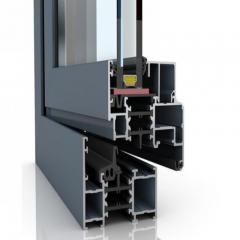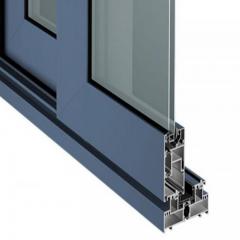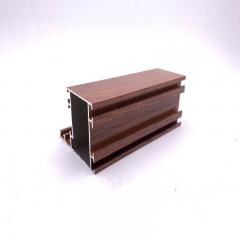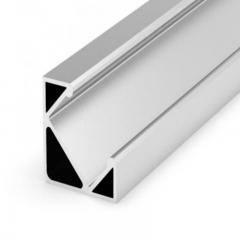
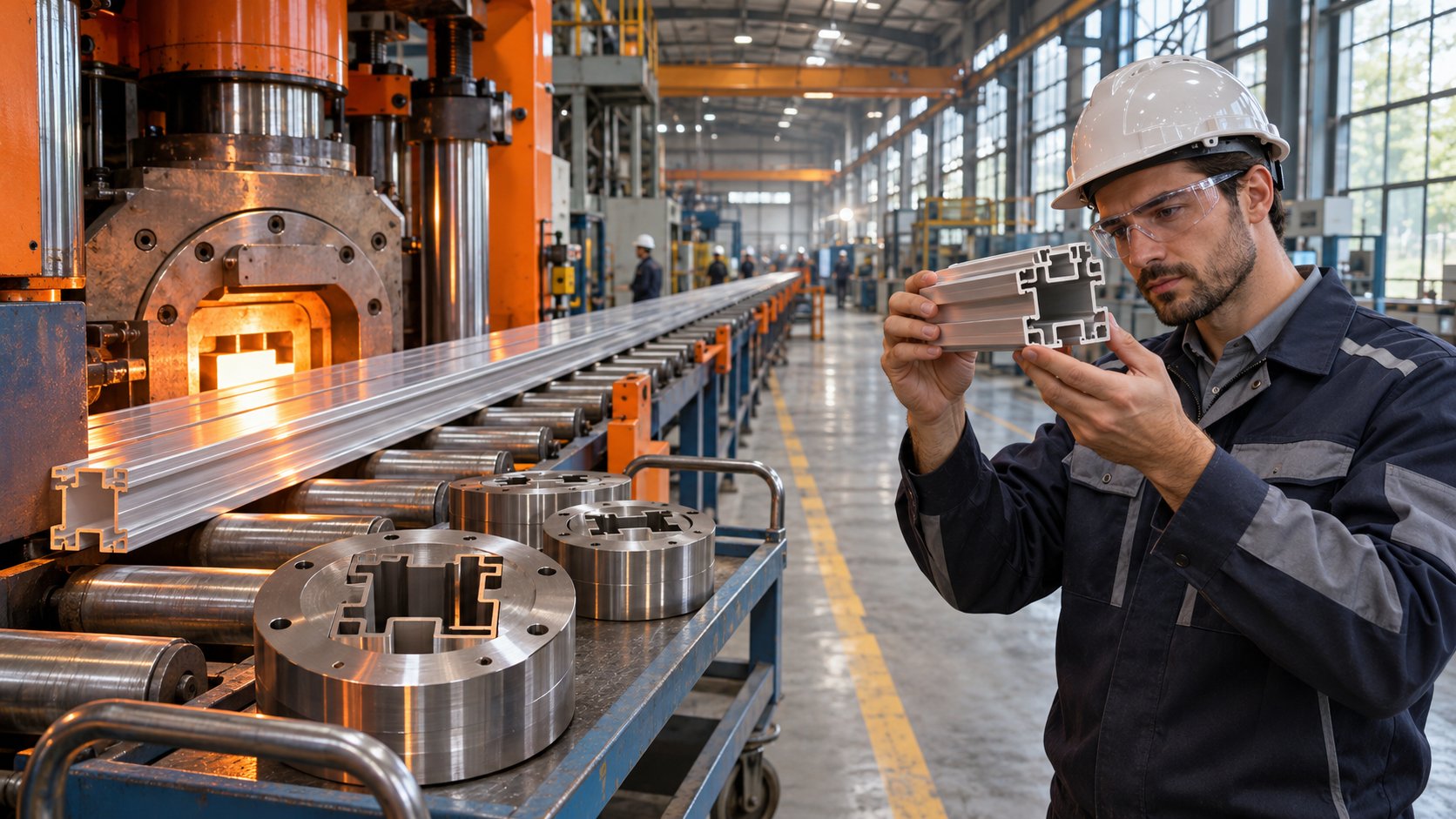
To choose an aluminum extrusion manufacturer, start by writing down the part, before you look at any supplier list. The alloy, size, tolerances, finish and volume decide which manufacturers can make the part at all, so a clear spec cuts a long search down to a short one.
Imagine sending a rough sketch to ten extruders and getting three replies, each quoting a different alloy and length. That spread usually means the request left too much open. Profile Precision Extrusions makes the point in its extrusion design guide that circle size and alloy set the first limits on what a shop can produce. The sections below expand that idea into a full spec you can complete before you search.
Most custom profiles use 6000-series alloys. A 6061 vs. 6063 vs. 6005 comparison from Metra describes 6063 as the choice for fine detail and anodized or painted surfaces, 6061 for heavy structural loads and machining, and 6005A as a middle option with close to 6061 strength and better extrudability. Record the temper as well, such as T5 or T6, because it sets the final mechanical properties. If your part is window trim or a lighting track, a 6063 aluminum extrusion manufacturer is a natural place to start. If you specify a 2000- or 7000-series hard alloy, expect far fewer suppliers. Alloys such as 2024 and 7075 need specialized processing and heat treatment, and many extruders don't offer it.
Next, record the profile envelope:
These numbers rule suppliers out because of how the aluminum extrusion manufacturing process works. A heated billet is pushed through a steel die, and the profile is then quenched, aged and cut to length. The press and die have to accommodate the CCD. Thin walls need a die that keeps metal flow balanced, and hollow profiles need more complex dies. Quenching also varies by alloy: 6063 can be air-quenched on the runout table, while 6061 often needs a water quench that can distort the profile without careful control. As one example of a published limit, PPE's guidance covers profiles that fit within roughly a 3.5 to 4.0 inch circle, with a 0.025 in. minimum wall for 6063. A buyer looking for a lightweight aluminum extrusion manufacturer for thin-walled parts can screen shops quickly against published figures like these. PPE notes that its figures are design guidelines, so final feasibility is still confirmed on the actual drawing.
Name the tolerance standard that applies to your part:
Then mark only the critical-to-quality dimensions as tighter than standard. PPE advises picking the one or two dimensions that control fit or function. Putting tight tolerances on every dimension raises cost and reduces the number of shops that will quote. Specify the finish (mill, anodized or powder coated) and mark which surfaces are cosmetic. List the secondary operations as well, such as CNC machining, punching, thermal break or assembly. If a feature will be machined after extrusion, say so on the drawing, so the extruder isn't asked to hold that tolerance in the as-extruded profile.
State your annual volume, the quantity per release, and whether the job is a prototype or a production program. These figures decide whether a supplier's minimum order quantity (MOQ) works for you and how the die cost spreads across your parts. ZigiTech's extrusion cost guide points out that the same die cost makes up a large share of a short program and a much smaller share of a long repeat program.
You can copy this checklist into your internal spec sheet:
Step 3 checks the CCD and wall figures against each supplier's press capability. The spec also shows how many separate processes the part needs, from die work through finishing. That is the first thing to consider when deciding whether to make the part yourself, outsource it, or use a sourcing agent.
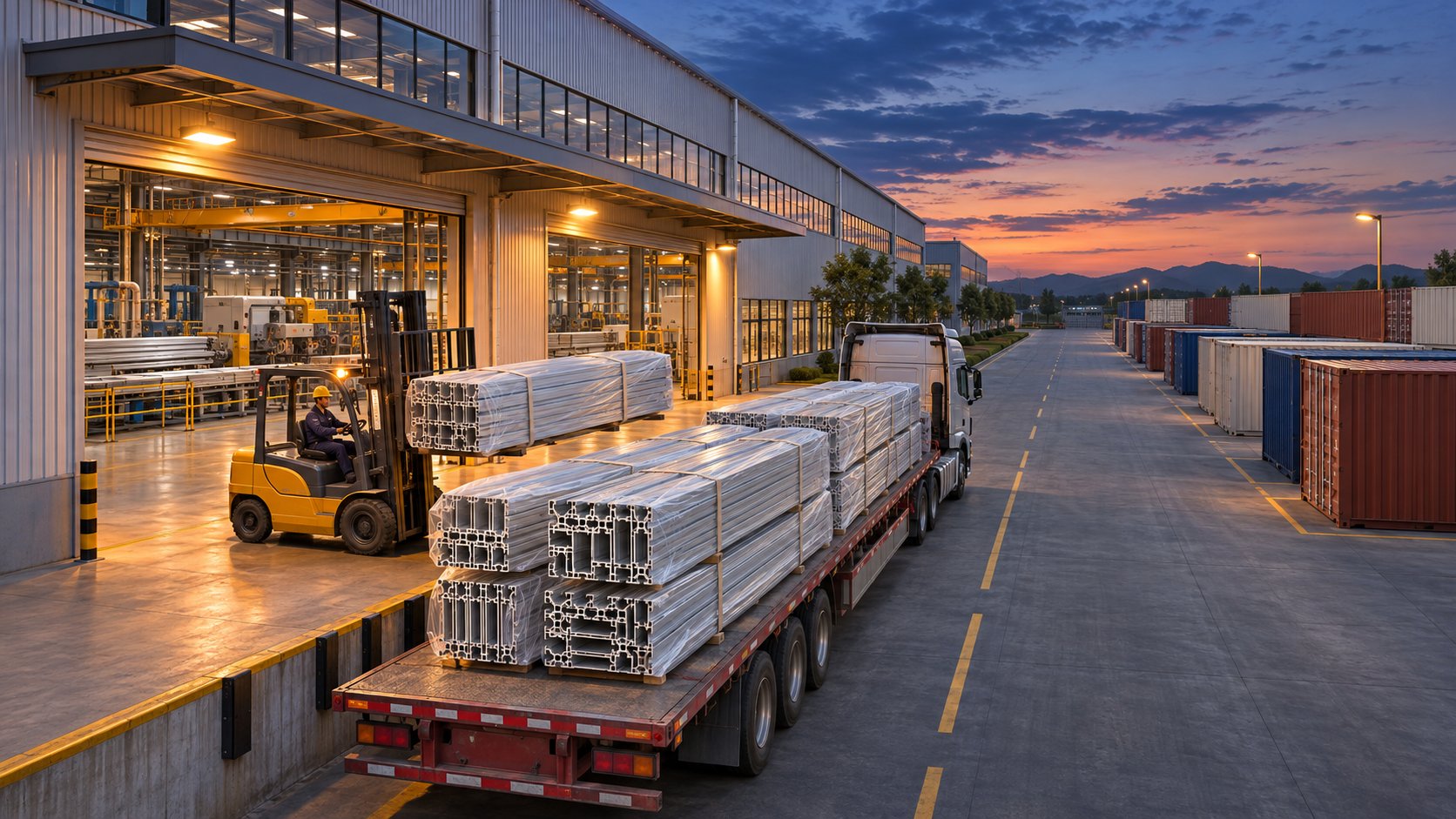
Your spec sheet tells you what the part needs. It doesn't tell you who should make it. If you search for aluminum extrusion manufacturers before you settle that, you may end up comparing a local extruder, an overseas mill and a trading company as if they sold the same service. Each one carries different costs and risks. The sourcing model you pick decides who owns the die, who answers for defects and what the part costs once it reaches your dock.
As volumes grow, some OEMs start pricing an aluminium extrusion machine. The press turns out to be the smaller part of the job. Foshan Sailixin, a press maker, explains in its press installation guide that a working line also needs billet heating, a loader, a puller, a cooling bed, a stretcher, saws and aging ovens. All of that equipment has to keep pace with the press, or the press can't reach its rated output. The press also needs a foundation designed for heavy dynamic loads, plus electrical power, cooling water, compressed air and a hydraulic system. Beyond the line itself, you would also need:
An outsourced profile manufacturer already carries those costs and spreads them across many customers. Shengxin Aluminium is one example of this model. It offers outsourced custom aluminum extrusion that runs drawing review, alloy selection, die development, extrusion, machining and finishing in one workflow. Shengxin sells profiles, not extrusion presses, so it is an alternative to buying a line, not a place to buy one. The table below applies the same criteria to every option.
| Sourcing model | Capital outlay | Process control | Lead time | Tooling responsibility | Quality ownership |
|---|---|---|---|---|---|
| Outsourced integrated custom extruder (example: Shengxin Aluminium) | No press investment. You pay a die charge per profile. | The supplier controls the process from die through finish. You control the spec and approvals. | Fewer handoffs between die work, extrusion, machining and finishing. | The die is developed inside the workflow. Ownership and transfer terms still need to be written down (see Step 6). | One supplier answers for the finished part. MOQ, hard-alloy availability and the ±0.05 mm tolerance (selected profiles only) all need project review. |
| Outsourced extrude-only supplier | No press investment. You pay a die charge plus separate charges from finishers and machinists. | The supplier controls extrusion. You or your subcontractors control everything after it. | Each added vendor adds transit and queue time. | The extruder holds the die. Terms need to be in writing. | Split. A finish defect can turn into a dispute between the extruder and the finisher. |
| Sourcing agent | No press investment. The agent's margin is added to the factory price. | Indirect. The agent relays specs and inspection results to you. | An extra communication layer can slow down changes. | It is often unclear which factory holds the die, and in whose name. | The agent may run inspections, but you are one step removed from the factory's quality system. |
| In-house press | Highest: press line, foundation, utilities, dies, ovens, finishing and staff. | Full control of the process and the schedule. | You set it yourself, but only after a long build and commissioning period. | You buy, maintain and store every die. | Entirely yours, including scrap and rework. |
In-house extrusion usually makes sense only when your own volume can keep a press line busy and your company is ready to run a metal-forming plant. For most custom profiles, one of the outsourced models is the better fit.
A unit price doesn't show what location adds to cost and risk. Compare suppliers on these points:
A sourcing agent sits between you and an overseas factory. A good agent screens factories, handles language barriers and may run inspections for you. The agent's margin is built into your price, though, and you see the factory only through the agent's reports. Ask which factory will make your part and whether you can audit it yourself. Duty rates change often, so confirm the current rates and your HTS classification with a licensed customs broker before you compare quotes.
A search for "where to buy aluminium" mostly turns up metal service centers and online stock shops. They sell standard angles, tubes, channels and bars cut to length. That works if your bracket can be made from a catalog shape. A custom profile needs its own die, so you need a custom aluminum extrusion manufacturer that designs and runs dies, not a distributor.
A search for an "aluminum extrusion manufacturer near me" is still useful. A nearby plant is easy to audit in person, and short runs or urgent releases benefit from truck delivery. A search for "aluminum extrusion manufacturer USA" also takes import duties out of the comparison for US buyers. Distance should only break ties among suppliers that pass your Step 1 spec. A plant an hour away is no use if its presses can't handle your circle size or wall thickness, and a brochure won't tell you that. You find out by looking at the press list.
When a supplier tells you "we can run that," what is the claim based on? It should be based on the press list. If you compare the CCD, wall, weight and length from your Step 1 spec against each supplier's presses, you can rule shops in or out before anyone spends a week on a quote.
Two press numbers matter most. Tonnage is the force available to push the billet through the die. Container diameter is the size of the billet the press can hold, and it limits how wide a profile can be. Profile Precision Extrusions treats circle size as a limit on what a shop can make, and the press is where that limit comes from. The die has to fit the press, and the profile has to fit inside the die.
One press manufacturer's tonnage guide gives approximate pairings. An 800-ton press handles a maximum circumscribed circle of about 90 mm, a 1,250-ton press about 120 mm, and a 1,800-ton press about 160 mm. PPE's envelope of 3.5 to 4.0 inches, or about 89 to 102 mm, falls at the small-press end of that range. These figures are rules of thumb. Each plant's dies and containers set its actual limit.
The same guide describes a plant that tried to run a 160 mm multi-cavity hollow profile on a 1,250-ton press. The die was too large for the press, and the profile had to be redesigned. Large, heavy sections belong with large aluminum extrusion manufacturers that run big presses. Small, thin-walled parts such as LED frames, trim and small heat sinks often run better on presses of 500 to 800 tons. Alloy and geometry raise the force a profile needs. The guide estimates that 6005 and 6082 need 20 to 40% more extrusion force than 6063, and that a hollow needs 15 to 50% more than a solid profile of the same size.
Each of these numbers can eliminate suppliers:
The number of presses matters as much as their size. If only one press in a plant fits your profile, a breakdown or a booked schedule stops your order. Several presses in your range give the supplier a backup, but only if the same die fits the other press.
Hollow and complex shapes add a die requirement. Researchers writing in Metals estimate that about 90% of hollow aluminum profiles are made with porthole dies. In a porthole die, bridges hold a mandrel that splits the metal into streams, and the streams weld back together in a welding chamber. Bridge design affects the quality of that weld seam. A complex aluminum extrusion manufacturer should run a die shop with real experience building porthole and bridge dies.
Treat tolerance claims with the same care. A figure such as ±0.05 mm in precision aluminum extrusion manufacturing usually applies only to some profiles. Whether a shop can hold it depends on the geometry, the alloy and the wall thickness. Ask for evidence from parts similar to yours.
Use this table as an aluminum extrusion manufacturing capabilities checklist and as the agenda for your first call with each supplier.
| Criterion | Question to ask | Proof to request |
|---|---|---|
| Press list | What is the tonnage and container size of each press, and how many presses fit my profile? | An equipment list with tonnage, container diameter and the number of presses |
| Maximum CCD | What is the largest circle size you run on each press, for solids and for hollows? | Drawings or photos of current parts near that size |
| Minimum wall thickness | What is the thinnest wall you have produced in my alloy and temper? | A comparable profile drawing or a production sample |
| Maximum length | What is the longest piece your runout table, ovens and finishing lines can handle? | Written length limits for each process step |
| Tolerance capability | Which tolerances have you held on profiles similar to mine? | Sample inspection reports with dimensional data |
| Measuring equipment | Do you use CMMs, profile projectors and gauges, and are they calibrated? | An equipment list and current calibration certificates |
| Capacity utilization | How heavily loaded are the presses that fit my profile? | The current loading and the lead time that loading supports |
Aluphant's supplier audit guide notes that suppliers who send sample inspection reports with photos and dimensional charts tend to show stronger quality awareness. The same guide lists missing calibration certificates for measuring tools as a warning sign.
A supplier whose press range does not cover your profile is out, whatever its price.
A press that fits your profile only covers the extrusion itself. Before the part reaches you, the die, the finish and the machining may each pass through other companies. Every handoff adds lead time and another party that can be blamed when a defect appears.
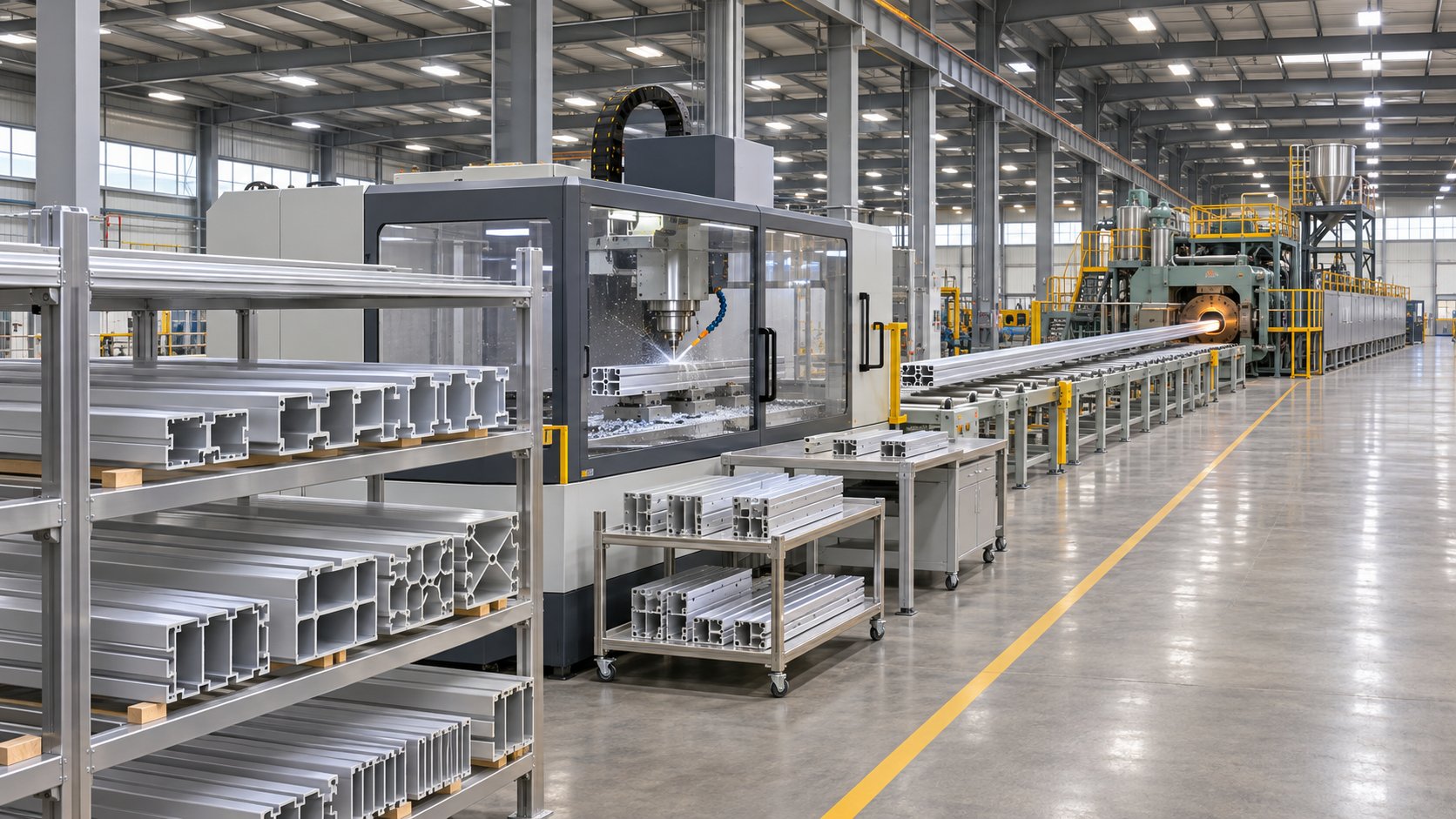
Suppose a batch of anodized profiles arrives with scratches on a cosmetic face. The extruder says the parts left its plant clean. The anodizer says the scratches were already there when the parts arrived. When the work is split across companies, you can spend weeks working out who caused a defect before anyone agrees to fix it. A map of which processes a supplier runs itself, and which it sends out, shows you where disputes like this can start.
In aluminum extrusion manufacturing, the press is only one stop. For each operation your part needs, find out whether the supplier does it in-house: the die shop, anodizing, powder coating, CNC machining, thermal break, fabrication, assembly and packaging. Each step that leaves the plant adds:
Not every outsourced step carries the same risk. Outsourced packaging matters little on a structural bracket. Outsourced anodizing matters a lot on a consumer part with a visible face. The order of operations matters too. Clinalu's enclosure design guide notes that machining before anodizing gives finished edges, while machining after anodizing leaves bare aluminum exposed. If two different companies do those steps, someone has to control the sequence.
Many supplier websites advertise aluminum extrusion turnkey manufacturing. Some mean every step happens in one plant. Others mean the supplier coordinates a chain of outside vendors. Either model can work, but you need to know which one you are buying. Ask each supplier for:
Deltek's supplier audit guide recommends the same methods: inspect the facilities, review documentation and records, and interview key personnel. It also lists inspection and nonconformance records among the documents an audit should check. Record each supplier's answers in a table like this one:
| Process | In-house or outsourced | Risk if outsourced | Proof to request |
|---|---|---|---|
| Die shop | In-house die shop, or the name of the outside die maker | Slower die corrections, and one more company between you and your tooling | Live view of the die shop and records of recent die trials |
| Anodizing | In-house line, or the name and location of the anodizer | Transit damage to cosmetic faces, color variation, disputes over where a defect began | Live view of the line, samples finished on it, anodize thickness records |
| Powder coating | In-house line, or the named coater | Handling marks, extra queue time, disputes over coating thickness | Coating thickness and adhesion test records from recent lots |
| CNC machining | In-house machining centers, or the named machine shop | Datums that don't match the extrusion drawing, machining done in the wrong order relative to finishing | Machine list and an inspection report on a machined part similar to yours |
| Thermal break | In-house assembly line, or the named processor | Extra transit, and assembly quality checked by a company you never audit | Test records for assembled thermal-break profiles |
| Fabrication and assembly | In-house, or the named vendors | Fit problems that each party blames on the other | Assembly fixtures or drawings and a sample assembled part |
| Packaging | Packed at the producing plant, or repacked elsewhere | Repeated handling, transit damage, lost lot labels and traceability | Packaging photos and a sample label showing the lot number |
Shengxin Aluminium is one example of a supplier that runs these steps as a single workflow. Its custom aluminum extrusion services take a project through this sequence:
Shengxin lists electronic enclosure profiles among its applications, along with automation equipment, machine frames, heat sinks, solar mounting systems, and window and curtain wall components. If you need an aluminum enclosure extrusions manufacturer, treat that listing as a starting point. Integration still requires confirmation of the profile design, machining and assembly scope. Clinalu advises specifying an enclosure as an assembly built around the circuit board, connectors and end closure, which makes that confirmation easier. MOQ also needs project review.
A workflow description is still the supplier's own claim. Ask Shengxin for the same operations list, live audit and nonconformance answer you would ask of any custom aluminum extrusions manufacturer. Those answers show who does each job. They do not show whether each line runs under an audited quality system, or whether the anodizing line holds a license of its own. Those questions need certificates you can check.
How can you tell whether a supplier actually runs a quality system or only shows a logo on its homepage? Certifications answer part of that question, but only if you know what each one covers. Some certify a management system across a company. Others license a single finishing line. Material and tolerance standards such as ASTM B221 or EN 755-9 don't certify anyone. They set the rules your parts are measured against, so they belong on your drawing and purchase order.
ISO 9001 is the baseline. It shows that an outside auditor has checked the supplier's quality management system, including document control, corrective action, calibration and management review. Most high quality aluminum extrusion manufacturers hold it. A supplier without it is a warning sign, but holding it doesn't set a supplier apart from the others.
Two sector standards build on ISO 9001. IATF 16949 adds automotive requirements such as defect prevention, reduction of process variation and customer-specific requirements. Require it for automotive work. AS9100 adds aerospace requirements such as configuration management, product safety and counterfeit-part prevention. If you are looking for an aerospace aluminum extrusions manufacturer, a supplier without AS9100 doesn't qualify. ISO 14001 covers environmental management, meaning how the plant controls waste, emissions and chemical handling. It says nothing about part quality.
Qualicoat and Qualanod work differently. Qualicoat licenses coating plants for organic coatings such as powder coating, and Qualanod licenses anodizing plants. Each license belongs to a specific finishing plant that has passed the association's inspections and tests. It is not a general quality badge for the company. Qualicoat keeps its licenses in a licensed coaters database that it updates regularly. A Qualicoat logo on an extruder's website may belong to the coater it subcontracts to, which is why the process map from Step 4 matters here.
Material standards set chemistry and mechanical properties. ASTM B221 covers extruded bars, rods, profiles and tubes, with chemical, tensile, yield and elongation requirements. EN 755-2 sets mechanical properties on the European side. Tolerance standards set limits on dimensions and form: ANSI H35.2 in the US, EN 755-9 in Europe and GB/T 14846 at Chinese mills. Bor USA's tolerance standards guide advises naming each standard with its edition, such as ANSI H35.2-2024 or EN 755-9:2016. It also recommends putting ASTM B221 on its own line, separate from the tolerance line.
The mill test certificate (MTC) links the metal you receive to the standard you cited. It should identify the heat or lot, report the measured chemistry and mechanical properties, and name the standard and temper they were tested against. If an MTC lists only nominal values, or cites a different standard from your purchase order, it doesn't show that your lot meets your spec.
| Standard | What it proves | When to require it | How to verify |
|---|---|---|---|
| ISO 9001 | The supplier runs an audited quality management system | For every supplier, as the baseline | Certificate number, accredited registrar, producing site in scope, expiry date |
| IATF 16949 | The quality system meets automotive requirements | Automotive parts | The certificate, confirmed with the issuing certification body |
| AS9100 | The quality system meets aerospace requirements, including configuration control and traceability | Aerospace and defense parts | A search of the IAQG OASIS database |
| ISO 14001 | The plant runs an audited environmental management system | When your customers or sustainability policy require it | The same checks as for ISO 9001 |
| Qualicoat | A named coating plant holds a license for its coating process | Architectural powder-coated profiles | The Qualicoat licensed coaters list |
| Qualanod | A named anodizing plant holds a license for its anodizing process | Architectural anodized profiles | The Qualanod licensee list |
| ASTM B221 | Chemistry, tensile, yield and elongation of extruded products | US material specification on the drawing and purchase order | An MTC that cites B221 and its edition |
| EN 755-2 | Mechanical properties of extruded profiles | European material specification | An MTC that cites EN 755-2 |
| ANSI H35.2 | Dimensional and form tolerances, published in inch and metric (H35.2(M)) versions | US drawings | Inspection reports measured against the cited edition |
| EN 755-9 | Dimensional and form tolerances for profiles inside a circumscribing circle of up to 800 mm | European drawings | Inspection reports measured against the cited edition |
| GB/T 14846 | Dimensional tolerances for extruded profiles from Chinese mills | When a Chinese mill quotes against it | Inspection reports, plus written confirmation of how it maps to your drawing standard |
A logo on a brochure doesn't prove anything. Ask for the full certificate as a PDF and check these points:
Then ask for two documents: a summary of the most recent audit, including any nonconformities and how they were closed, and a sample MTC from a recent lot in your alloy. A supplier that sends both quickly is usually one that keeps its records in order.
If you need a low carbon aluminum extrusion manufacturer, ask for recycled-content data split into pre-consumer and post-consumer scrap, a product carbon footprint or EPD, and Aluminium Stewardship Initiative certification status where relevant. Ask which boundary each carbon figure uses. The ASI's low carbon aluminium brief notes that "low carbon" primary aluminium has no formal definition, although a cradle-to-gate footprint below 4 t CO2e per tonne is a common reference. The brief also attributes 95% of the sector's emissions to primary production, so the source of the billet's metal usually matters more than the extrusion plant. EU importers will need the same supplier data for CBAM declarations.
Certificates and standards show that a supplier's systems work and that your parts are measured against rules both sides agreed to. None of them says who owns the die your profile runs on, or whether you can take that die with you if you leave.
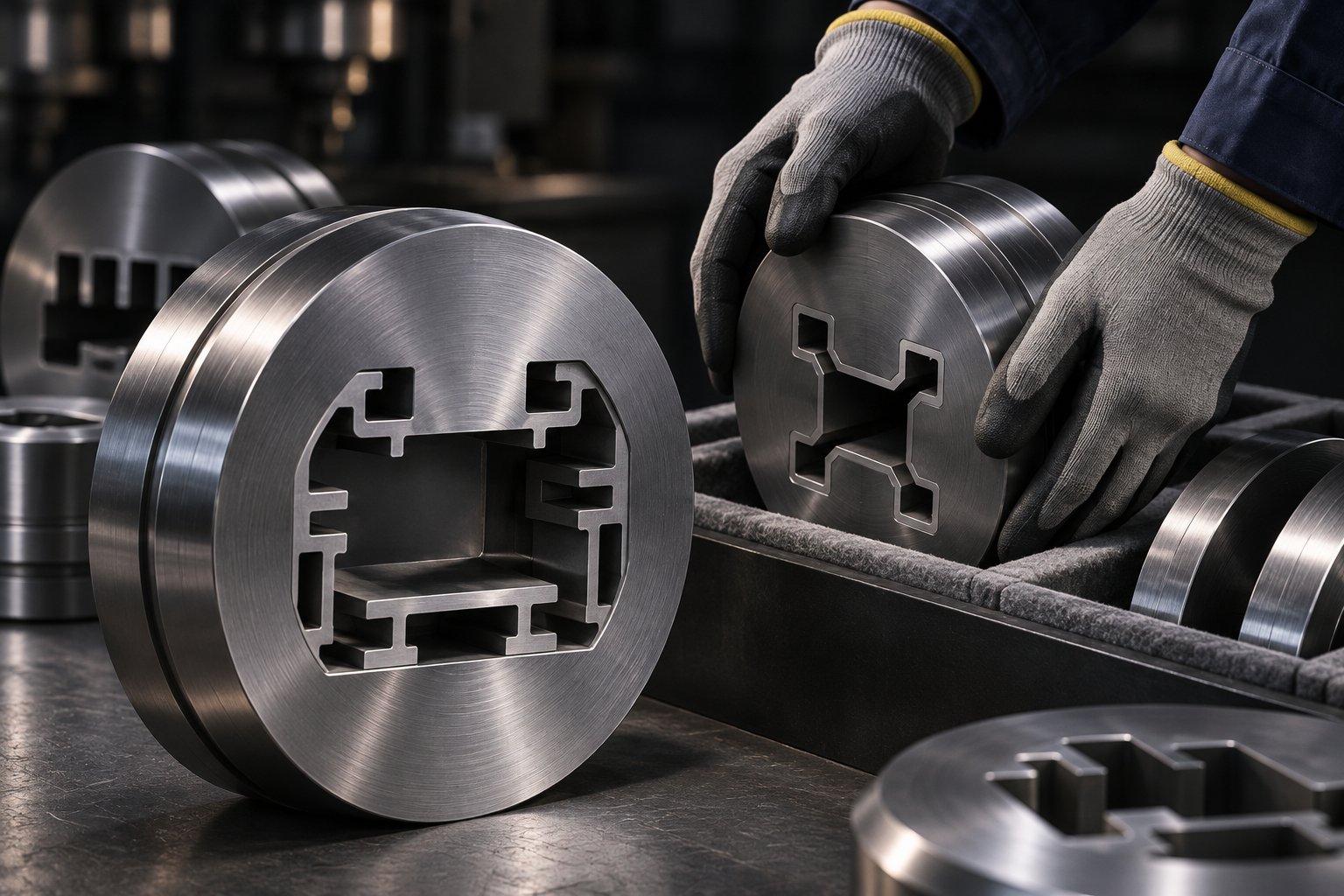
You paid the die charge, so you own the die. Is that right? Often it isn't. The die terms decide whether you can move your profile to another supplier later, and most buyers don't read them closely until they want to leave. The time to negotiate them is before the supplier cuts any steel.
Some extruders design and cut dies in their own die shop. Others buy them from an outside aluminum extrusion die manufacturer or a specialist aluminum extrusion tooling manufacturer. Either way can produce a good die. The difference shows up when a trial goes wrong. Gemini Group's guide to extrusion dies notes that die design still relies heavily on the designer's experience, and that efficient die correction extends die life and reduces downtime. With an in-house shop, the die goes from the press to the correction bench in the same building and runs again. With an outside die maker, the die ships back, waits in that company's queue and then returns. Accountability also splits: if the profile comes out of tolerance, the extruder and the die maker can each blame the other. If your supplier buys its dies, ask which aluminum extrusion die manufacturers it uses and who pays when a new die fails its trial.
A die charge may buy you the die. It may also only buy the right to have your profile run on it. Some suppliers keep title, and others recover part of the die cost through the piece price. A tooling ownership checklist from DecoverAI advises reviewing title, possession and risk of loss as separate questions, and warns against inferring title from an invoice alone. For your contract, that means the agreement should name each die, state when title passes to you, and say whether you can transfer the die.
Even when ownership is clear, the die may not run anywhere else. Dies are built for a specific press and container size. Each die sits in a stack with a backer, bolster and die ring, and Gemini Group notes that support tooling requirements depend on the press's operating parameters. A die cut for one plant may need rework, or a full replacement, before another plant can run it. Before you rely on being able to move a die, ask a second supplier whether its presses could run it, and make sure you would receive the die drawings and setup data.
Get die and sample lead times in writing, along with what happens if the first samples fail. Then settle maintenance. Dies are nitrided to harden their working surfaces, and the treatment has to be repeated. A nitriding guide from Aluminium Guide explains why: nitrogen slowly escapes during hot service, so operators pull the die, clean it and nitride it again. Ask who pays for corrections, repeat nitriding and replacement of worn dies. Also ask whether the supplier retires dies that sit inactive for a set period, and how much notice you get before that happens.
Ask for these clauses in the supply agreement or tooling schedule:
Governing law affects how these clauses are enforced, so have counsel review the final wording.
Settle die terms before the first die is cut, because they set the cost of switching later.
Die terms are hard to add once a quote is accepted, so put the ownership questions in your request for quotation. That way every supplier answers them in writing, alongside price and lead time.
What happens when you email "Need 10 tonnes of aluminium profiles" to five suppliers? AL Circle's extrusion RFQ guide uses that request as its example of what not to send. One supplier quotes an unfinished profile. Another adds anodizing and machining. A third assumes different tolerances. You get three prices for what are really three different products. A complete request for quotation (RFQ) package gives every aluminum extrusion manufacturer on your shortlist the same facts, so all the quotes describe the same part.
Sign a nondisclosure agreement (NDA) with each supplier before you share drawings. Then send:
Ask every supplier to answer in the same format:
Also ask whether the quoted weight is theoretical or based on an approved sample. Clinalu's extrusion cost guide notes that process yield, trial material and cut-off losses can all enter the calculation. Require each supplier to list every deviation, exclusion and assumption. If a quote says nothing about a requirement, treat that requirement as unconfirmed.
The questions a supplier asks show you how strong its engineering team is. Capable aluminum extrusion profile manufacturers often come back with suggestions like these:
Be cautious when a quote for a complex profile comes back with no questions at all. The supplier may have priced the part on assumptions it never shared with you. AL Circle warns that if those assumptions change after tooling has started, you may face revised prices, longer lead times or rejected material.
Send the identical package to all the custom aluminum extrusion manufacturers on your shortlist. If you clarify a point for one supplier, send the same clarification to the rest. With the same inputs, any price gap comes from real differences in conversion efficiency, tooling approach or lead time. Those differences are still spread across several cost elements, though, so the lowest price per kilogram is not always the lowest total cost.
Say two quotes come back for the same profile. Supplier A has the lower price per kilogram. Supplier B costs more, but its price covers anodizing, protective packaging and a firm die lead time. You can't tell which one is cheaper until both quotes are split into the same cost elements. Bor USA makes this point in its guide to industrial aluminum profiles. It advises OEM buyers to compare total installed cost instead of price per pound of aluminum, and it notes that a custom profile with a higher tooling cost can lower the cost of every assembly built after it.
An extrusion price usually starts with the metal and then adds the cost of turning that metal into your part. All Foils' LME and Midwest Premium explainer gives the North American all-in formula as the London Metal Exchange (LME) base price, plus the Midwest Premium (MWP), plus fabrication or conversion, plus freight. The article was written for foil buyers, but the metal components also apply to extrusions bought in the US. It reports that the MWP hit a record of about $0.85 per pound in 2026, driven by tariffs and the gap between US demand and domestic production. A premium that large and that changeable is the reason you need to know which index and premium each quote follows. Many aluminum extrusion manufacturing companies show metal as its own line, separate from conversion, and the breakdown you asked for in Step 7 should make that split visible.
| Cost element | What it covers | What to check |
|---|---|---|
| Metal cost | Aluminum or billet, priced from a market index plus a regional premium | Which index (such as the LME) and which regional premium (such as the MWP) it follows, the averaging period used, and how often the price adjusts |
| Conversion cost | Billet heating, pressing, quenching, stretching, aging and cutting, plus the plant's yield losses | Whether it is quoted per kilogram or per foot, and whether scrap and cut-off losses are built in or billed separately |
| Die charge | Die design, manufacture, trials and first corrections | The number of dies, which corrections are included, the ownership terms from Step 6, and any refund or amortization after a set volume |
| Finishing | Anodizing, powder coating or other finishes | Coating or anodize thickness, color, appearance surfaces, and whether the work is in-house or subcontracted, which adds handling and transit |
| Fabrication or machining | CNC machining, punching, cutting to length, thermal break and assembly | Per-piece or per-operation pricing, setup charges, and the tolerances held after machining |
| Packaging | Interleaving, film, bundling, crates and labels | Whether the protection fits your cosmetic surfaces and whether export packaging is included |
| Freight terms | Transport to your site under the stated Incoterm | Which Incoterm applies, where risk passes to you, and whether insurance and port fees are included |
| Duties for imported parts | Tariffs, anti-dumping and countervailing duties, and broker fees | Who is importer of record, which HTS code the supplier assumed, and where the metal was smelted and cast. Confirm current rates with your customs broker. |
A lower price per kilogram only holds if nothing else goes wrong. These costs are rarely on the quote, but you end up paying them:
No single company is the best aluminum extrusion manufacturer for custom profiles for every buyer. The best supplier for you is the one that scores highest against weights your own team sets. Art of Procurement's supplier selection guide describes the method. Agree on criteria and weights with stakeholders before the quotes arrive. Then rate each supplier on a scale such as 1 to 5 or 1 to 10, multiply each rating by its weight, add up the totals, and review the result with stakeholders. Treat part-capability fit from Step 3 as pass or fail, so any supplier whose presses can't run your profile is removed before scoring.
| Criterion | What to score | Your weight (%) | Supplier A | Supplier B | Supplier C |
|---|---|---|---|---|---|
| Part-capability fit | Press range, wall thickness and length against your spec (pass or fail first, then score the margin) | ||||
| In-house process coverage | Share of your required operations done under one roof (Step 4) | ||||
| Certifications | Verified certificates whose scope covers the producing site (Step 5) | ||||
| Quality evidence | Inspection reports, mill test certificates and calibration records on similar parts | ||||
| Die terms | Written ownership, maintenance and release clauses (Step 6) | ||||
| Communication | Response speed, quality of design feedback and clarity of answers | ||||
| Total landed cost | All cost elements from the table above, plus the hidden costs listed | ||||
| Weighted total | Sum of rating × weight | 100% |
Established aluminum extrusions manufacturers expect these requests and answer them as routine. Be cautious with any supplier that:
A high score on the scorecard is still based on what the supplier has told you. The first real evidence comes when you measure parts made on your own die.
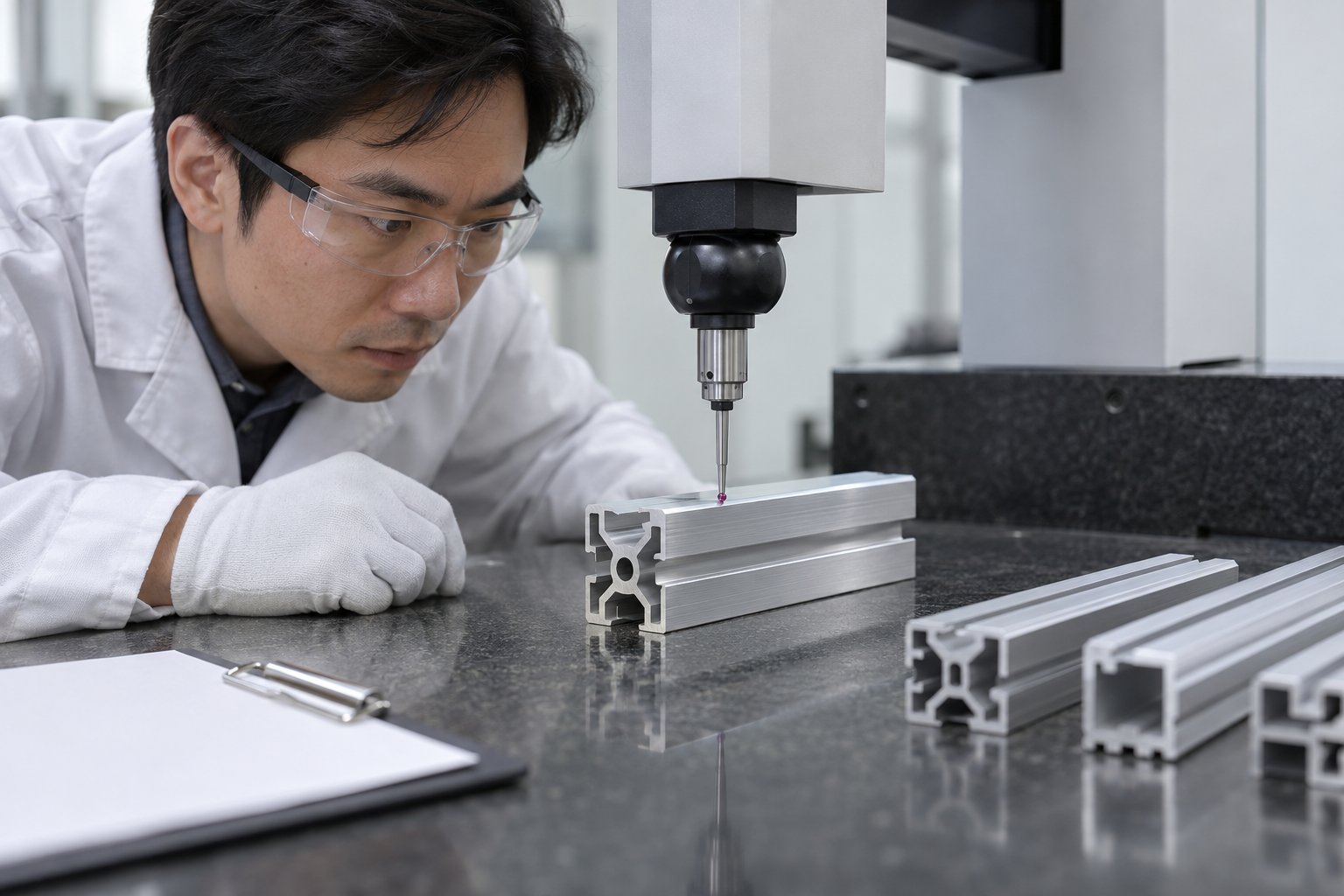
Picking a supplier from a scorecard doesn't mean the supplier is qualified. It means you have chosen who to test. Everything in the quote, the press list and the certificates is still the supplier's own claim until you measure parts made on your die. Qualification is how you find out whether the supplier can become a reliable industrial aluminum extrusion manufacturer for your program.
Agree on the acceptance criteria in writing before any samples ship. The agreement should say which dimensions get measured, how many pieces, against which edition of the tolerance standard, and how cosmetic defects will be judged. If you skip this, you and the supplier will end up arguing over the rules after the parts arrive. Ask for samples made on the production die and the press that will run your orders. When they arrive, check:
Automotive buyers usually require a Production Part Approval Process (PPAP) submission. PPAP is the AIAG procedure a supplier uses to show that its process makes the part to spec on every run, and it is completed before production shipments start. The customer sets the submission level. Level 1 is the Part Submission Warrant alone, and Level 5 is complete data reviewed at the supplier's site. An overview of PPAP levels from Igera Solutions notes that Level 3 is common for production parts. Any aluminum extrusions manufacturer certified to IATF 16949 should already know the process. A tooling change, a move to a new site or a new sub-supplier can each trigger a new PPAP. That means moving your die to another press, or switching to a different anodizer, can require a resubmission.
Samples show what the die can produce when the supplier is paying close attention. A limited first production order shows what the plant does on an ordinary run. Use the trial order to check:
Increase volume only after the trial lots pass.
A supplier that qualifies once still has to keep performing. Ivalua's supplier scorecard guide recommends rating each KPI on a standard scale, weighting the KPIs by importance, and reviewing strategic suppliers monthly or quarterly. Any result below an agreed threshold should lead to a corrective action plan. Track these metrics:
Agree on the target for each metric with the supplier, based on your application. Schedule regular re-audits, and add an extra one whenever the supplier changes its site, a subcontractor or your die. A high quality aluminum extrusion manufacturer will expect these reviews.
Check your own part before you check any supplier. Write down the alloy and temper, the circumscribing circle diameter (CCD), the minimum wall thickness, the weight per foot, whether the shape is solid, semi-hollow or hollow, the cut length, the tolerance standard, the finish and your annual volume. Then ask each candidate for its press list, with the tonnage, container diameter and number of presses that can run your profile. Tonnage and container size limit how large and how complex a profile a plant can run. If a shop's presses don't cover your profile, drop it before you request a price. It also helps if more than one of the supplier's presses fits your profile. Then a breakdown or a full schedule on one press doesn't stop your order.
For most custom profile programs, outsourcing costs less and carries less risk. A press alone doesn't make finished parts. A working line also needs billet heating, a puller, a cooling bed, a stretcher, saws, aging ovens, a heavy-duty foundation and utilities. You would also need a die supply, finishing, trained staff and scrap recycling. In-house extrusion usually pays off only when your own volume can keep a line busy. If you outsource, you can choose an integrated custom extruder, an extrude-only supplier or a sourcing agent. Shengxin Aluminium is one example of the integrated model. It handles drawing review, die development, extrusion, machining and finishing for profiles in alloys such as 6061, 6063 and 6005A. It sells profiles, not presses. Its MOQ and specialty hard alloys require project review, and its stated plus or minus 0.05 mm tolerance applies only to selected profiles. Run the same checks on Shengxin that you would run on any other supplier.
Require ISO 9001 from every supplier as the baseline. Add IATF 16949 for automotive parts and AS9100 for aerospace parts. ISO 14001 covers environmental management and says nothing about part quality. For architectural finishes, look for Qualicoat for powder coating or Qualanod for anodizing. Each of those licenses belongs to one specific finishing plant, and that plant may be a subcontractor rather than the extruder. Ask for the full certificate and look up its number with the registrar. Then confirm three things: the registrar is accredited, the scope names the plant that makes your parts and the processes it runs, and the certificate has not expired. The Qualicoat and Qualanod associations both publish lists of licensed plants that you can search.
Not automatically. A die charge may buy the die itself, or only the right to have your profile run on it, and some suppliers keep ownership. Put ownership in the supply agreement. List each die, state when ownership passes to you and confirm that you can transfer it. The agreement should also cover who pays for die corrections, repeat nitriding and replacement of worn dies, plus storage, insurance, notice before inactive dies are scrapped, and release terms if you change suppliers. Even when ownership is clear, each die is built for one press and container size. Another supplier may have to rework or replace it. Negotiate these terms before the first die is cut, because they decide what switching suppliers will cost you.
Send every shortlisted supplier the same RFQ package: drawings, alloy and temper, marked critical-to-quality dimensions, the tolerance standard and its edition, annual and per-release quantities, finish, secondary operations, packaging, required documents and Incoterms. Ask for a price breakdown that shows metal, conversion, die, finishing, machining, packaging, freight and duties as separate lines. Ask which market index and regional premium the metal price follows. Then compare total landed cost, adding scrap, rework, late deliveries, inventory carrying costs and duty exposure. A weighted scorecard, with weights your own team sets, keeps the decision objective. Be wary of a very low price with no cost breakdown, or a quote for a complex part that comes back without any questions.



 Servicio en línea
 0086 136 3563 2360
 sales@sxalu.com
 +86 136 3563 2360
 español
 English
 français
 Deutsch
 русский
 português
 العربية
 ไทย
 Việt
 Українська