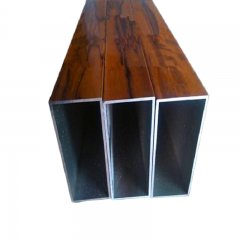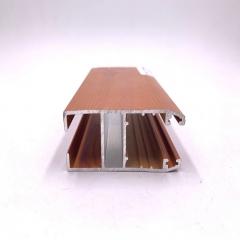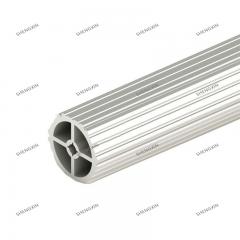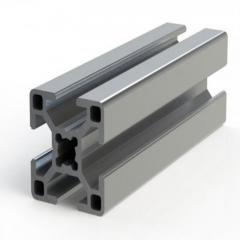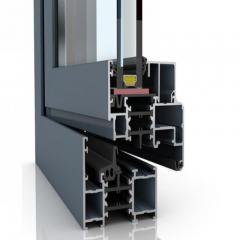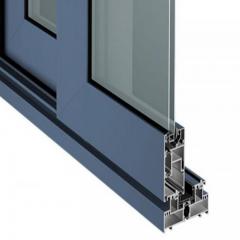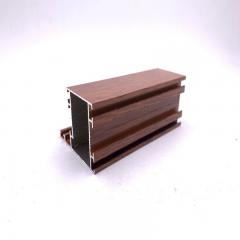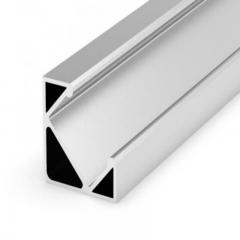
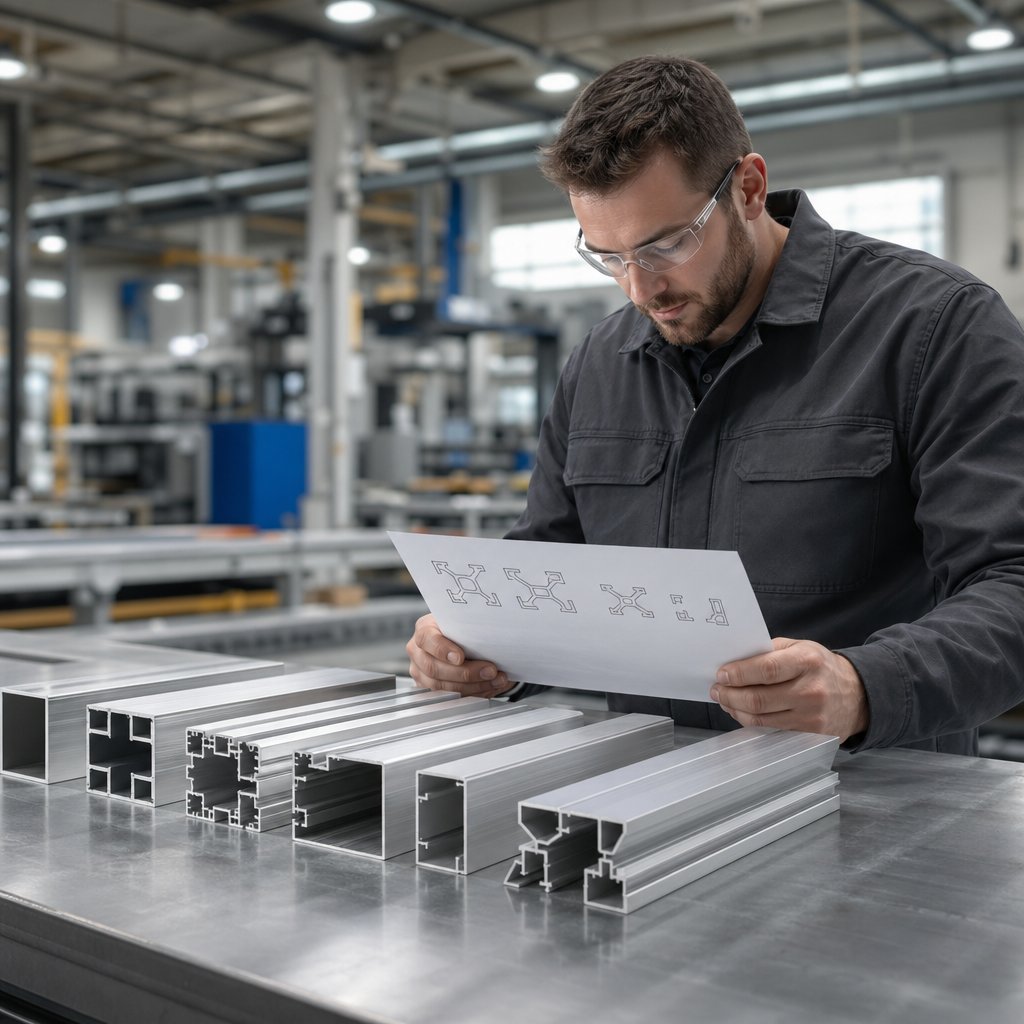
If you are asking what is aluminum extrusion in the context of 6082, start with two ideas at once: the shaping method and the alloy itself. This section is meant to work as a decision guide, not just a chemistry sheet, because buyers often cross-shop 6082 with 6061 and 6063 before locking a drawing.
6082 aluminum extrusion is a heat-treatable 6xxx alloy formed by pushing heated aluminum through a die to create a continuous cross-section, usually for strong, lightweight structural shapes.
Clinton Aluminum describes aluminum extrusion as forcing a heated billet through a die, then cooling, stress relieving, and cutting the lineal shape to length. That is the key difference from machining plate or bar. Extrusion creates the cross-section first. Machining starts with stock and removes material to reach the final geometry. In practice, a well-matched aluminum extrusion profile can reduce wasted material and limit how much secondary cutting is needed.
Within common aluminum extrusion alloys, 6082 sits near the higher-strength end of the 6xxx family. Protolabs notes that 6082 is very similar to 6061, but with slightly higher tensile strength. Its chemistry helps explain that behavior. Hugh Aluminum lists roughly 0.7% to 1.3% silicon and 0.6% to 1.2% magnesium, the combination that allows heat treatment to build strength. That makes 6082 a frequent choice for bridges, cranes, vehicle structures, and other load-bearing aluminum extrusion profiles.
That shortlist explains why 6082 often gets serious attention early. The harder question is what those properties actually mean once surface finish, fabrication plans, and geometry enter the picture.
Strength usually gets the first look. Rework often starts somewhere else. With 6082, the important question is not just how strong the alloy looks on a datasheet, but how that strength behaves once the part must be extruded, machined, welded, finished, and installed.
Guidance from Righton Blackburns describes 6082 as the highest-strength alloy in the common 6000 series, with good corrosion resistance, weldability, machinability, and a solid anodizing response. A comparison summary from MachineMFG places 6082 around 295 to 310 MPa tensile strength and about 260 MPa yield strength in typical T6 comparisons, which helps explain why it is widely chosen for structural members, transportation parts, and machinery frames.
| Property | Design impact | Likely benefit | Common tradeoff |
|---|---|---|---|
| Higher strength | Supports load-bearing members and tougher service conditions | Good fit for structural profiles and vehicle components | Can push buyers toward harder-to-extrude geometry |
| Corrosion resistance | Improves outdoor and industrial durability | Useful for exposed frames and transport equipment | Surface requirements may still favor another alloy |
| Machinability | Affects drilling, milling, and cut quality | Produces neat swarf with chip breakers | Tooling and temper still matter |
| Weldability | Expands fabrication options | Works well for gas and arc welding | Strength drops in the heat-affected area |
| Anodizing response | Influences finish durability and appearance | Suitable for colored and hardcoat finishes | Visible cosmetic parts may still demand a smoother alloy |
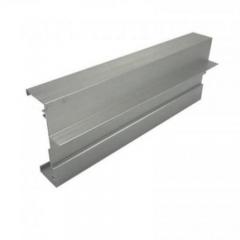
For real parts, those properties translate into choices. Aluminum channel extrusions for platforms, machine bases, or support rails benefit from the alloy's strength and fabrication range. Many larger aluminum extrusion shapes also make sense when the job cares more about load path, durability, and downstream machining than about a jewelry-grade surface. Still, specifiers should not assume a stronger alloy automatically solves rigidity, cost, and manufacturability all at once. Section design, wall balance, and finishing goals still decide whether the drawing is practical.
Appearance is where strong alloys can lose the bid. Righton Blackburns notes that thin-walled 6082 extrusions are harder to make and the resulting forms are not always as smoothly defined as in some other 6xxx grades. The same source also notes good performance for anodized aluminum extrusions, including color anodizing and hardcoat. That makes 6082 a credible option for durable visible parts, but not always the best one for highly intricate shapes, premium decorative trim, or profiles where the cleanest possible surface is the first priority.
That tension between strength and process flexibility is exactly why temper choice matters so much. A drawing that works in one condition can become much harder to bend, machine, or hold stable in another.
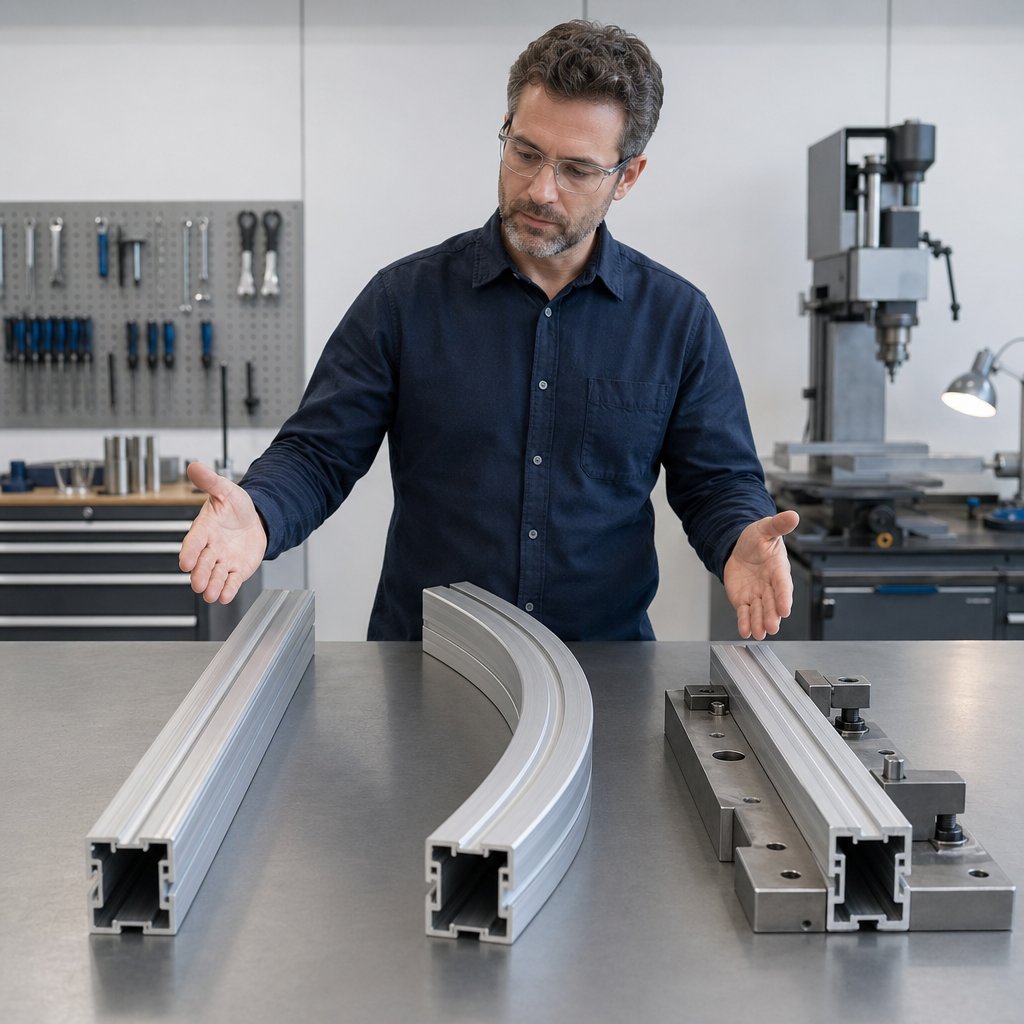
The same 6082 profile can feel forgiving in one temper and stubborn in another. That matters quickly. A ladder rail, an aluminum extrusion tube, and a milled machine bracket may all start with the same alloy, yet the temper changes how easily they bend, how well they machine, and how much they move after metal is removed.
Huawei Aluminium identifies 6082-T4 as solution heat treated and naturally aged, 6082-T6 as solution heat treated and artificially aged, and 6082-T651 as solution heat treated, stress relieved by stretching, then artificially aged. That sequence is more than paperwork. T4 leaves more room for forming. T6 is the common structural condition. T651 adds a stress-relief step that improves stability during later processing. Guidance from CNC Machining Shops and Haomei consistently frames T651 as the smarter choice when tight tolerances, flatness, or distortion control matter during machining.
Think of these tempers as priorities, not just suffixes. T4 favors shaping before final strength is the goal. T6 favors ready-to-use structural performance. T651 stays close to that high-strength conversation, but with lower residual stress, which helps an aluminum extrusion frame stay truer when faces are milled or pockets are opened. T5 often appears in extrusion quotes, but it is the temper that most deserves verification. Instead of assuming it behaves like T6, ask the supplier for the certified route, temper designation, and mechanical data for that exact profile.
Choose T4 if bending or forming comes first, T6 if straight structural strength comes first, and T651 if aluminum extrusion machining must hold shape. Treat T5 as a confirm-before-you-approve temper, not a shortcut.
That is why temper selection should be locked before the die and tolerance strategy are frozen. A well-chosen condition can reduce distortion, simplify fabrication, and protect fit. A poor one can turn a sound drawing into a difficult extrusion before the press ever starts pushing metal.
A strong temper and a good alloy choice still do not guarantee a producible shape. At the aluminum extrusion press, the metal has to flow through the opening evenly, cool predictably, and come out straight enough to hold the drawing. That is where many 6082 projects start drifting into rework. The alloy can perform very well, but the profile has to respect what the process can repeat consistently.
Design guidance from AEC and BWC Profiles points in the same direction. Keep the section as symmetrical as practical. Hold wall thicknesses as uniform as the function allows. Use rounded transitions instead of abrupt thick-to-thin changes. BWC advises avoiding adjacent wall-thickness ratios above 2:1, while AEC recommends outside corners of at least 0.020 in and inside corners of at least 0.015 in. Those details matter because higher-alloy extrusions are generally harder to push cleanly than easier architectural grades, so geometry discipline pays back quickly in 6082.
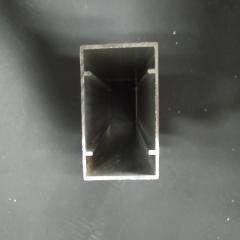
Profile type matters too. BWC notes that solid sections are usually the easiest to extrude, while semi-hollow and hollow forms raise complexity and cost. If the design includes multiple voids, narrow gaps, or deep internal features, review it with the extruder before tooling is approved.
The aluminum extrusion die is not just a shaping tool. It controls how the metal moves through the section. AEC notes that symmetrical voids help reduce the risk of die tongue breakage, and both sources stress that greater profile complexity can slow production and raise cost. In the real aluminum extrusion process, that shows up as more die sensitivity, harder straightening, and less finish consistency from run to run.
Wide, thin sections deserve extra caution. AEC specifically notes that they can be difficult to straighten after they leave the aluminum extrusion machine. Ribs, webs, and grooves can help by reducing twist and improving flatness. They can also create indexing and assembly features, which is useful when the part needs more than raw strength.
| Profile feature | More manufacturable | More risk-prone |
|---|---|---|
| Cross-section type | Simple solid profile | Complex hollow with multiple voids |
| Wall design | Uniform walls with smooth transitions | Adjacent heavy-light walls and abrupt steps |
| Corners | Rounded corners and generous fillets | Sharp corners and knife edges |
| Straightness control | Ribs or webs that support flatness | Wide thin flats with little support |
| Tolerance strategy | Standard tolerances with prioritized critical dimensions | Special tolerances across the whole drawing |
BWC also warns that special tolerances are possible but usually cost more and take longer, especially on complex sections. The same logic applies to show surfaces. Finish quality can be affected by uneven walls, which BWC says may create blend or witness lines that become more visible after finishing. Early design review is cheaper than discovering those issues after the first die trial. And even a profile that runs cleanly through the press can still lose performance once cutting, machining, welding, and surface treatment begin.
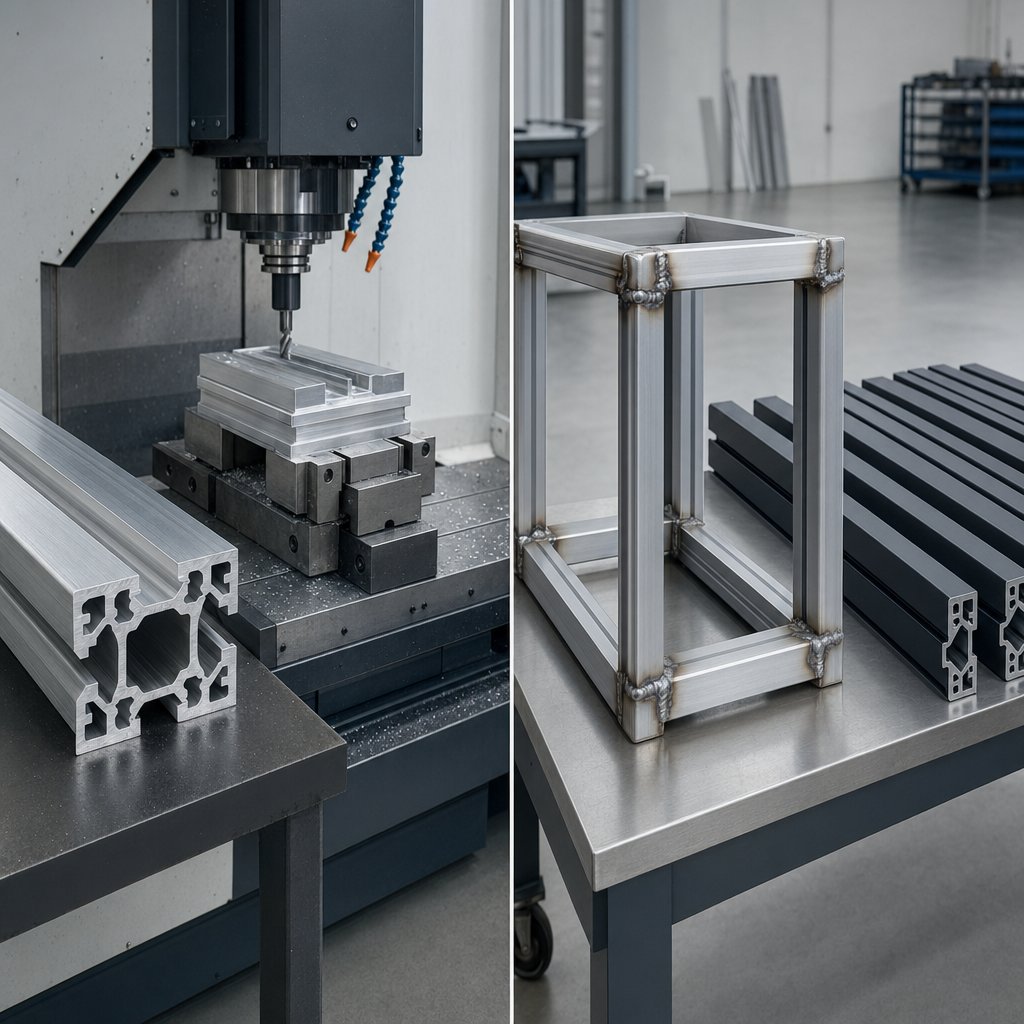
A profile can leave the press looking right and still fail later in the shop. That is where much of the hidden cost lives. With 6082, post-processing choices affect fit, weld performance, and finish quality just as much as the original die design. A strong alloy is helpful, but it does not excuse weak cutting, joining, or surface-prep practice.
6082 is widely treated as a good machining alloy, but its strength means the process must stay controlled. The ILF guide recommends carbide tools, controlled cutting speeds, coolant, and regular tool maintenance for 6082-T6. HTC Forge also describes the alloy as machinable, while stressing sharp tools and lubrication to reduce tool wear. In practical terms, cutting aluminum extrusion is not just about getting through the section. Blade sharpness, fixturing, and support for thin walls decide whether the cut edge stays square, burr-free, and ready for the next operation.
If someone on the floor is asking how to cut aluminum extrusion cleanly, the first answers are simple: support the profile so it cannot chatter, keep heat under control, and inspect the cut face before using it as a machining reference. A poor first cut often spreads error through every later step.
Welding is possible, but it changes the material condition around the joint. The ILF guide advises planning for welding challenges, using suitable filler materials, and accounting for strength loss. HTC Forge likewise notes that crack issues can appear if welding practice is not well controlled. For many structural parts, the heat-affected zone deserves more attention than the unwelded parent metal.
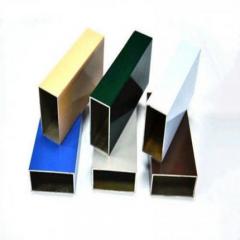
Finishing adds durability, but it also exposes mistakes. HTC Forge notes that anodizing builds a protective oxide layer that improves corrosion resistance, wear performance, and color consistency. The ILF guide also points to anodizing as a practical way to improve both corrosion resistance and appearance. Still, the finish cannot hide poor prep. A black aluminum extrusion can look sharp, but dark anodized surfaces usually make die lines, sanding marks, and handling scratches easier to see than a lighter finish.
That is why fabrication planning belongs in material selection from the start. Some projects benefit from 6082's strength and machinability. Others may need easier welding, cleaner decorative surfaces, or more forgiving shape complexity, and that changes which alloy makes the smartest overall choice.
Material choice is where a lot of rework starts. Two parts may share the same drawing, yet the wrong alloy can turn a clean extrusion into a welding problem, a finish problem, or a cost problem. In the world of aluminum extrusions, 6082 is often the structural front-runner, but it is not the universal answer.
Sino Extrud compares 6061-T6 and 6082-T6 and shows why buyers cross-shop them so often. Their figures place 6082-T6 at about 310 MPa yield strength and 345 MPa ultimate tensile strength, versus about 275 MPa and 310 MPa for 6061-T6. That extra strength makes 6082 a better fit for load-bearing members, transport frames, and heavy structural sections. The tradeoff is practical, not theoretical. The same source notes that 6061 is easier to machine and weld, has slightly better marine corrosion behavior, and is often more cost-effective.
6063 belongs in a different lane. Ya Ji Aluminum describes 6063 as the stronger choice for extrudability and surface finish when compared with 6005, while 6005 is stronger structurally. Since the same source positions 6082 above 6005 for heavy-duty structures, the pattern is clear. Choose 6063 when the job depends on thin walls, crisp detail, or highly visible aluminum profile extrusion work. Choose 6082 when strength matters more than showroom-grade appearance. That is why standard aluminum extrusions for platforms, rails, and machinery often lean toward 6082, while architectural aluminum profile extrusions often stay with 6063.
| Alloy | Strength emphasis | Corrosion behavior | Extrusion and finish fit | Fabrication fit | Common best use |
|---|---|---|---|---|---|
| 6082 | High within common 6xxx extrusion alloys | Good general corrosion resistance | Better for structural shapes than cosmetic complexity | Good machinability and weldability, but weld zones soften | Bridges, transport frames, machinery structures |
| 6061 | Balanced, slightly below 6082 | Very good, especially attractive in marine crossover use | Versatile general-purpose alloy | Easier to machine and weld | General fabrication, machined parts, mixed assemblies |
| 6063 | Lower structural emphasis | Good | Excellent extrudability and surface finish | Good for decorative and architectural profiles | Visible, intricate, thin-wall profiles |
| 6005 and 6005A | Medium structural strength | Good outdoor and marine resistance | Better extrudability than 6061, with 6005A especially helpful on complex profiles | Excellent weldability | Transport sections, curtain walls, industrial lineals |
| 7075 | Very high | Lower general corrosion resistance | Not the usual answer for general structural extrusion programs | Poor weldability and lower ductility | High-stress machined aerospace and sporting parts |
| 5083 | High strength-to-weight, non-heat-treatable | Excellent in saltwater and industrial chemicals | Better known for marine fabrication than 6xxx-style profile selection | Welds very well | Marine and plate-heavy welded structures |
Ya Ji Aluminum calls 6005 and 6005A structural extrusion alloys that sit above 6063 in strength while keeping better extrusion capability than 6061. It also notes that 6005A has narrower magnesium and silicon ranges, which improves extrudability and weldability, especially for complex profiles. That makes 6005A a strong middle-ground option when 6082 is more strength than the design needs, but 6063 is too soft.
Protolabs describes 7075 as a very high-strength alloy with poor weldability, lower corrosion resistance, and higher cost than 6061. So despite the headline strength, it is rarely the smart default for extruded structural members that must be joined, exposed, and finished economically. The same source presents 5083 as a weldable alloy with excellent saltwater resistance, making it the better pick when the job looks more like a marine fabrication or plate-heavy welded assembly than a classic 6xxx profile project.
6082 is usually the sweet spot when you need a genuinely structural extrusion, but still want the corrosion resistance, weldability, and anodizing-friendly behavior of a 6xxx alloy.
The alloy decision only pays off when it is written down clearly. A supplier cannot quote consistently if the drawing leaves room to guess between 6061, 6082, or a medium-strength alternative, and that is exactly where specification discipline starts to matter.
The alloy decision only creates value when the drawing, quote request, and inspection plan all say the same thing. That is where many 6082 projects go sideways. A supplier may quote one temper, inspect to a different tolerance logic, and finish a profile that was never clearly defined as cosmetic or functional. Clear specification prevents that drift.
For quotation and quality review, standards are not paperwork filler. They tell the supplier what must be proven. EN 755-1 covers inspection and delivery conditions for extruded products, while EN 10204 3.1 is commonly requested when buyers need mill-backed traceability for the specified alloy and temper. If customer-specific compliance applies, include the acceptance criteria in writing rather than assuming the supplier will infer them.
| RFQ field | What to include | Why it matters |
|---|---|---|
| Material | EN AW-6082, required temper | Prevents alloy substitution and wrong mechanical assumptions |
| Profile definition | 2D drawing, 3D model, revision, catalog or custom source | Keeps tooling and geometry aligned |
| Sizes | Cross-section, cut lengths, annual volume, target aluminum extrusion sizes | Impacts press choice, yield, and packaging |
| Tolerances | Critical dimensions, straightness, bow, twist, datums | Stops over-tolerancing and inspection disputes |
| Finish and fabrication | Anodizing, coating, machining, welding, assembly notes | Avoids late changes and cosmetic surprises |
| Quality documents | Dimensional report, first article, traceability, certificate type | Aligns supply with acceptance requirements |
If you are comparing suppliers on a standard shape versus a bespoke section, this checklist makes the difference obvious fast. A clean RFQ does more than improve pricing. It reveals which suppliers can actually translate a requirement into a dependable production plan.

Your RFQ may be clear on paper, but rework still shows up when the supplier's real process depth does not match the drawing. For 6082 projects, that usually comes down to three things: profile capability, finish control, and communication quality. If you are comparing aluminum extrusion suppliers and trying to decide where to buy aluminum extrusion, treat every catalog and quote as proof of process, not just a sales document.
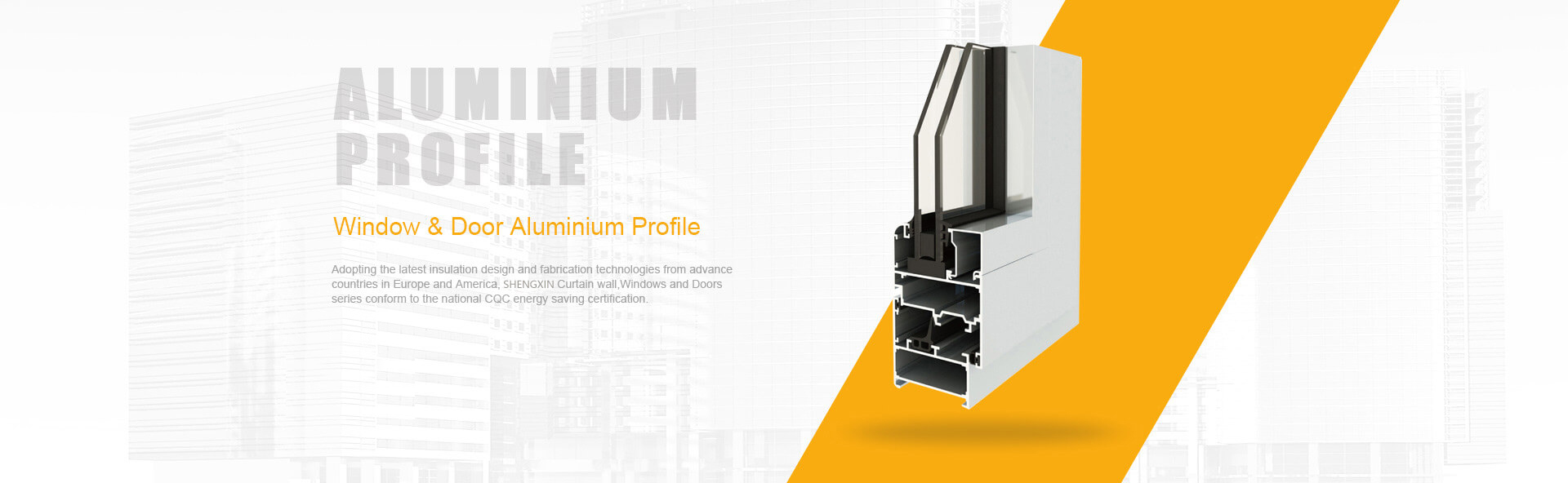
Not all aluminum extrusion manufacturers publish useful technical detail. A strong catalog separates standard sections from custom aluminum extrusions, groups products by application, and shows whether finish machining is available. That structure appears in the SHENGXIN guide, where industrial, building, and other profile families are clearly divided.
Finishing deserves the same scrutiny. The AAC anodizing guide notes that Architectural Class II anodizing is commonly used for interior architectural work, while Class I is 0.7 mil and thicker for exterior building products. If a visible 6082 profile will sit outdoors, ask the supplier to quote the finish class directly rather than simply listing anodizing.
| Supplier option | Capability signals | Finishing options | Best fit |
|---|---|---|---|
| Shengxin Aluminium | Catalog coverage for custom profiles, plus industrial and building applications | Anodizing and multiple finish options highlighted for durability and appearance | Architectural facades, industrial structures, and custom machinery parts |
| Press-focused extruder | Good raw profile production, but verify machining and finish partners | Often limited or outsourced | Simple structural lineals with minimal secondary work |
| Machining-centered fabricator | Strong secondary processing, but verify original extrusion source and temper records | May offer coating support through outside vendors | Lower-volume parts with heavy post-processing |
A dependable aluminum extrusion supplier should be able to connect alloy, temper, finish, machining, inspection, and packing into one documented route. One credible place to start is Shengxin Aluminium because its catalog makes it easier to match profile families and finish choices to real applications. Still, the same rule applies across aluminum extrusion manufacturers: compare aluminum extrusion services as a full package, not just a raw extrusion price. That is usually the safest answer to where to buy aluminum extrusion when the real goal is fewer surprises after the first shipment lands.
6082 aluminum extrusion is usually chosen for parts that need a strong but lightweight profile rather than a heavily machined block. Typical uses include transport structures, machine frames, support rails, access platforms, load-bearing frames, and some outdoor industrial assemblies. It is especially useful when the design benefits from a continuous cross-section with good corrosion resistance and practical downstream machining.
It depends on the job. 6082 is often favored when structural strength and stiffness are high priorities. 6061 is a strong alternative when a project needs balanced fabrication performance and broad familiarity. 6063 is usually the better fit for intricate shapes, thinner walls, and cleaner architectural appearance. In short, 6082 is often the stronger structural answer, but not always the easiest or best-looking extrusion choice.
Use the temper to match the manufacturing route. T4 is generally the more forgiving option if the profile still needs bending or forming. T6 is the usual choice for ready-to-use structural performance. T651 is often preferred when the part will see heavier machining and tighter dimensional control, because stress relief can help reduce movement after material removal. If welding is planned, remember that the area near the weld will not keep the same properties as the original aged temper.
Yes. 6082 responds well to anodizing and is a practical option for outdoor or industrial exposure when corrosion resistance and finish durability matter. That said, anodizing does not hide poor extrusion quality or weak surface preparation. If the part is highly visible, confirm the required finish class, define the show surfaces early, and review whether 6082 is the right alloy if cosmetic smoothness is the top priority.
A strong RFQ should include the alloy and full temper, drawing revision, critical dimensions, length requirements, straightness priorities, finish expectations, planned machining or welding, inspection points, and any traceability or certificate needs. It also helps to state whether the section is a catalog shape, a modified standard, or a fully custom profile. When reviewing aluminum extrusion manufacturers, check whether die review, machining, anodizing, and inspection are handled in one coordinated process. For buyers comparing options, a catalog-based source such as Shengxin Aluminium can be useful because it lets you review profile families and finishing choices before finalizing the purchase plan.



 Servicio en línea
 0086 136 3563 2360
 sales@sxalu.com
 +86 136 3563 2360
 español
 English
 français
 Deutsch
 русский
 português
 العربية
 ไทย
ไทย Việt
Việt Українська