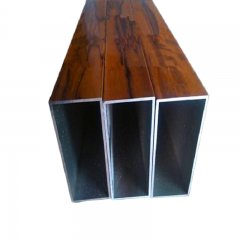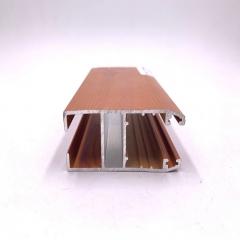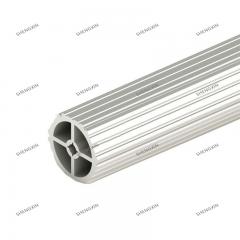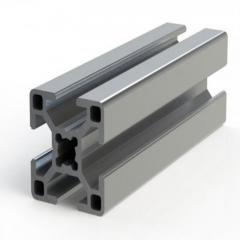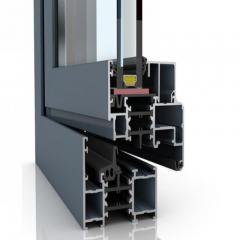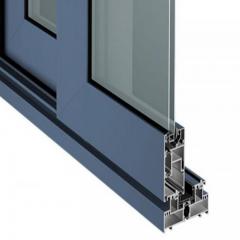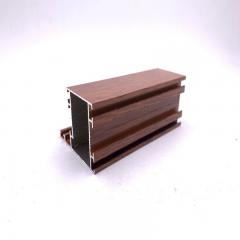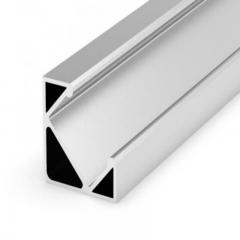
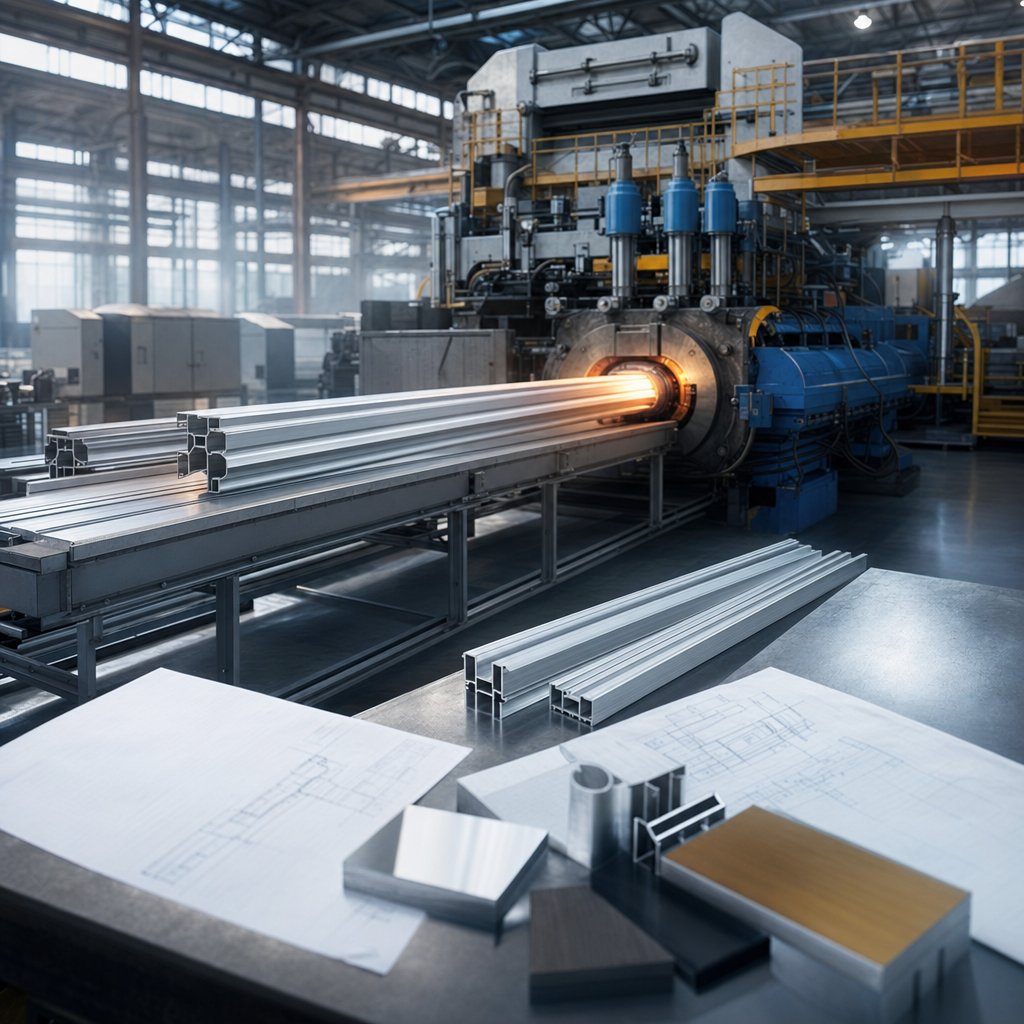
If you are buying parts for a frame, rail, housing, or machine assembly, the term can sound more technical than it needs to be. In plain language, an aluminium extrusion manufacturer takes aluminium alloy, shapes it into a specific cross-section, and turns that shape into a usable part for a real application.
An aluminium extrusion manufacturer produces aluminium profiles by pushing heated alloy through a shaped die, then manages the steps needed to deliver consistent finished parts.
That job often includes far more than simply running an extrusion press. A true production partner may handle:
Not every company selling profiles actually makes them. A distributor or trader usually buys finished shapes and resells them, which can be useful for common stock items or smaller quantities. A fabrication-only shop may cut or machine extrusions but still relies on another factory to make the base profile. By contrast, true aluminium extrusions manufacturers control production closer to the source, which usually gives buyers better visibility into tooling, tolerances, and batch consistency. If your part is custom, an aluminium extrusion profile manufacturer is often the better place to start.
When buyers compare aluminium extrusion manufacturers, catalog size can look impressive. Still, inventory matters less than capability when the part must be light, strong, finished correctly, and ready to assemble. The real value of an aluminium extrusion manufacturer lies in whether it can support custom geometry, finishing, fabrication, and quality assurance as one controlled workflow. Those capabilities shape cost, lead time, and defect risk long before the quote turns into a shipment.
That is where sourcing gets more interesting, because the factory's process decisions are often what separate a low quote from a reliable part.
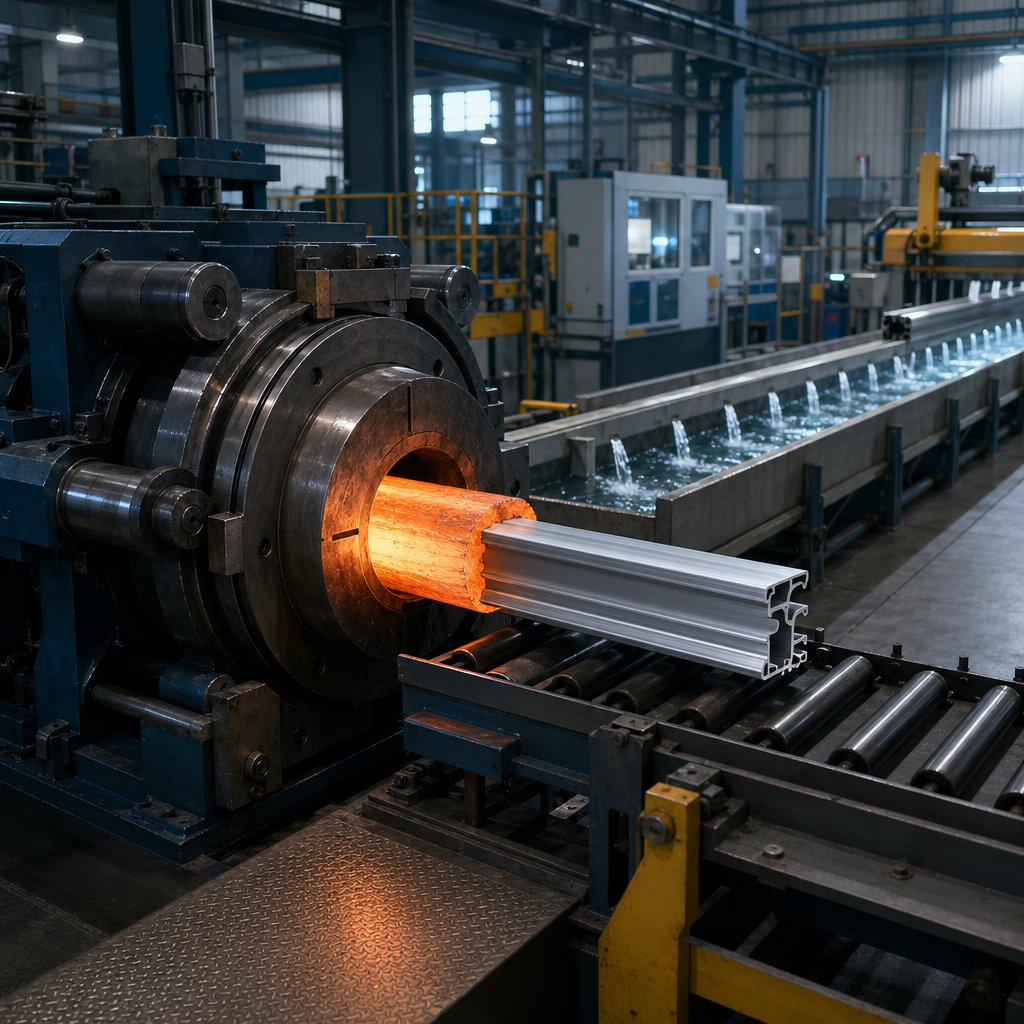
A low quote can hide a much longer factory story. In real aluminium extrusion manufacturing, cost, consistency, and delay risk are shaped by a chain of connected decisions, not just one press run. The JM Aluminium process overview and technical guidance from the Aluminum Extruders Council both show the same pattern: a profile moves through tooling, heating, extrusion, cooling, strengthening, finishing, and inspection before it is truly ready for use. That is why the aluminium extrusion manufacturing process deserves buyer attention, even if you are not an engineer.
The die is where drawings meet manufacturing reality. The AEC places die design, die manufacturing, correction, quenching, heat treatment, and process control in the same technical conversation because they all influence metal flow and profile stability. In buyer terms, the aluminium extrusion die manufacturing process is not a side issue. It affects whether a shape runs smoothly, needs repeated die correction, or creates scrap and variation before the first acceptable batch is packed.
Sinoextrud also notes that repeatability depends on clear standards, stable process settings, tooling condition, and reliable inspection, not just one successful run. Whether a plant makes tools in-house or works with an aluminium extrusion dies manufacturer, die wear, setup discipline, and measurement timing all influence how closely future batches match the first one.
| Production stage | Buyer impact |
|---|---|
| Drawing review and die preparation | Drives upfront tooling cost, and unclear drawings often slow approval. |
| Billet heating and press setup | Affects startup stability, schedule reliability, and early scrap risk. |
| Extrusion run | Shapes surface quality and dimensional consistency from batch to batch. |
| Cooling, straightening, and aging | Influences strength, straightness, and distortion risk. |
| Finishing and fabrication | Adds queue time, but can reduce later handoffs and handling errors. |
| Inspection and release | Weak checks may save time briefly but raise defect and assembly risk later. |
Seeing this process as a system helps buyers ask sharper questions about tooling, controls, and inspection, especially when profile shape, wall thickness, and size start pushing manufacturing limits.
A profile can look simple on a drawing and still be difficult to extrude at a stable cost. The friction usually comes from the relationship between shape, wall balance, size, tolerance, alloy, and the press available. Actual limits vary by die design, alloy, and press tonnage, so the better question is not just whether a section can be made, but whether it can be made repeatedly without excess scrap, rework, or variation.
Complexity is not just about a profile looking intricate. In extrusion, it often means multiple voids, thin ribs, deep channels, sharp corners, or a layout that makes metal flow unevenly. Guidance from PPE notes that a section with one void is generally less expensive to produce than one with five, and smoother transitions improve manufacturability. That is why many aluminium extrusion profile manufacturers review drawings before they commit to tooling. A shape may be possible in theory, yet still need small design changes to run cleanly and consistently in production.
Wall thickness is one of the biggest hidden cost drivers. Large thickness changes can cool unevenly, which increases the chance of warping, twisting, and surface inconsistency. Keeping walls as even as possible, or at least using gradual transitions, helps the metal flow more predictably. Tolerances work the same way. PPE also emphasizes defining tight tolerances only on dimensions that truly matter, because overly strict limits across the entire profile can raise cost and slow production without improving function.
Size has a hard manufacturing side too. Bonnell Aluminum explains that press size determines the largest cross-section a plant can run, based on the smallest circumscribing circle around the shape. Even then, a large thin-wall hollow may demand more press force than a simpler solid section. That is why the same drawing may fit one aluminium extrusion section manufacturer comfortably and push another plant into a less stable process window.
| Design factor | What it means in plain language | How it affects manufacturability | What buyers should ask suppliers |
|---|---|---|---|
| Profile complexity | How many voids, ribs, corners, and deep features the shape contains | More complexity can disrupt metal flow, increase die correction, and raise scrap risk | Have you run similar hollow or asymmetrical profiles before, and what design changes would improve stability? |
| Wall thickness balance | Whether thick and thin areas stay reasonably consistent across the profile | Uneven walls can cool at different rates and cause distortion or surface variation | Which areas of this design are most likely to warp, twist, or need revision? |
| Overall profile size | The outer envelope of the cross-section, not just its weight | Size affects press selection, handling, and whether the section fits the plant's capability range | Which press would run this profile, and does the size push your normal limits? |
| Tolerance expectations | How tightly each feature must match the drawing | Tighter tolerances can mean slower runs, more inspection, and possible extra machining | Which dimensions can stay commercial, and which truly require tighter control? |
| Alloy choice | The balance between strength, corrosion resistance, finish quality, and machinability | Different alloys extrude and finish differently, which changes cost and repeatability | Is the specified alloy necessary for the end use, or is there a more production-friendly option? |
| Press capacity and tooling fit | Whether the plant's tonnage and die capability match the geometry | A marginal press-tooling fit can cause instability, slower output, and more defects | Do you handle tooling in-house or work with aluminium extrusion die manufacturers, and how do you manage first-run die corrections? |
Cheap quotes often assume the profile will run with minimal die correction, little trial work, and no real design feedback. That is where problems start. Bonnell's process guidance explains that excessive temperature and speed can make metal favor larger openings, which makes thin projections and sharp corners harder to hold and more prone to tearing. Alloy choice adds another layer. PPE's examples show why 6061, 6063, and 7075 are not interchangeable decisions. Strength, finish quality, corrosion resistance, and extrudability do not all point in the same direction.
Takeaway: For custom shapes, manufacturability is part of supplier selection, not a separate engineering detail. The stronger partner is usually the one that challenges wall imbalance, questions noncritical tight tolerances, and recommends prototyping or die changes early. Once the base profile is stable, finishing and secondary fabrication start to have just as much influence on sourcing simplicity and consistency.
The base profile is only half the purchase. In many projects, sourcing convenience and downstream risk are shaped by what happens after extrusion. Guidance from Can Art and Zetwerk shows why: surface finishing affects corrosion resistance, wear, UV performance, appearance, and total cost of ownership, while secondary operations influence whether the part arrives as a raw length or something much closer to installation-ready.
Finish choice is not just cosmetic. It should be decided early so it matches the part's environment, assembly method, and visual target.
Zetwerk lists CNC milling, CNC cutting, drilling, tapping, reaming, punching, bending, heat treatment, robotic welding, and assembly within its extrusion workflow. For buyers, that matters because every outside handoff can add coordination, handling, and another inspection point. Many aluminium extrusion parts manufacturers can supply straight profiles, but parts with holes, threads, slots, or precise cut features often call for the deeper workflow seen in stronger aluminium extrusion cnc manufacturers. If the design depends on formed geometry after extrusion, an aluminium extrusion bending manufacturer may fit better than a press-only source.
| Process type | Appearance goals | Durability implications | When to keep secondary operations with the same supplier |
|---|---|---|---|
| Mill finish | Clean raw-metal look or base for later treatment | Relies mainly on aluminium's natural corrosion resistance | Useful when cut length, deburring, and handling condition must stay controlled before later coating or machining |
| Anodizing | Natural metallic appearance in a narrower color range | Excellent corrosion, abrasion, and UV performance, but harder to repair locally | Best when alloy response, masking, surface quality, and inspection need one accountable source |
| Powder coating | Wide color, texture, and branding flexibility | Good corrosion protection with pretreatment, but UV stability varies by resin and heavy impact can chip the film | Best when finish coverage must stay aligned with machining, holes, or assembly points |
| CNC machining, bending, and assembly | Supports final fit more than decoration | Can reduce rework and extra handling in later stages | Smart when the extrusion needs to arrive ready for installation or repeat production |
Broader finishing and fabrication scope does not automatically make one supplier better, but it often makes responsibility clearer and procurement simpler. Those differences tend to matter most when buyers start comparing manufacturers on evidence rather than on price alone.

By this stage, the real question is not who has the flashiest website or the longest product list. It is who can turn your drawing into repeatable production with the least risk. Ranked supplier lists rarely show that. A better method is to score each factory against the same evidence set. The weighting model in this supplier audit guide is useful because it breaks qualification into visible categories instead of vague impressions.
Ask every supplier for the same proof. That keeps the comparison fair. Useful evidence includes press capability, supported alloys, die handling, finishing scope, machining equipment, inspection tools, sample reports, traceability records, and how nonconformances are corrected. A factory that gives clear, specific answers is often easier to trust than one with a broad catalog but thin documentation.
| Criterion | Evidence to request | Suggested weight | Why buyers should care |
|---|---|---|---|
| Tooling support | Die review notes, DFM feedback, correction plan | 15% | Strong tooling support reduces trial-and-error cost and early scrap. |
| Profile complexity handling | Examples of similar hollow, thin-wall, or asymmetrical profiles | 15% | Shows whether the supplier can run difficult shapes consistently. |
| Finishing range | In-house or controlled subcontract finishing, inspection method | 10% | Fewer handoffs usually mean better surface consistency and simpler accountability. |
| Fabrication services | Machine list, calibration status, fixturing approach | 10% | Matters when parts need cutting, drilling, tapping, or assembly before shipment. |
| Quality documentation | FAI or PPAP capability, lot traceability, CAPA records | 25% | Good records make repeat orders and dispute resolution far easier. |
| Communication | Response speed, engineering clarity, issue ownership | 10% | Poor communication turns small drawing questions into long delays. |
| Logistics fit | Packaging method, shipment options, realistic lead-time breakdown | 10% | Total landed cost depends on transit, packaging protection, and schedule reliability. |
| Production continuity | Billet supply stability, subcontractor control, backup planning | 5% | A good sample means little if the supply chain breaks on repeat orders. |
Those weights are only a starting point, but they force a more honest conversation than a simple low-quote comparison.
Location affects transit time, communication windows, and sometimes price. It does not automatically prove quality. The price guide linked above shows why buyers should separate quoted price from total sourcing performance: lower-cost overseas supply can come with longer freight and planning windows. That is why searches for aluminium extrusion manufacturers near me, aluminium extrusion manufacturers uk, or aluminium extrusion manufacturers in china should lead to the same next step, namely a document-based comparison.
The same rule applies when screening aluminium extrusion manufacturers in india, aluminium extrusion manufacturers in australia, or aluminium extrusion manufacturers in germany. Do not assume strength or weakness by region alone. Ask for sample inspection records, process controls, finishing accountability, and lead-time realism. Then score what is proven.
The shortlist usually gets much smaller when those filters are applied, and the best fit depends heavily on whether the part is headed for construction, transportation, or industrial machinery.
A supplier can score well on price, tooling, and finishing, yet still be the wrong fit for the part's real job. End use changes the decision. Markets highlighted by Taber and application examples collected by Light Metal Age show why construction, transportation, and industrial machinery ask very different things from the same production process.
Construction buyers usually care about structural function, weather exposure, corrosion resistance, and appearance at the same time. Curtainwall members, roof structures, beams, and modular framing often need clean surfaces, reliable fit, and coatings suited to outdoor use. When evaluating a building and construction aluminium extrusion manufacturer, look closely at finishing control, long-length handling, and packaging that protects visible surfaces.
Transportation shifts the focus toward lightweight strength and repeatability. Taber points to automotive, rail, and aerospace uses, while Light Metal Age shows extruded profiles in EV structures, vehicle partitions, and loading platforms. If you are screening an aluminium extrusion automotive manufacturer, ask how it manages hollow sections, machined features, and dimensional consistency from batch to batch.
Industrial machinery often needs tougher profiles, more machining, and stable repeat orders. Equipment frames, guides, rails, and motor housings can be less appearance-driven but more demanding in dimensional control and fabrication depth. Buyers comparing aluminium extrusion equipment manufacturers and specialist aluminium extrusion motor body manufacturers should verify CNC capability, die upkeep, and how the factory handles custom shapes that must assemble without rework.
| Industry | Common extrusion role | Critical capability to verify | Likely follow-up questions |
|---|---|---|---|
| Construction | Curtainwalls, louvers, roof beams, modular framing | Outdoor finish control, straightness, protected handling | Which finish suits the environment, and how are long visible profiles inspected and packed? |
| Transportation | EV members, rail parts, vehicle frames, partitions | Repeatable hollow profile production, tight fabrication control | Have you run similar multi-void sections, and how are batch-to-batch changes documented? |
| Industrial machinery | Machine frames, guides, motor housings, equipment structures | Robust profile capability, machining depth, die maintenance | What machining is done in-house, and how is die wear managed for repeat orders? |
A good sample is only the start. Quality guidance from AL Circle shows that repeat consistency depends on billet quality, die condition, stable process control, and post-extrusion inspection. For buyers, that means asking practical questions about raw material traceability, die maintenance routines, inspection records, and how drawing or finish revisions are approved before they reach production.
That matters even more with custom parts and when dealing with aluminium extrusion motor body manufacturers, where a small tooling or machining change can affect downstream assembly. Buyer takeaway: application context narrows the shortlist fast, because it tells you which factory capabilities deserve a closer look on the supplier's website.
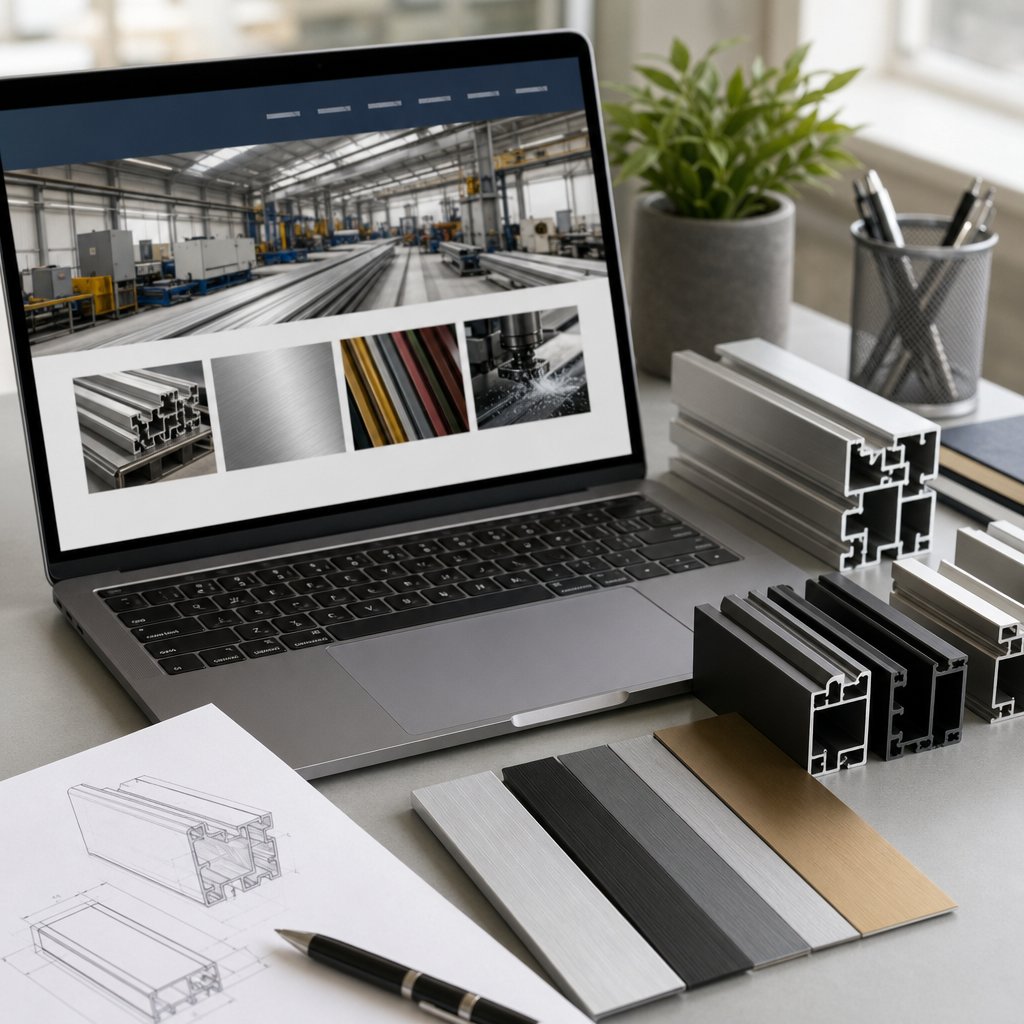
Supplier fit becomes much easier to judge when you stop reading websites like brochures and start reading them like evidence. The most useful capability pages usually show the same core signals found across Paramount, ALLWIN, and PSI Industries: custom profile support, fabrication depth, finishing options, and some proof of inspection or application experience.
A strong page explains how the supplier turns a profile into a usable part. If your design depends on heat control, an aluminium extrusion heatsink manufacturer should show heat sink capability directly. If the part is a housing, an aluminium extrusion enclosure manufacturer should show enclosure or housing applications. Buyers looking for an aluminium alloy extrusion manufacturer should also check whether the site discusses alloy choice alongside finishing and end use, rather than treating material selection as an afterthought.
One practical example is Shengxin Aluminium. Its capability presentation is worth reviewing if you need custom profiles in multiple shapes and sizes, surface treatments, and corrosion-resistant extrusions for construction, transportation, or industrial machinery.
| Resource reviewed | Published capabilities | Documentation clarity | Application relevance |
|---|---|---|---|
| Shengxin Aluminium | Custom profiles, varied sizes, surface treatments, structural use focus | Good first-pass check for scope match | Useful for lightweight structural parts |
| Detailed factory capability page | Extrusion, CNC, anodizing, powder coating, packaging | Best when processes are spelled out | Useful for custom and repeat-order programs |
| Catalog-only supplier page | Mostly stock shapes and basic contact info | Limited | Better for simple buys than engineered parts |
A shortlist built this way is far more reliable, but the quote only becomes meaningful when your own drawings, finish notes, and volume assumptions are just as clear.
A capability page may tell you what a factory can do. A usable RFQ tells it what your part actually needs. The buying inputs repeated in the checklist from Custom Profiles and the guide from Edmo are simple but powerful: design data, alloy, finish, fabrication, quantity, and packaging. When those details are missing, suppliers have to guess, and that guesswork often shows up later as delay, rework, or a quote that changes after technical review.
Better input shortens quoting time and reduces production misunderstandings.
Keep those items in one RFQ file set so every supplier is pricing the same job. That matters whether your search started with aluminium extrusion manufacturer uk, aluminium extrusion manufacturer in china, aluminium extrusion manufacturer in india, or aluminium extrusion manufacturer malaysia. If you want one practical capability page to test against your checklist, review Shengxin Aluminium. It is a relevant next-step resource for buyers who need custom profiles, multiple shapes and sizes, surface treatments, and corrosion-resistant solutions for construction, transportation, or industrial machinery. A clear brief does more than secure a cleaner first quote. It also makes repeat production easier to control.
A manufacturer is involved in making the profile itself, usually including tooling review, extrusion, and often added services such as finishing or machining. A distributor mainly resells existing shapes, which can work well for standard items but gives you less control over die changes, process visibility, and repeat consistency. If your part is custom or performance-sensitive, asking who actually produces the profile is one of the fastest ways to separate a source partner from a stock seller.
Die design controls how aluminium flows into the final shape, so it has a direct effect on surface quality, dimensional stability, and how smoothly production starts. Profiles with thin ribs, hollow areas, deep channels, or uneven geometry often need more careful die correction before they run cleanly. A capable supplier will flag those risks early and may suggest small design adjustments that reduce scrap, shorten sampling, and improve batch-to-batch repeatability.
For many custom parts, yes. Keeping extrusion, surface treatment, and secondary work under one management flow can reduce handling damage, simplify accountability, and make it easier to control appearance around machined or punched areas. It also streamlines procurement because you are coordinating one production path instead of several separate vendors. For simple stock lengths, splitting suppliers may still be practical, but engineered parts often benefit from a more integrated setup.
Send a complete RFQ package with the profile drawing or CAD file, critical dimensions, alloy preference, finish requirement, fabrication details, cut lengths, tolerance priorities, expected order volume, sample needs, packaging instructions, and shipping constraints. Clear inputs help suppliers quote the same job instead of making different assumptions. That usually leads to fewer revisions, faster technical review, and a better chance of getting a usable first price.
Use the same evidence checklist for every supplier, whether you are reviewing a local source or overseas options. Look for proof of tooling support, finishing control, machining depth, inspection records, traceability, packaging methods, and realistic lead-time communication rather than relying on region-based assumptions. A capability page can help with early screening, and a resource such as Shengxin Aluminium is one practical example to review if you need custom profiles, varied surface treatments, and corrosion-resistant solutions for construction, transportation, or industrial machinery. Still, the final comparison should be based on drawings, samples, and documents, not marketing language alone.



 Servicio en línea
 0086 136 3563 2360
 sales@sxalu.com
 +86 136 3563 2360
 español
 English
 français
 Deutsch
 русский
 português
 العربية
 ไทย
ไทย Việt
Việt Українська